A leg-up for the limbless
The disabled are the beneficiaries of a programme that provides prosthetics through camps in rural regions
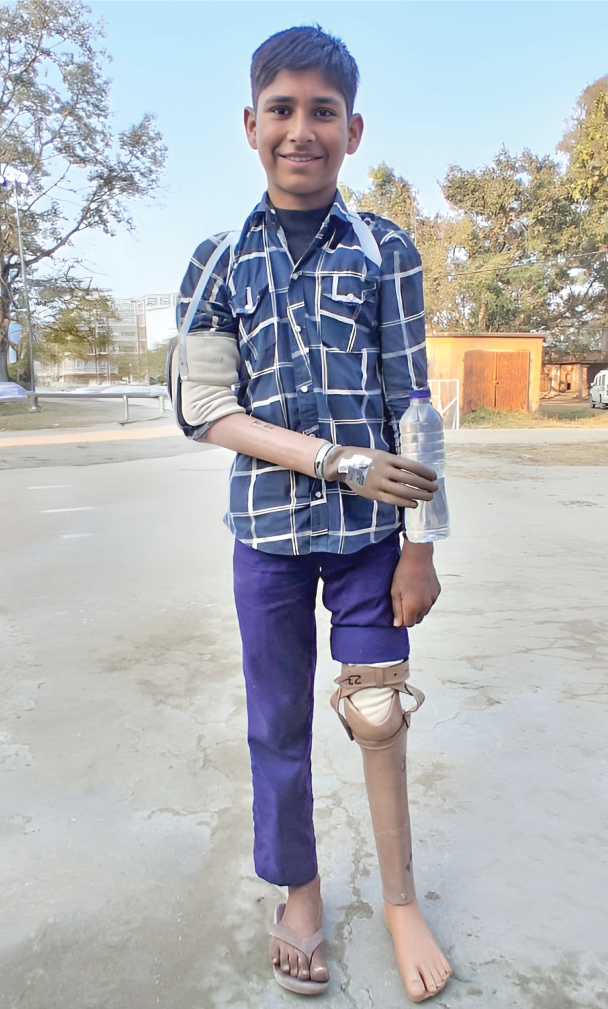
Born with congenital deformities in her arms and lower limbs, Naziya Mohammad struggled to cope with the simplest of everyday tasks. The now 18-year-old Delhi resident’s destiny took a turn for the better when she read about a prosthetics initiative — originating from the pioneering ‘Jaipur foot’ — and the success stories of its life-changing effectiveness.
That’s when Ms Mohammad and her family approached the Delhi branch of the Shree Bhagwan Mahaveer Viklang Sahayata Samiti (BMVSS), the Jaipur-based nonprofit behind the initiative. A team of technicians from BMVSS helped with Ms Mohammad’s medical evaluation and the fabrication and fitting of an artificial below-the-knee limb.
Getting the Jaipur foot and being able to move around has been emotional for Ms Mohammad. “I no longer feel limited,” she says. “I’m able to walk independently and handle many of my daily activities.” What comes through clearly is her gratitude to BMVSS, which has since 1975 being spreading the word on, and demonstrating the benefits of, the Jaipur foot. As for the need, the numbers tell the story.
About 10 million Indians live with locomotor disabilities, including individuals who have lost their limbs due to road accidents, cancer, diabetes, landmines and gunshots. The country also has 4 million polio survivors with affected limbs. Unfortunately, as many as four out of five Indians with such limb disabilities do not receive prostheses or assistive devices, primarily due to financial barriers (prosthetic limbs can cost up to ₹150,000 or more).
BMVSS has been trying to plug the affordability gap for more than five decades, a period during which it has provided the Jaipur foot and assistive devices to some 2.5 million disabled people. The organisation’s prostheses cost only around ₹2,500-5,000 and are fitted free of cost for the poor.
Remarkably, the Jaipur foot is the world’s only non-articulated foot — a prosthetic foot with no hinged ankle mechanism — that enables its users to walk or run on uneven terrain, swim and squat.
While prosthetics used in developed countries (carbon-fibre feet, silicone liners and modular endoskeletal limbs), are lighter and easier to use, they are much more expensive, costing between ₹100,000 and ₹500,000. The Jaipur foot costs a fraction of that and its fitting takes less than a day (modular systems often need multiple sittings).
Focusing on the rural
In 2025, the Tata Trusts joined hands with BMVSS to set up camps across Bihar, Jharkhand, Maharashtra, Uttarakhand and Uttar Pradesh, the objective being to reach people beyond urban centres. The camps are a necessity, given that about 75% of people with disabilities reside in rural areas.
“During the 19-month duration of the initiative, from September 2025 to March 2027, about 18,000 individuals will be gifted a new lease of life,” says Sanjiv Phansalkar, head of programmes at the Tata Trusts.
The idea of BMVSS emerged from trauma. Its founder, retired civil servant DR Mehta, suffered a life-threatening road accident and was admitted to a hospital in Jodhpur (Rajasthan) with a broken right femur. The doctors initially felt amputation was inevitable, but eventually they managed to save Mr Mehta’s life and limbs. During his five-month-long stay in hospital, Mr Mehta resolved to set up an artificial limb centre for those less privileged than him.
The Jaipur foot was developed in 1968 at Saai Man Singh Medical College, Jaipur, by a group of doctors and a master craftsman. News of what was a groundbreaking development in prosthetics took time to spread, though, with a mere 50 limbs being fitted in the first seven years. Now the number of limbs fitted every year is about 16,000.
“BMVSS is the world’s largest organisation for the rehabilitation of the disabled,” says Premendra Raj Mehta, chairman of the nonprofit. “We have been active in more than 40 countries spread across Asia, Africa and Latin America, and we have even organised camps in war-torn regions.”
The Jaipur foot has advanced in many ways since its early days. It has become lighter, more durable and more biomechanically aligned. The foot is now made using lightweight wood, high-density polyethylene and rubber compounds to ensure longer life, improved ankle joint mobility and a more natural gait.
Stanford connection
Typically, above-knee amputees in India and the developing world are fitted with a single-axis knee joint, which does not allow rotating movement. The benefits here are its low cost and simplicity in fabrication, but this design limits movement and affects the patient’s gait. Then an upgrade came into the picture.
A collaboration between the Shree Bhagwan Mahaveer Viklang Sahayata Samiti (BMVSS) and Stanford University, USA, led to the development of a joint based on the polycentric concept. The Stanford ‘Jaipur knee’ mimics human gait by providing stance stability and what is known as ‘swing phase response’.
The device has been successfully fitted on more than 30,000 patients since its unveiling in 2009, with encouraging outcomes in terms of acceptability, compliance, durability and performance. The device was hailed by Time magazine in 2009 as one of the 50 best inventions of that year.
BMVSS is working on expanding its reach, and that’s where the association with the Tata Trusts comes into play. With grant support from the Trusts, the organisation expects to improve its outreach in the hinterland through camps, the setting up and running of which are a complex affair.
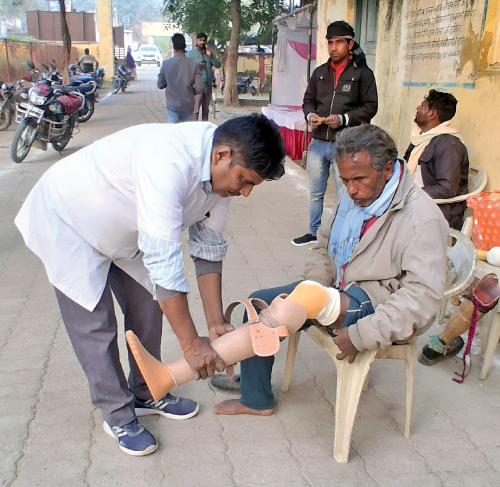
Before planning a camp, BMVSS collaborates with local authorities and NGOs to assess needs in the area and identify the requirements of patients. A typical one-day camp caters to about 250 beneficiaries, with facilities for screening, measurement, fabrication and fitting in one place. The prosthetic limb is customised by trained technicians.
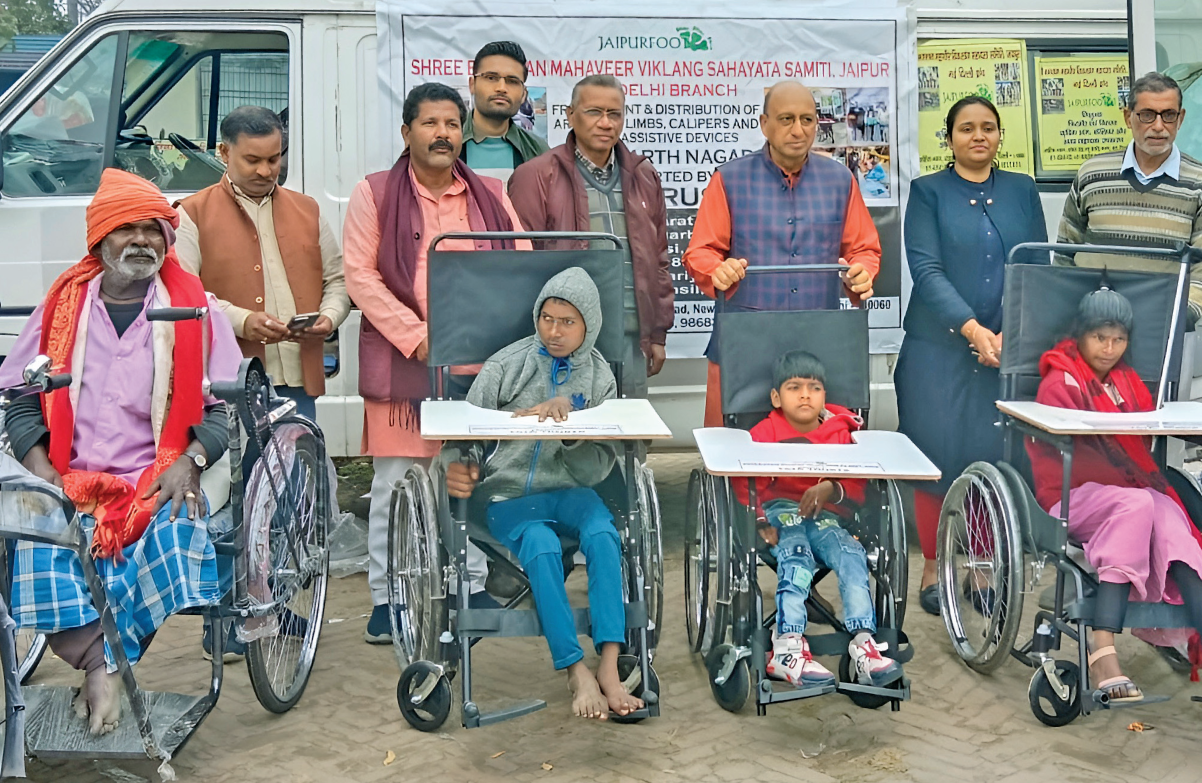
The camps are not limited to prostheses. Disabled patients are provided with assistive devices such as hearing aids, blind sticks, walkers, rollators, wheelchairs and crutches. “The Tata Trusts’ contribution to the initiative has enabled BMVSS to hold on-site camps to effectively reach people who cannot travel to big cities or hospitals,” says Piyush Khanorkar, a programme officer at the Trusts.