Booked for life
Writers and illustrators were the stars of the show at the Parag Awards, which continues to celebrate children’s literature in different Indian languages
Taposhi Ghoshal, an illustrator of children’s books, is no stranger to the power of imagination in young minds. She saw it on display again recently when offering a seat to a little girl during a Delhi Metro ride. The little girl was insistent on playing games on her parent’s mobile phone. To divert her, Ms Ghoshal asked if she’d like to see a picture book.
For the next 40 minutes, the little girl described each image she saw in such detail that Ms Ghoshal was wonderstruck. “Kids get hooked to screens because we don’t give them books,” she says, “but those visuals come so fast that your mind moves fast with them. Books offer the possibility to hold an image in your mind and go beyond it.”
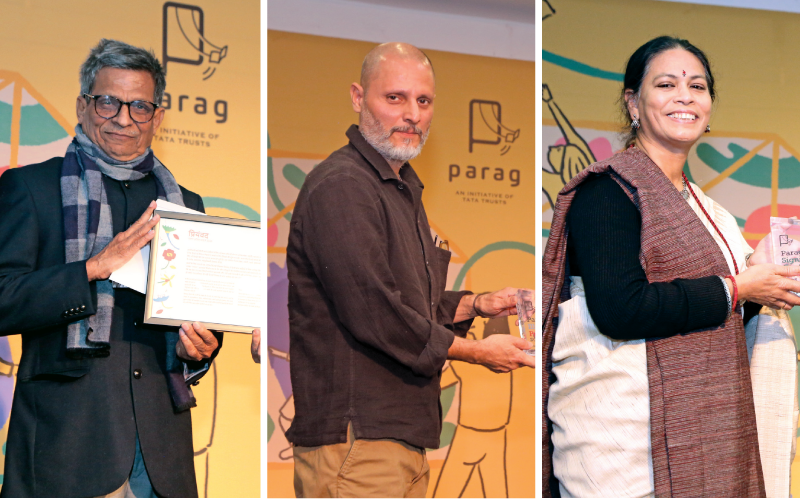
Ms Ghoshal is one of the winners of the Parag Awards 2025, taking home the Parag Significant Contribution Award. The other winners for 2025 were Hindi litterateur, historian and editor Priyamvad, who received the Parag Author Prize, and Rishi Sahany, who got the Parag Illustrator Prize.
The Parag Awards, formerly known as the Big Little Book Award, are an annual event of the Parag Initiative, which is part of the Tata Trusts. Parag has been supporting the development of children’s books in Indian languages for more than two decades. This includes working with writers, illustrators and publishers to create books and building the capacities of librarians and educators through professional courses that help in catalysing the reading habit.
Nurturing young talent and recognising writers and illustrators through the Parag Awards is part of the effort. “Children deserve books that offer joy, imagination, nuanced storytelling and rich visuals,”says Maulshree Kalothia, who heads the Parag Initiative.
Parag added three new award categories from 2025: the Author Prize, the Illustrator Prize and the Parag Children’s Choice Award. The last is based on a children’s poll that reflects the growing landscape of children’s literature. This went to the delightful Aada Paada, a book by Sushil Shukla, a Hindi poet and director of publishing house Ektara, with illustrations by Atanu Roy, himself a Parag award winner in 2016.
Fillip for writers and illustrators
The Parag honours help shine a light on children’s literature in India across languages, providing a much-needed fillip for talented writers and illustrators. “This is the first award I have received for my writing for children,” says Mr Priyamvad. “That it comes from the Tatas makes me happier still.”
Mr Priyamvad’s intense and sensitive works of fiction and nonfiction have appealed to adults for nearly 50 years. He began writing for children eight years ago at the behest of Ektara’s Mr Shukla. “I took up the challenge after he pursued me for two years,” says the Kanpur-based author.
Nurturing the new
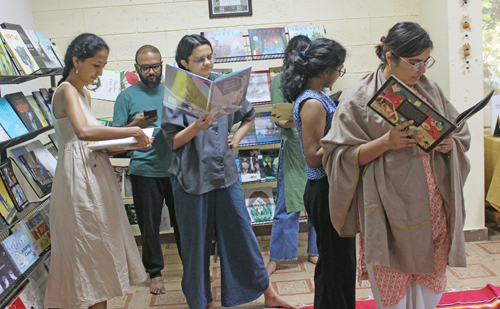
Apart from supporting the publication of children’s books, the Parag Initiative catalyses the development of new voices and approaches in children’s literature through capacity-building programmes like ‘More than Words: An Illustrators’ Masterclass for Creating Wordless Stories’ and ‘Grooming of Writers and Illustrators for Children’s Literature and Development of Early Readers in Hindi’.
The impact has been telling. Launched in 2024 to immerse illustrators and mentors in wordless picture books as a medium of storytelling, the More than Words masterclass gets 100+ applications for its 25 seats. Of the 24 storyboards presented in More than Words 2025, all but one were selected to be developed as books and magazine features by various publishers. Writer-illustrator Sanika Deshpande, a 2024 masterclass participant, had her wordless book, Cat Walk, released in January 2026.
“The Masterclass moves deliberately from conceptual understanding of a picture book and perspective building on styles and formats to creating one’s own stories,” says Maulshree Kalothia, who heads the Parag Initiative. Budding illustrators develop story concepts with mentors, which are then presented to publishers. “It is a model where each participant goes back nourished.”
Similarly, the Ektara programme addresses the gap in children’s literature in underrepresented genres like plays, memoirs, reportage and wordless narratives. The programme is aiming to develop 50 early-reader picture books in Hindi over three years, sourced primarily through its workshops.
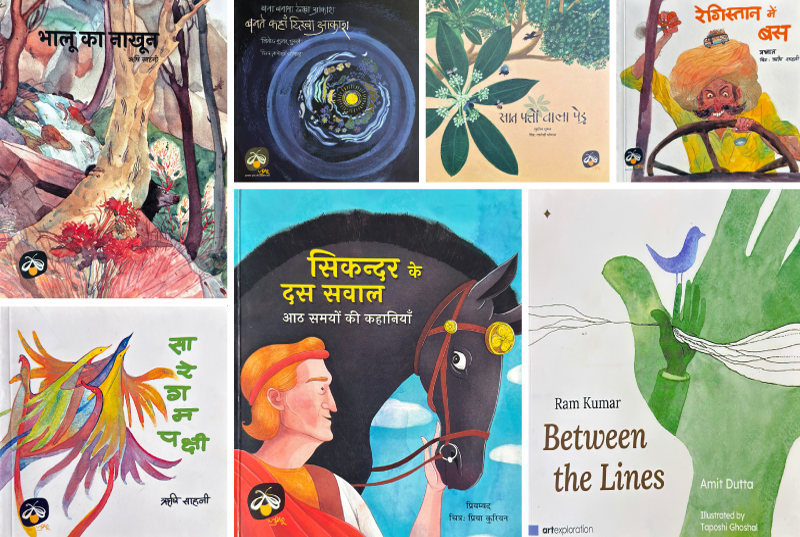
Mr Priyamvad’s first stab at children’s literature was a short story published in Chakmak magazine. Since then, he has written four children’s books, including captivating works of history like Sikandar ke Dus Sawal (Sikandar’s Ten Questions) and the popular novel Nachghar, a love story for children.
Children’s stories have outgrown the world of fairies and dragons and kings and queens, points out Mr Priyamvad. “Now the writing is closer to life. New voices have come in. Themes like religion, caste and gender are being raised. All of this is very good change. I want to sensitise children to the different experiences and issues of life.”
Apart from recognising and motivating creators, the Parag Awards signpost the evolution in children’s literature in India. This is evident in Rishi Sahany’s metaphor-laden watercolour illustrations that simultaneously lean into the playful and the absurd, appealing to both youth and adults.
Growing up on the foothills of Lonavala near Mumbai, Mr Sahany was keen to become an artist. A graduate from Mumbai’s JJ School of Fine Arts, he worked as an animation artist and won a national award for his film, Sound of Joy, before turning to illustration with a satirical book on kids and religion. This led him to Ektara.
“In animation, you see your work after six-seven years and sometimes the end result is not satisfying because several artists have worked on it,” says Mr Sahany. “But with books people were seeing my work and I was getting feedback.
Coming a long way
Mr Sahany has come a long way from when his first book, Roo, was published in 2021. That was followed by the poetry collection Registan Mein Bus (Bus in the Desert), with its delightful illustrations, Bhaloo Ka Nakhoon (Bhaloo’s Nails), and the wondrous wordless book, Sa Re Ga Ma Pakshi (Sa Re Ga Ma Bird), which is about a young artist finding her voice.
As the popularity of Indian picture books has grown over the last two decades, the illustrations lighting them up have also evolved. There’s diversity of styles, mediums and in the representation of places and characters.
This change has been apparent to Ms Ghoshal, a graduate of the Delhi School of Art. She began illustrating children’s books in the 1990s after she met Geeta Dharmarajan, writer and founder of the nonprofit, Katha. “In the early days, I used to illustrate as close to the text as possible,” says Ms Ghoshal, “but I soon realised that I don’t have to depict only what the writer is saying. When I interpret the text in my own way, I can add many things.”
Ms Ghoshal’s versatility stems from her love for experimenting with different art styles and mediums, as seen in works ranging from Mr Shukla’s Saat Patton Wala Ped to Udayan Vajpayee’s Naam Hai Uska Paakhi to Amit Dutta’s Ram Kumar: Between the Lines. “The work guides me to the medium,” she says. “Every work is like a journey and I have to find my path. Sometimes colours or a movie or even a sari inspire me. Sometimes I start from the middle of a story, sometimes I make a paper collage. I always want to experiment and to enjoy each illustration.”
Mr Sahany’s illustrations are wide-ranging, from exaggerated caricatures to realistic studio drawings, from minimalist line drawings to elaborately painted landscapes. “In the book on Kumar Gandharva [the renowned classical singer], I wanted to work with different media so I did pencil sketches, watercolours and oil colours in the same book,” he says.
For Mr Priyamvad, life with all its mysteries and difficulties is the biggest inspiration. “I am inspired by humans, how they live and talk. If I feel an idea or incident will work for children, then I write it for them.”
For Parag Awards, honouring such creators is a way to elevate children’s literature in India and in Indian languages, and to extend its boundaries.