Call of the creative
Fledgling talents from art schools across India got the opportunity to spread their wings at the Students' Biennale, now an essential part of the much-celebrated Kochi-Muziris art festival
Reppandee Lepcha is on the road not known and that’s fine by her. “I imagine myself with a sickle finding a path through the forest, trying to figure my way out,” says the 28-year-old native of Shipgyer in Sikkim. “I’m not sure what lies on the other side or what I will discover.” Whatever that may be, this budding artist reckons, the journey will be worth her while.
Ms Lepcha, an art student with a master’s in science — “That’s the stable stream to pursue where I grew up,” she says — was one of more than 200 fledgling talents from about 175 state-funded art schools across India who showcased their work at the Students’ Biennale, which has evolved to become an intrinsic segment of that splendid celebration of art and creativity, the Kochi-Muziris Biennale (KMB).
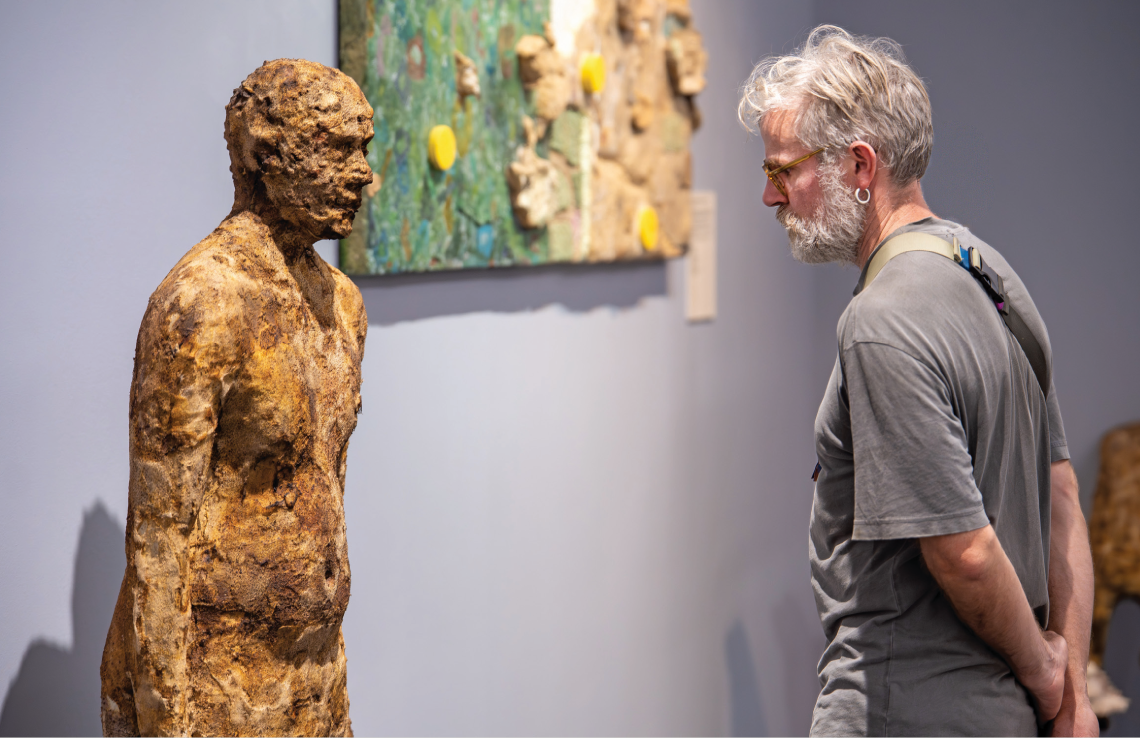
Called ‘shifting landscapes’, Ms Lepcha’s exhibit is rooted in her identity and her people. She employs an intriguing blend of materials (paper pulp, rice paper, hemp wool and flowers) to weave a melancholy story of cultural and linguistic loss. “Like with many indigenous groups, the language and traditions of the Lepchas, the small tribal community I belong to, are fading away,” she says. “My work is an expression of the frustration and anger I feel about this.”
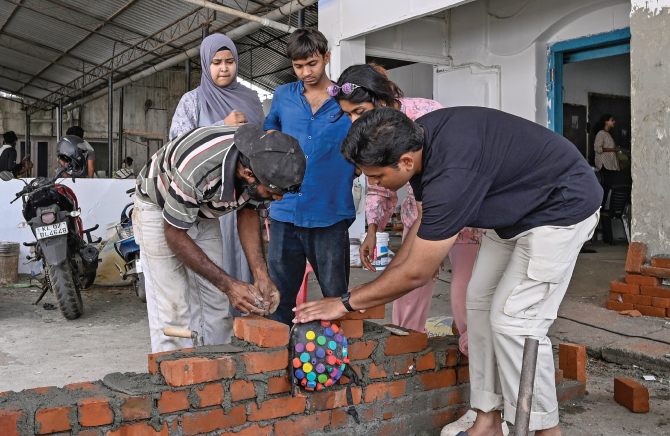
Loss of another kind — of innocence and playfulness in the face of war and conflict — permeates the mixed-media installation crafted by Arshaan Ali Khan and his four art-student compatriots from the Free Thinkers Collective at Aligarh Muslim University. ‘Where Memories Are Immured’ is about children traumatised by war and its ordeals, says the 23-year-old Mr Khan. “We wanted to give a voice to the voiceless children suffering from the desensitisation that is happening wherever there’s conflict and violence.”
Staying true
Honesty in rendering surely eases the artist’s endeavour to explain the bizarre and frightful times we live in, or social realities that have to be navigated by way of unwritten rules. It’s a quality that illuminates the work of Vaishali Bhandari and seven of her mates, graduate students from the Jawaharlal Nehru College of Fine Arts in Shimla. They ponder the question ‘To Be Who?’ through video, cyanotype (a 19th-century printing method) and through eyes that are everywhere — expressing, expecting, judging.
“We use eyes to reveal how society looks at women,” says the 22-year-old Ms Bhandari, “how you have to fit in a certain way, do stuff that others decide, and suppress your actual self. This is about gender, the demands placed on women and the scrutiny they have to live with: don’t wear clothes like that, don’t sit like that, don’t walk like that.”
From searing to contemplative, from the personal to the universal, the range of subjects enriching the Students’ Biennale reflected the wider canvas of artworks on display at KMB. The need for such a programme is acute, given the state of creative learning in India and the shortage of resources and infrastructure for education in the arts.
The Students’ Biennale, in the context, offers a stage like no other for promising artists seeking opportunities to sharpen their skills, connect with peers, mingle with masters, and take a big step towards becoming full-fledged practitioners of their craft. The Tata Trusts support for the Biennale is an effort to help bring all of these elements together.
ABC sets the tone
An absorbing adjunct of the Kochi-Muziris Biennale (KMB) concentrated attention on a seemingly complicated undertaking: bringing art to children and children into art.
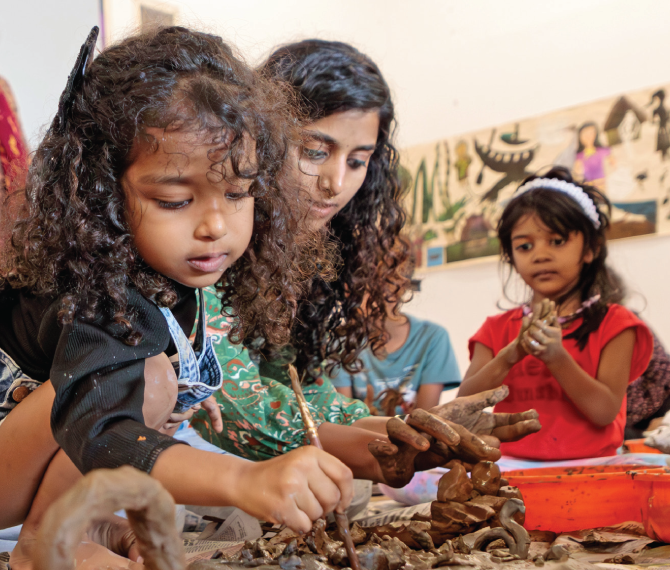
The Art by Children (ABC) programme, also supported by the Tata Trusts, is a key component of KMB’s educational outreach. The objective is to make art education accessible in Kerala’s schools through hands-on activities that combine music, dance, play and ecological awareness.
Self-expression, critical thinking and community engagement are on the ABC menu, as also workshops and ‘art rooms’ to encourage aesthetic awareness and progressive values. Helping out are art educators and creative practitioners from across India in an effort that involves schools, families and local communities.
ABC connected with about 5,000 schoolchildren and teachers over the course of the Biennale. The art room project covered six government schools in Ernakulam, Alappuzha and Thrissur; anganwadi (childcare centre) workers were trained in art-themed learning for children; and some 120 families were reached in an effort to integrate art into community life.
As with the Students’ Biennale, ABC fosters collaborative learning environments that extend beyond classrooms and into inclusive public spaces. “ABC is a learning space with a strong ecological and social consciousness; it responds to contemporary realities,” says programme head Blaise Joseph.
Launched in 2014, the Students’ Biennale may not attract eyeballs in the manner of its parent, but it remains a crucial complementary piece of what is a unique festival of the arts. And perhaps more so than ever in an environment where the space for art and its expression continues to shrink.
Awards for the best
The Trusts have backed the Students’ Biennale at four of KMB’s six editions, including the latest, which concluded on March 31 following a run of more than three months. A highlight of this support has been the institution of awards for art students and student-artist groups, with winners receiving one-month residencies in Indian art institutions and travel grants to visit global art hubs.
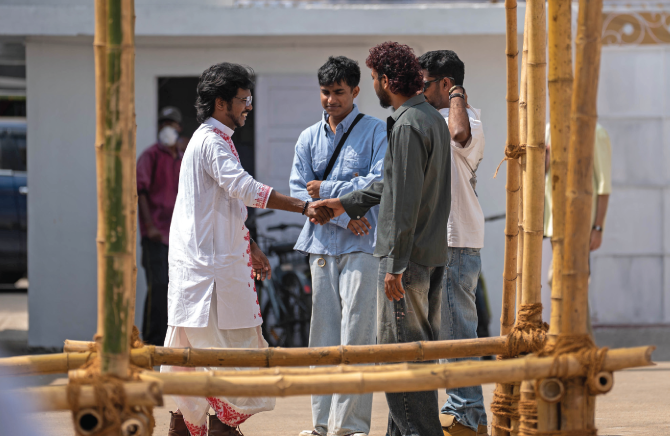
The Trusts have also supported KMB’s Art By Children initiative, which links schools and communities to established artists and educators through workshops and modules in art, craft, theatre and music.
The 2025-26 version of the Students’ Biennale, titled ‘Sensing Grounds’, stays true to a model that has served the programme well. It was helmed by seven curator collectives and featured 70 artworks by students selected through an open call, workshops and curatorial visits. These students were given production grants and they could bank for guidance on the curator collectives, comprising art educators and experts who see themselves more as collaborators than mentors.
“Curation cannot be about momentary situations; we see it as long-term relationship building and the students as our future collaborators,” says Dharmendra Prasad, a multimedia artist who is part of the Assam-based Anga Art Collective, which has under its wing student participants from the Northeast. “Our candidates are emotional and they get spooked by the rush of the art world. Curating in such a situation is complex; it’s cultural, it’s delicate.”
Mr Prasad is loath to advise his wards about becoming artists. “That’s important, of course, but more important is that they themselves tell their stories, or somebody from outside will — and badly. In truth, we are learning from them even as we guide them.”
Boundless world of art
For Shamooda Amrelia of the Mumbai-based Secular Art Collective, which covers participants from Maharashtra, Bihar, Jharkhand and Madhya Pradesh, the Students’ Biennale is as crucial as KMB itself. “This is not a lesser being; it is the future,” she says. “There is a commonality in our students, yet they are very diverse. Far from pigeonholing them, we have sought to expand their horizons. Their journey ahead could lead anywhere; the world of art is boundless.”
“The Students’ Biennale has evolved into a first-of-its-kind national exhibition platform for Indian art students,” says Paroma Sadhana, programme manager, arts and culture, with the Tata Trusts. “Over the years, it has become a springboard for young artists to launch their careers, get exposure and learn about exhibiting. It’s invaluable.”
Ms Sadhana, who has tracked the Students’ Biennale from up close, believes the artworks on show have become bolder and more conceptual over time. “There are more and more media-based displays, performance pieces and large-scale installations rather than the traditional paintings and sculptures. With the awards, the Trusts conceptualised them to recognise talent as well as potential.”
As for KMB, the mother ship appears to have steadied, the swells that rocked the 2022 edition behind it. This was the “people biennale”, one media report gushed. Visitor numbers that could add up to 1 million — the vast majority from Kerala — attest to the event’s popularity as a source of insight and spectacle. As usual, the setting helped: the colonial warehouses and bungalows hosting the artworks, the old-world charm of Fort Kochi and that distinct Kerala flavour.
Themed ‘For The Time Being’, KMB 2025-26 featured works by 66 collectives and artists from 25 countries, among them Marina Abramovic, the Serbian conceptual and performance artist, and Argentinian sculptor Adrián Villar Rojas. This time out, India’s first and largest international exhibition of contemporary art succeeded in reinforcing its credentials as an artist-led, people-focused enterprise.
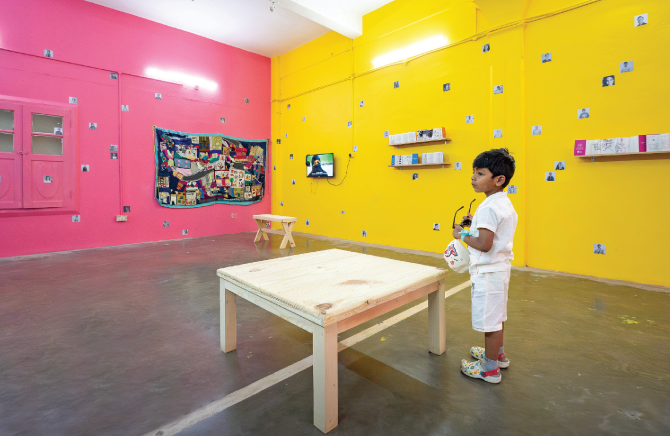
“Every KMB edition comes with its own set of challenges, and we have been able to learn from our mistakes and grow from them,” says Mashoor Ali, the programmes manager for the Students’ Biennale. “We have expanded to reach students from remote regions. Another major shift was the increase in group projects, which allowed many more students to participate.”
One of those is Rohit Athavale, a 25-year-old pursuing his master’s at the JJ School of Art in Mumbai. Mr Athavale’s installation artwork depicts Mumbai’s degeneration: the low-income living zones of the marginalised, bloodthirsty builders, communal tensions and the unravelling of once-syncretic neighbourhoods.
“I have chosen caste and class because they are everyday realities for millions of poor people,” says Mr Athavale. “Then there’s the discrimination, both opaque and transparent. The aesthetic of my artwork tries to capture all of that.” Does he see a future as an artist? “I have to keep practicing. There are many stages and you have to break them down. Can I have a stable life? That depends on how I manage things. I have to keep a balance.”
Immersed in her milieu
Tai Sasum, a demure 25-year-old bachelor’s student at the Rajiv Gandhi University in Doimukh in Arunachal Pradesh, lacks Mr Athavale’s faith in the future sorting itself out. What she has is an intense understanding of her milieu and of familial despair. Ms Sasum’s installation, ‘forest shelter’, employs dyes, paintings and video to explore memory, longing and, most of all, her mother’s life.
“When I was young, the forest near my home was a saviour; that’s how I always saw it,” she says. “The real reason [behind my artwork] was to be imaginative and delusional, to carve out a safe space — a forest shelter — for my mother, who was married off when she was a child to my father, who was very old. I wanted to change her life story; I wanted her to run away, even if that meant I would never have been born.”
Participating in the Students’ Biennale has been an exhilarating experience for Ms Sasum. “I loved it,” she says. “I saw some Japanese performance artists. They were captivating and scary, so deep into their art.” Does she see herself pulling off something similar? “Not at all; I would be embarrassed. Actually, I don’t exactly know what I want to do. It’s all open; I want to be a free spirit.”
