Resources matter
A study of 11 high-GDP Indian states reveals how shortcomings in budgetary allocations are undermining their justice delivery systems
The delivery of justice is an essential service, guaranteed through the constitutional promises of ‘equality before the law’ and ‘the protection of life and personal liberty’. As a sovereign function that cannot be undertaken by any other entity, it is the prerogative of the state to ensure access to justice. Every government, therefore, is duty-bound to provide an impartial, efficient, responsive and accessible justice system for all citizens. But can the government truly meet its mandate if essential building blocks are missing?
Limited means
A significant share of institutional budgets (85% to 90%) is allocated to salary expenditure, leaving limited scope for investments in infrastructure, technology and long-term capacity development. As overall public expenditure shrinks, relative to GDP, competition for limited resources has intensified, further reducing the fiscal space available to the justice system.
Even the limited funds allocated are often underutilised. Factors such as rigid central schemes that restrict expenditure on staffing — the Modernisation of Police Forces Scheme, for instance — states’ inability to meet cost-sharing requirements, and administrative delays due to staffing gaps contribute to this underutilisation.

Valay Singh is the cofounder and lead of the India Justice Report
Against this backdrop, ‘Budgets for Justice’ is a first-of-its-kind study by the India Justice Report. It examines budgetary allocations and expenditures for the justice systems in 11 states with the highest GDP in India and each with a population exceeding 10 million people.
Taken together, these 11 states account for over 60% of India’s police strength, over 70% of high court and subordinate court judge vacancies, and 60% of the national prison population.
Using budget documents for 2023-24 and 2024-25, the study analyses the scale of allocations, utilisation levels and the degree of disaggregation across the core pillars of the justice system to better understand how budgets for justice are structured, prioritised and spent, particularly in key areas such as police modernisation, judicial infrastructure and access to legal aid.
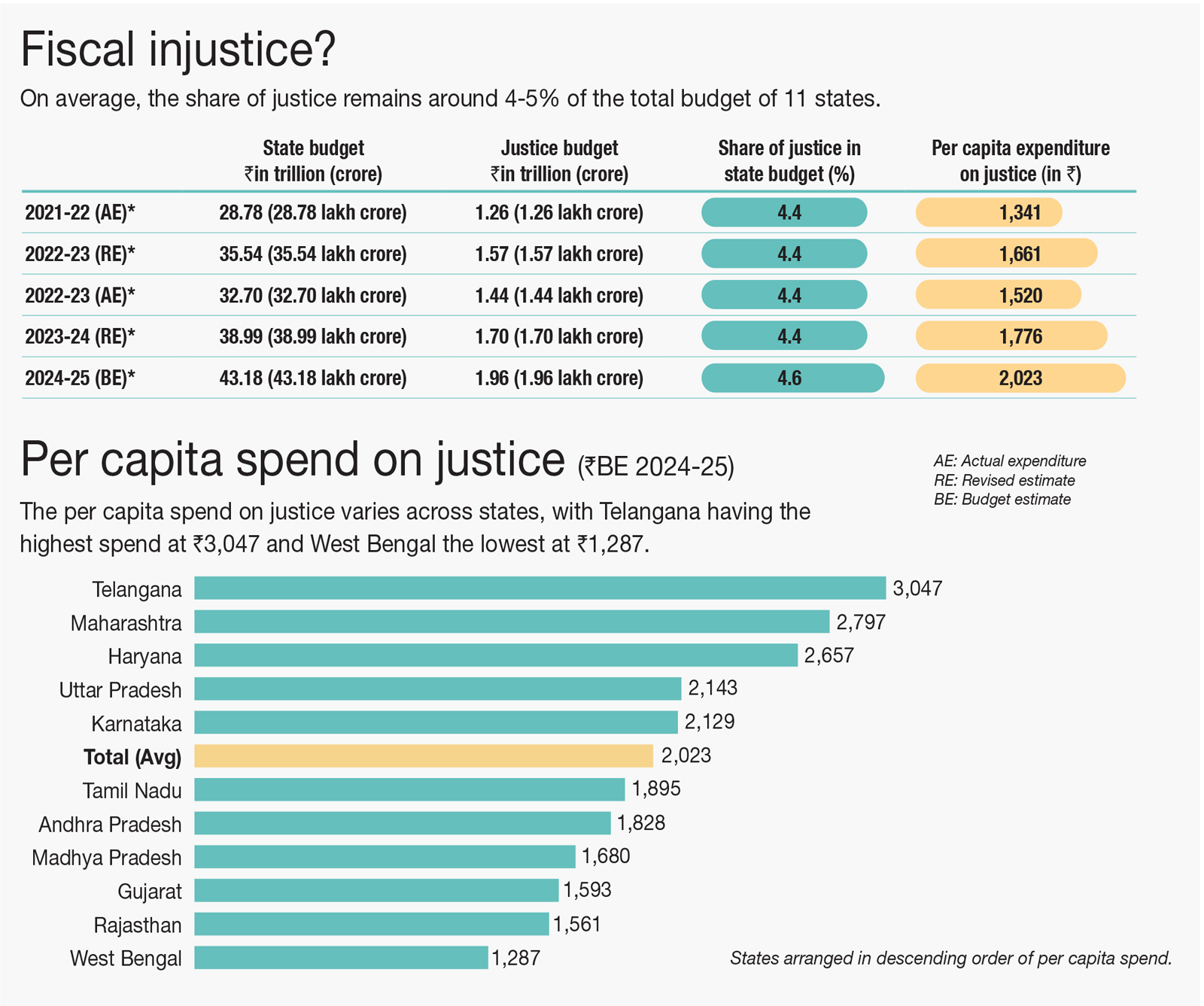
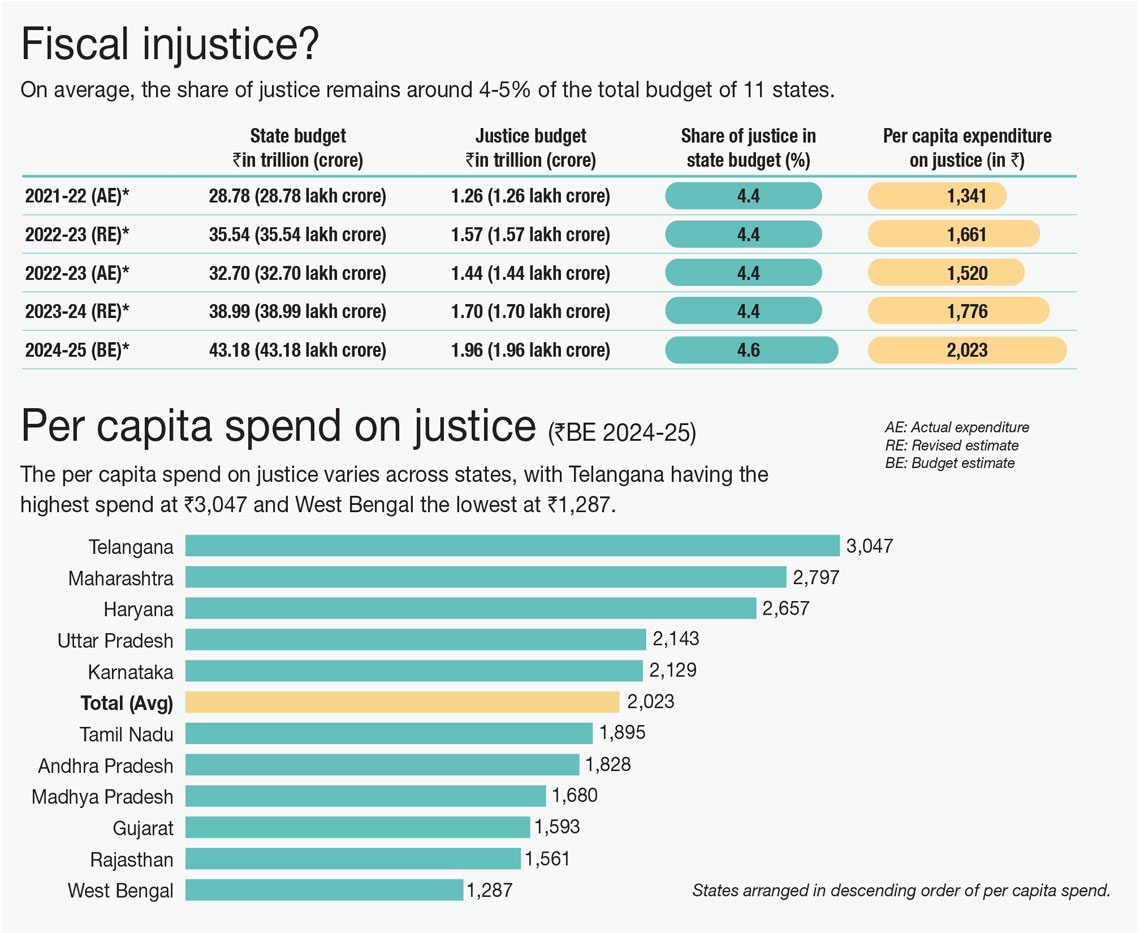
The study revealed that while the overall budget for justice has increased from ₹1.57 trillion (1.57 lakh crore) in 2022-23 to ₹1.96 trillion (1.96 lakh crore) in 2024-25, the bulk of the increase is absorbed by the police, which continues to receive over 80% of total justice allocations. In contrast, the judiciary, prisons, legal aid and rights bodies such as the state human rights commissions (SHRCs) remain marginal in terms of budget share, often receiving less than 1% of overall state spending. Victim compensation across the 11 states is ₹660 million (66 crore).
Illustratively, Gujarat, Haryana, Karnataka, Uttar Pradesh and West Bengal together allocated ₹16.77 billion (1,677 crore) for prison infrastructure in 2024-25. In contrast, SHRCs remain severely underfunded, with a total budget of ₹415 million (41.5 crore) allocated across these five states, which is the lowest allocation among justice institutions.
Even within better-funded institutions like the police and judiciary, essential components such as training, technology, and modernisation receive a disproportionately small share. For example, less than 2% of budgets are allocated to training for police and less than 1% for the judiciary. Allocation to schemes directly connected to women and children — Cyber Crime Prevention against Women, Children and Safe City, etc — have also declined between 2022-23 and 2024-25.
On average, 4.3% of states’ budget funds were allocated for justice in 2024-25. This ranged from 2.6% in Rajasthan to 5.3% in Maharashtra to 7.3% in Uttar Pradesh. Seen in terms of spend per person, the highlighted states spent ₹389 per person a year on the justice system (excluding the police). The average Indian likely spends more each month on eggs.
Overall, per capita spending for states was estimated to be ₹1,667 on police, ₹353 and ₹67 on judiciary and prisons, respectively, and only ₹9 on legal aid. For disaggregated data available in five high-GDP states (Gujarat, Haryana, Karnataka, Uttar Pradesh and West Bengal), per capita spend on SHRCs was less than a rupee.
Big share for the police
It is, to some extent, justifiable that the police receive the larger share of financial resources given that it has the largest workforce, infrastructure needs and workload, and services court processes, among other tasks.
While this figure of ₹1,667 seems skewed in comparison with average per capita spends on judiciary, prisons and legal aid, it is important to note that the lack of enough disaggregation conceals the actual expenditures on frontline police personnel, their recruitment and training, funds for police stations and other citizen-centred services.
Crucially, less than 1.5% of the police budgets across the 11 states was allocated for training in 2024-25. For the judiciary, this figure hovered at around 0.5%. At least three states (Haryana, Karnataka and Maharashtra) allocated less than 1% for police training from their police budgets, while Madhya Pradesh allocated the most (2.4%). The analysis also noted that while the funds for police training as a percentage of the overall budget has increased over the years, for the judiciary they have stagnated.
Overall, police training was allocated ₹22.08 billion (2,208 crore) in 2024-25 in the 11 states, 39% over the previous year’s revised estimates. More than a quarter of the allocation was in Uttar Pradesh, which has the largest police force (269,000 personnel). A deeper dive shows that, while the state’s actual police strength increased by 5%, the number of training institutes and their capacity to train personnel remain unchanged.
For the judiciary, the share of funds for training of judges and judicial staff ranged from 0.4% and 0.6% between 2021-22 and 2024-25. Only Uttar Pradesh invested more than 1% of its judiciary budget for training. At least six states had reduced the share compared with the previous year.
A look at utilisation shows Andhra Pradesh reporting over 100% utilisation of its training budget for the judiciary in 2022-23, followed by Karnataka (98%) and Rajasthan and Tamil Nadu (94% each). UP utilised just 41% of its training budget in 2022-23, despite having the highest budget allocation for that year.
The Budgets for Justice study’s findings will inform a multi-year, updateable database on the pillars of the country’s judicial system. Ultimately, this knowledge framework seeks to highlight the critical role that budgets play in ensuring that states can deliver justice to mandate, without which constitutional promises will remain unfulfilled.