The legalities of
everyday life
The Consumer Justice Report 2026 is a reminder that justice is not confined to criminal law or the constitutional rights of citizens — it also exists in the ordinary transactions that govern our existence

Valay Singh is the cofounder and lead of the India Justice Report
When we think about justice, it is natural for the mind to wander to the dramatic: criminal trials, constitutional challenges, landmark judgments and questions of liberty tend to dominate public conversations about the law. Justice is imagined as that which unfolds in courtrooms, involving serious crimes, state power and high-profile legal battles.
Yet some of the most common injustices experienced by ordinary people are far quieter. They occur when a family invests its life savings in a home that is never delivered, when an insurance company refuses a legitimate claim, when a bank imposes unlawful charges, when a defective product does not deliver what it promises, or when a service provider fails to honour its obligations.
These are not incidents that typically make headlines, but they shape the everyday experiences of millions of people. They determine whether individuals can trust markets, institutions and the legal mechanisms meant to protect them.
The Consumer Justice Report 2026, published as a complement to the India Justice Report (IJR), asks us to take these everyday violations seriously. It reminds us that justice is not confined to criminal law or constitutional rights. It also exists in the ordinary transactions that govern daily life.
The report sheds light on the functioning of India’s consumer disputeredressal system and reveals the extent to which institutional shortcomings are preventing consumers from obtaining timely and effective remedies.
Drawing on an analysis of RTI (right to information) responses on capacity and budgets, and 2.85 million consumer cases filed between 2010 and 2024, the report seeks to provide one of the most comprehensive assessments of consumer justice in India to date.
Lens on commissions
Some of its most revealing and urgent findings emerge from an analysis of state and district consumer disputes redressal commissions (SCDRCs and DCDRCs) in capital cities, which serve as important indicators of the health of the consumer justice system as a whole.
At the national level, consumer courts mirror the trends of the judiciary as a whole. Many are grappling with increasing delays and mounting backlogs. By the end of 2024, more than 500,000 consumer cases remained pending across the country.
Rather than decreasing, pendency has grown, increasing by approximately 21% between 2020 and 2024. The very institutions designed to provide quick and affordable remedies are increasingly struggling to keep pace with demand.
This trend is particularly concerning because consumer courts were established to provide an alternative to the lengthy and expensive processes associated with conventional litigation. The Consumer Protection Act envisions a system that is accessible, efficient and consumer-friendly. Cases are expected to be resolved within a matter of months, ensuring that individuals are not forced into prolonged legal battles to secure basic rights and entitlements.
The reality, however, often falls short of this vision.
The report paints a concerning picture of the state of consumer justice institutions in India. While consumer courts were established to provide accessible and relatively speedy remedies for disputes relating to goods and services, delays continue to persist across the system.
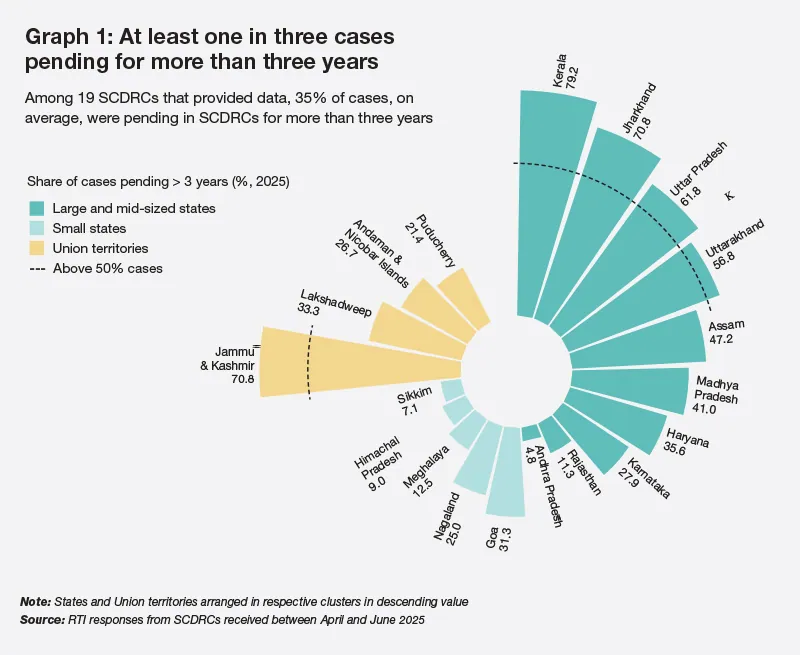
One of the report’s most striking findings is that nearly one in three pending cases before SCDRC has remained unresolved for more than three years, raising questions about the ability of these institutions to provide timely redress to consumers (graph 1).
The report also identifies significant human resource shortages across consumer justice institutions. As of January 2025, approximately 40% of sanctioned member positions in state consumer commissions were vacant, while vacancies among presidents and support staff were also recorded across several jurisdictions.
The report documents prolonged periods during which some commissions functioned without a full complement of leadership and personnel, alongside data on workload, case clearance rates and pendency. Together, these findings point to persistent capacity gaps within institutions responsible for resolving consumer disputes.
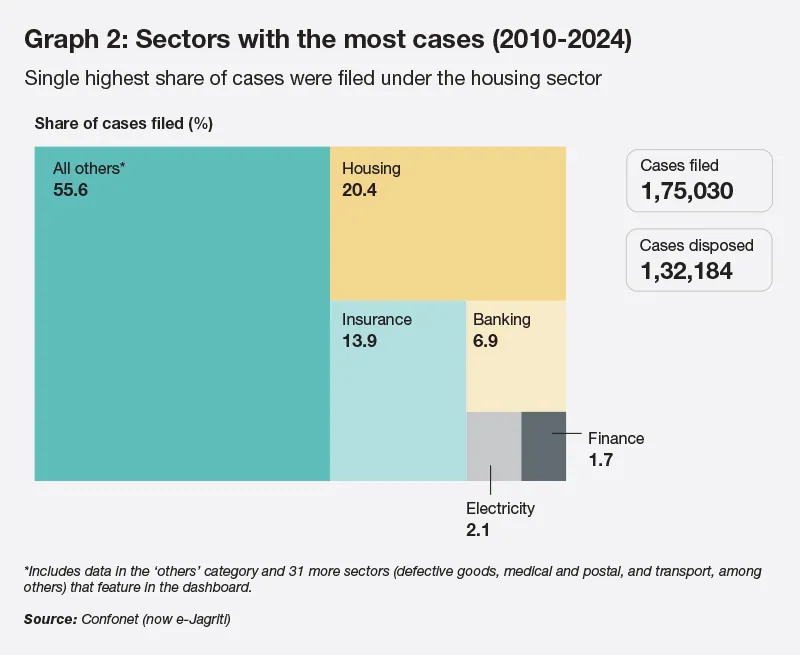
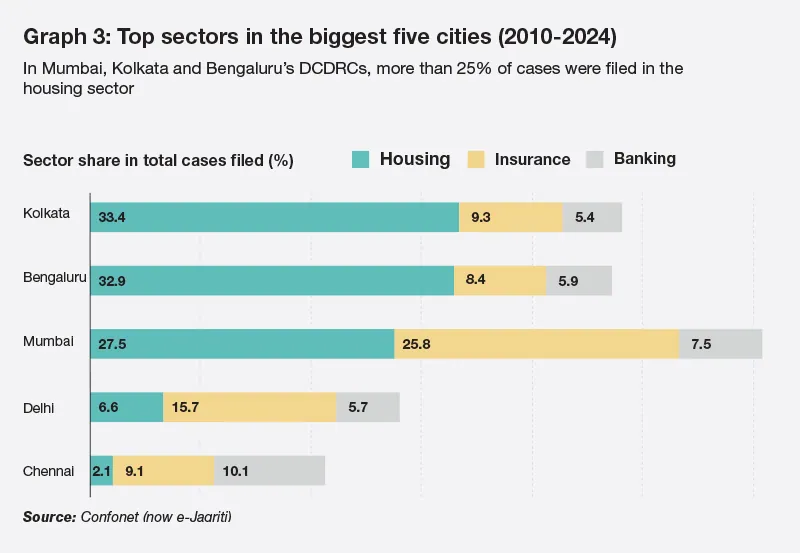
DCDRCs in capital cities offer a lens through which to understand these challenges (graphs 2 and 3). Capital cities are centres of commerce, housing, finance and service delivery, generating large volumes of consumer transactions and, consequently, consumer disputes. The functioning of their district commissions provides an insight into the capacity of consumer justice institutions operating under significant demand.
Consumer justice infrastructure itself remains unevenly distributed. At the time of assessment, India had 775 districts but only 685 operational DCDRCs. This means that many districts continue to lack a dedicated consumer forum, highlighting gaps in the institutional architecture of consumer justice.
The assessment of capital-city commissions reveals considerable variations across indicators such as vacancies, staffing, pendency, budgets and case clearance rates. Delhi’s district commissions recorded some of the strongest outcomes among the cities assessed, maintaining average case clearance rates of 95% across multiple commissions.
Kolkata, by contrast, recorded a substantially larger share of long-pending cases, with more than one-third of cases remaining unresolved for over three years in some commissions. Variations were also visible in staffing levels, with several commissions operating with vacant president, member or staff positions.
Across Chennai and Bengaluru, differences emerged in both institutional capacity and workload management. While some commissions maintained relatively strong disposal rates, others recorded significant vacancies among members and administrative staff.
Uneven performance
The assessment of ‘other capital cities’, including Andaman and Nicobar Islands, Vijayawada, Kamrup, Patna, Durg, North Goa, Gandhinagar and Gurugram, similarly revealed an uneven performance across jurisdictions. Only a third of these commissions achieved case clearance rates of 100% or more, while several continued to report substantial staff shortages.
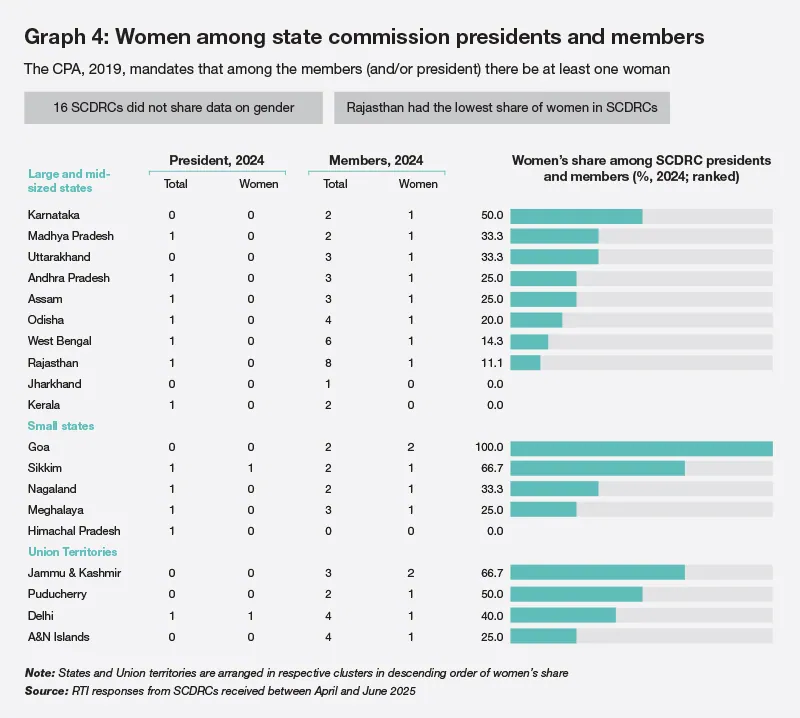
Representation varied considerably as well. The 2020 rules require every commission to have at least one woman, whether as president or member, and this is a minimal benchmark. While most responding commissions reported compliance, representation rarely exceeded the minimum. Very few institutions reported a woman president and, nationally, there were only two women presidents. Less than one-third of members in four SCDRCs are women, with Rajasthan having the lowest share of women in these commissions (graph 4).
Between 2021-22 and 2024-25, allocations grew by 52% for the 21 responding state commissions. Yet utilisation averaged 85% in 2024–25. Some states, though, reduced budgets despite rising caseloads and high vacancies.
At the district level, budget data were available for 14 capital-city commissions, which together received allocations amounting to ₹450 million between 2021-22 and 2024-25 and spent approximately ₹440 million.
The disparities between commissions were considerable. Bhopal received the highest cumulative allocation at ₹73 million over four years, while Vijayawada received only ₹930,000 during the same period. Expenditure patterns, too, varied significantly across the assessment period. These figures illustrate the differing resources available to consumer justice institutions, even as they operate under the same legislative framework.
Taken together, the findings broaden the way in which access to justice is understood. Consumer courts are often treated as a specialised or peripheral part of the legal system. Yet they are among the institutions most likely to be encountered by ordinary people seeking remedies for harms experienced in the course of everyday life.
The functioning of consumer justice institutions, therefore, provides an important measure of how legal rights operate in practice. Vacancies, infrastructure gaps, budget allocations, staffing levels, pendency and representation are not merely administrative indicators. They shape the ability of institutions to receive, process and resolve disputes.
The Consumer Justice Report 2026 places these experiences at the centre of the conversation, drawing attention to the systems, resources and institutions that underpin access to justice for millions of citizens across the country.