India’s lost Einsteins
Children from lower-income backgrounds need a leg-up — and then some — to realise their potential and find a place in the academic sun
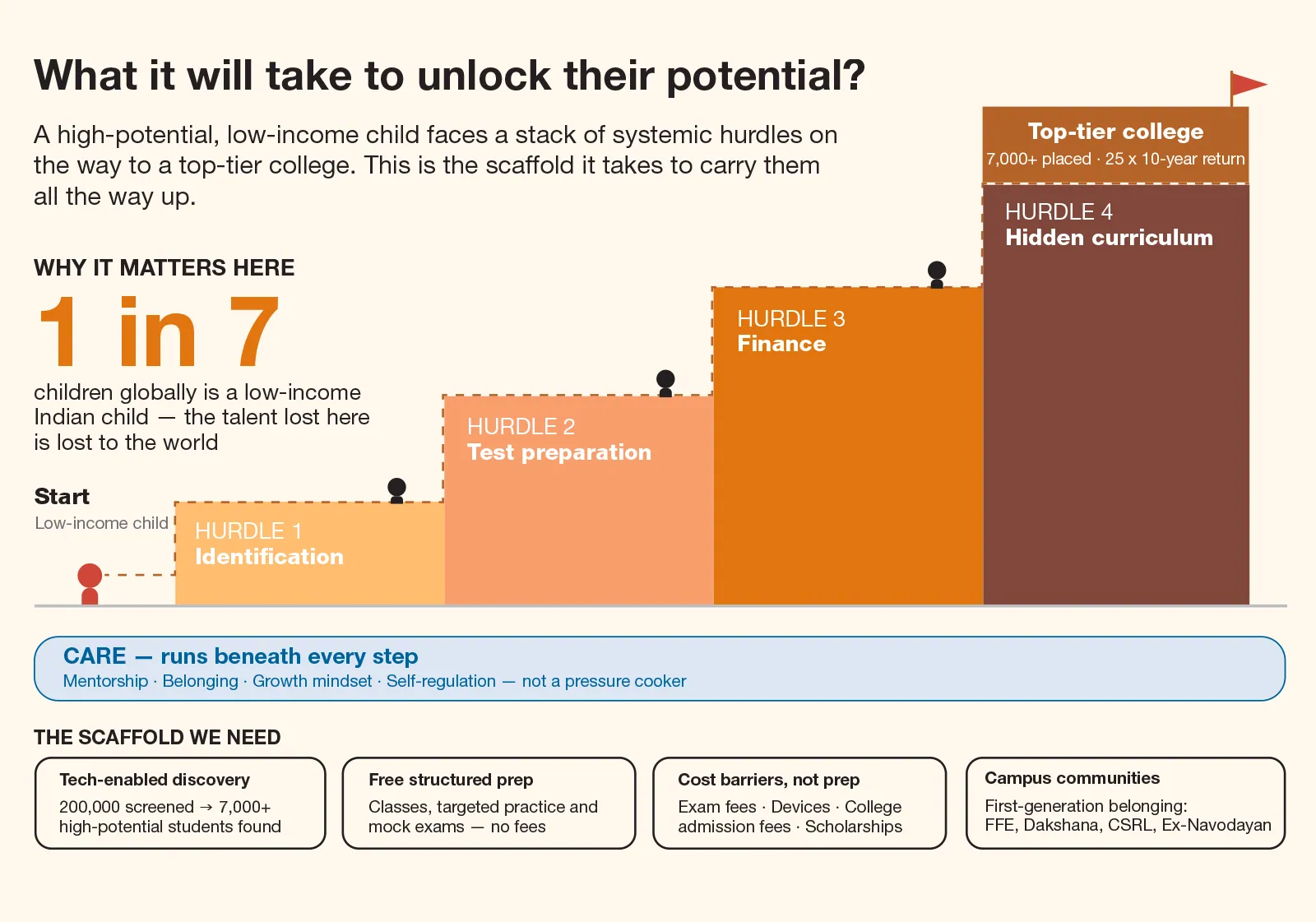
In his seminal 2019 paper tracking achievement gaps by income, Professor Raj Chetty of Harvard University found that if talented low-income children could invent at the same rate as their rich peers, America would have four times as many inventors, a generation of ‘lost Einsteins’ who never made it to the economy [1]. Nearly one in five of the world’s young people is from India, and most of them are poor. Close to one in seven children on earth comes from a low-income family in India, which means plugging the gap here moves the global needle more than anywhere else.
Avanti Fellows has spent more than 15 years chasing this goal. Through a combination of residential test preparation, public advocacy, government schemes and mentorship, we have helped more than 7,000 low-income students find a place in India’s top 3% of STEM (science, technology, engineering and mathematics) colleges, helping them make the transition from intergenerational poverty to securing a spot among India’s academic elite.
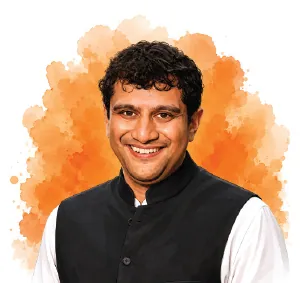
Akshay Saxena, cofounder and co-chief executive of Avanti Fellows, works at the intersection of public policy, nonprofit leadership and education reform
A distinct issue
Increasingly, state and national governments are starting to recognise that equity for high-achieving students is an issue that is distinct from broader educational inclusion, demanding its own policies and interventions. Investments here generate extraordinary returns.
Avanti’s long-term alumni data shows that an investment of ₹200,000 per child in test preparation yields an almost 25x return over 10 years in household earnings. The societal impact is far greater. Students who make this transition change the social culture in entire districts, build aspirations, create remittance flows into rural economies and, over time, help seed businesses, publish papers and add to India’s leadership.
The starting point is identification. To aspire to the top 3% STEM colleges in India one needs to have the conviction — and a signal — that this is a feasible choice. Most students we encounter systematically underestimate their abilities. While many are school or even district toppers, the lack of visible role models makes dreams of admission to a premier engineering college or medical school seem unattainable. This affects how they spend middle and high school, often pegging themselves to lower standards.
There are, additionally, few public pathways for exposure for students coming from less privileged backgrounds. The national talent schemes run by the National Council of Educational Research and Training no longer exist, and existing programmes such as the Aryabhatta Ganit Challenge see limited participation. The national infrastructure for Olympiads remains, but this is not broad-based, like in Singapore and Taiwan.
Our work shows that technology adoption in testing and outreach can play a dramatic role in student identification. In 2025, approximately 200,000 students participated in online testing in a partnership initiative we have with six government school systems.
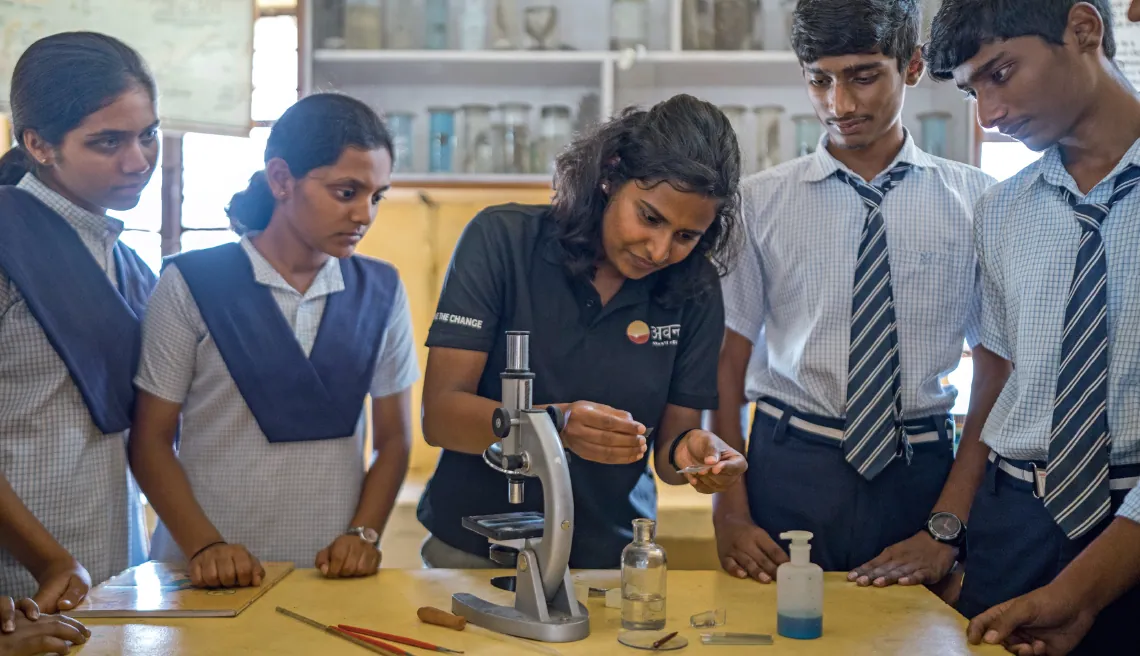
This helped us identify more than 7,000 high-potential students, all of whom received support either through residential programmes or online. Technology makes it easier to provide students with structured practice, surface their performance to administrators and teachers, and shift culture and expectations across entire systems.
The second factor is access to test preparation. Even getting a 90% score in board exams is not enough to qualify for India’s intense competitive exams. Most students today spend upwards of ₹200,000 per head on test preparation, and most rural areas lack quality coaching centres.
Even students who receive free test preparation from Avanti struggle to persist when they are not in fully free residential schools like the Navodaya Vidyalayas. Importantly, there must be the realisation that true equity in STEM education goes beyond the marksheet; it has to be rooted in a culture of care.
There are reasons for this shift in perspective. According to research conducted at Stanford University by Carol Dweck, Greg Walton and Geoffrey Cohen, true academic tenacity rests on four psychological pillars: belief about whether intelligence can grow, a sense of purpose, social belonging, and self-regulation.
The notion that these pillars develop in pressure-cooker environments is fundamentally flawed and has done far more harm than good. The students who survive these conditions during the test-preparation period become more vulnerable to the volatility of grades even after making it to their colleges of choice, thus affecting their ability to navigate the rigorous four years of their respective courses, and sometimes the rest of their lives.
The small percentage of students who make it to top colleges need additional support to benefit from the experience. Sociologists call it the ‘hidden curriculum’, with the unwritten rules of elite institutions that privileged students absorb from family and surroundings: how to navigate the place, how to ask for help, how to build networks[2].
Students from government schools, especially rural ones, arrive without this exposure and the gap is punishingly hard to close. These skills are learned slowly, practised informally and demand sustained mentorship. Several American universities now run dedicated first-generation programmes — some, like Georgetown University, were built to teach this hidden curriculum — that offer students a single port of call.
The rapid improvements in artificial Intelligence (AI) are likely to cause structural shifts in India’s knowledge economy. Hirings in the IT sector — the backbone of upward mobility for many of our students — has slowed to a trickle. The skills needed for a first job have grown exponentially and shifted higher up the value chain. Students who are unable to plan, create and think will find it hard to participate in the tech jobs of the future.
Sectors that to this day have a limited need for technology understanding are also rapidly evolving. The second curriculum will now include creativity and AI literacy and will likely become a greater hurdle. But the same technologies also offer solutions: personalised learning, building from scratch, starting a business, etc.
Knowledge and research are deeply democratised and internet access is now ubiquitous. We are already seeing our students embrace these technologies, change how they learn and adapt. We need to find ways to provide them with the scaffolding they need to learn better and more effectively on their own.
1. Bell, Chetty, Jaravel, Petkova & Van Reenen, “Who Becomes an Inventor in America? The Importance of Exposure to Innovation,” QJE 134(2), May 2019 (NBER w24062, 2017). Popular name “Lost Einsteins.”
2. Gable, R., The Hidden Curriculum: First-Generation Students at Legacy Universities, Princeton University Press, 2021. (Term originally: Jackson, P. W., Life in Classrooms, 1968.) -> the unwritten rules of elite institutions.