Mission: Restore
and preserve
A conservation programme in Ladakh is paving the path to protecting the region’s historical artefacts and the rich cultural legacy they represent
I have this opportunity to engage with Buddhist heritage in a living landscape where culture, community and the practice of conservation come together,” says Alenla Bhutia. That’s what being involved with an effort to restore and preserve has done for Ms Bhutia, who has travelled far from her native Sikkim to immerse herself in caring for a precious legacy of immeasurable value to Ladakh and
its people.
Restoring historical artefacts of cultural and religious significance is the concern for Ms Bhutia, who is part of the Shesrig Foundation, a women-led art and heritage conservation organisation based in Leh.
‘Shesrig’ denotes culture and heritage in the Ladakhi language and those are central to the undertakings of the Foundation — and of a Tata Trusts-supported programme to conserve relics and monuments from Ladakh’s storied past.
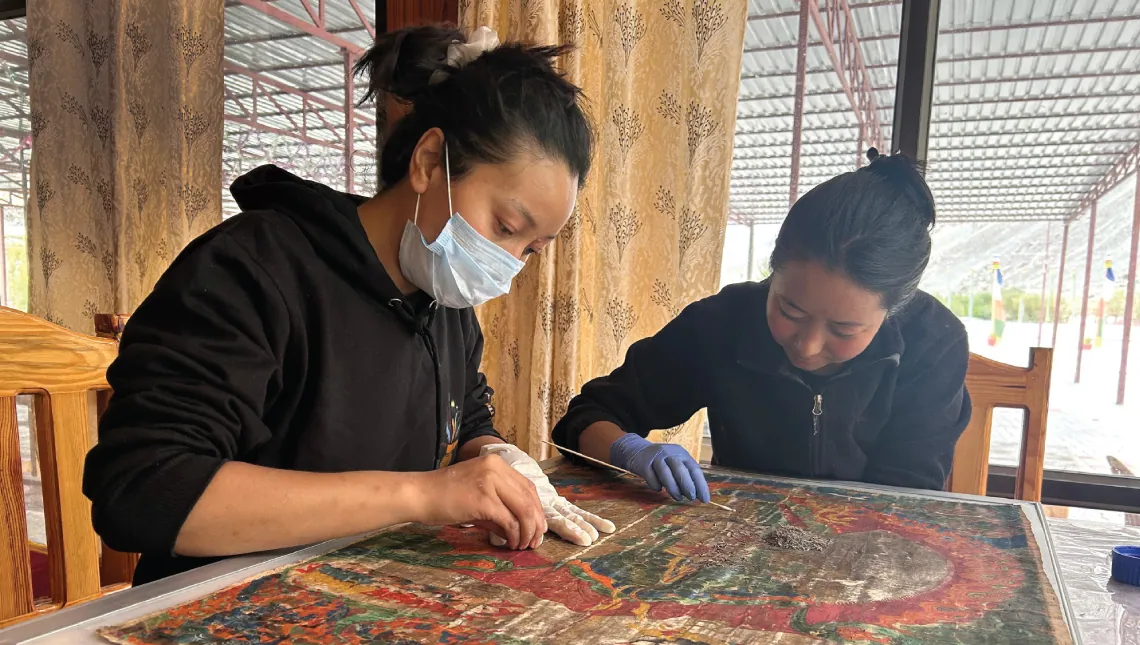
Launched in late 2024, the programme works with monasteries and village communities and has multiple components: the restoration and conservation of thangka and wall paintings and miscellaneous artefacts such as masks; building capacity for the Shesrig Foundation — this includes repairing its art conservation studio at Choskor House, a 200-year-old heritage structure in Leh — fellowships for two budding conservators; and community awareness projects.
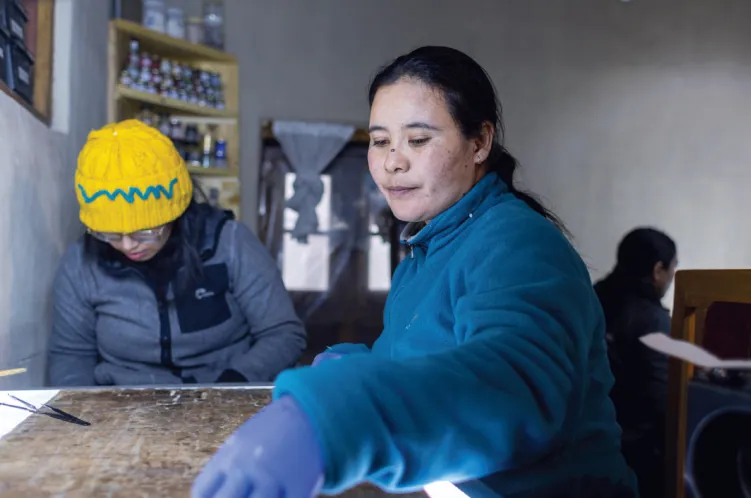
Backing from the Tata Trusts has enabled the Foundation to spread its wings. “It used to be that conservation in Ladakh was what people from outside did with funds they brought in,” says Noor Jahan, cofounder and director of the Foundation. “The Tata Trusts grant represents a change; it means we can do a lot of work that we had been aiming to do, principally collaborating with monasteries and communities and training locals in conservation.”
What the Foundation has been trying to pull off is anything but straightforward. “We Ladakhis often take our heritage for granted and that is a major challenge,” adds Ms Jahan, an alumnus of the Delhi Institute of Heritage Research & Management (and a former national-level ice hockey player). “People have good intentions but then they try to do something that ends up becoming a problem. We have had such incidents with wall paintings, especially.”
Development downer
Ladakh may still be picture-postcard pretty, but pristine it no longer is. So-called development, the downside of tourism, climate shifts and a lack of safeguards have hurt the place and its people. What has happened with the region’s historical artefacts in all of this is collateral damage.
“Only a handful of us in Ladakh are working in the art and heritage sector at this point,” says Ms Jahan. “Our fears stem from the influx of tourists and how we cater to them, infrastructure building and the heavy machinery employed to make roads and the like. Ladakh has a large number of rock art sites, among the most in the world, and we have lost a lot of this heritage due to rampant development.”
Ms Jahan bemoans the lack of awareness that leads to such destruction. “Right now everything is out there in the open and that’s what makes it more difficult. We don’t have a heritage policy in place; there are some archaeological monuments that are protected but there is no protection for lower-category monuments. We have a few private museums but not a single government museum.”
Conservation boost
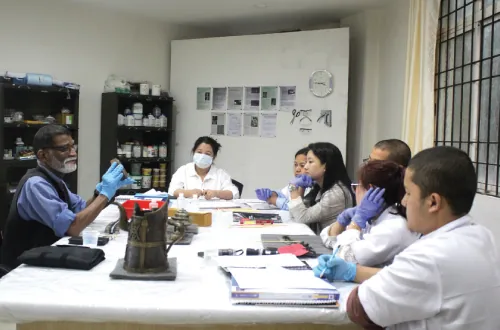
Sikkim has been the setting for two conservation training programmes supported by the Tata Trusts in a collaboration involving the Sikkim State Archives and Museum. Held during the summer and autumn months of 2024, the three-month-long courses were aimed at building the capacity of the staff of the Sikkim State Archives and Museums as well as monks, the custodians of important monastic collections in Sikkim.
The first training course was on the conservation of the material heritage of Sikkim (wood and metals). Implemented by the Uttarakhand-based Himalayan Society of Heritage and Art Conservation, this involved conservation practices specific to wood and metals in the Sikkim region. Designed to be immersive and intensive, the programme focused on practical training in conservation science for the group of staff and representative monks.
The second training course focused on best practices in preventive conservation. Organised in partnership with the Kolkata Centre for Creativity Conservation Lab, the participants were largely the same cohort from the first course. They were instructed in documenting objects, identifying signs of deterioration in artefacts, and in undertaking emergency repairs of art pieces.
One of the highlights of the programme was the reorganisation of the storage of the Sikkim State Archives and Museum’s collection. This was done in line with the ICCROM (International Centre for the Study of the Preservation and Restoration of Cultural Property) RE-ORG method, a structured framework that helps museums reorganise their storage spaces.
To top off the bad tidings, there’s good old-fashioned thieving, that ages-old criminality by which India’s cultural treasures have been spirited away to foreign shores. “That has happened in Ladakh as well,” says Ms Jahan. “The classic example is this wooden panel that disappeared from the Sumda Chun monastery. It was traced later to a private art collector in London.”
The professional side of what Ms Jahan and her six-member team labour to accomplish is relatively less complicated in comparison with the external factors at play. The team has restored 15 thangka paintings belonging to different monasteries in Ladakh. These scroll paintings date from the 16th century onwards and were carried back by monks and pilgrims travelling to Tibet, then a centre of
Buddhist learning.
Typically depictions of the Buddha or a protector deity, the thangka paintings worked on by the Shesrig Foundation needed the recreation of missing or torn bits. Before any restoration begins, the painting is photographed and documented. A treatment plan is then devised prior to the painting’s reintegration. A thangka artist is consulted if missing parts have to be added (after referring to religious texts).
The degree of difficulty in the restoration of wall paintings is of a higher order. The work is more complex and it entails travelling with people and materials to remote locations. The Foundation’s conservation team has been involved in two such projects: the first at a 12th-century temple in Saspochey village in Leh district and the other at a 14th-century shrine in Markha Valley.
With the Markha Valley wall painting, the local village community had approached the Foundation for help in restoring it. The painting was inside a partially collapsed stupa and the community, a superstitious lot, were afraid to touch it, lest they trigger a calamity or some such. “These were two very different and extreme sites and it was a huge challenge for us, logistically and personally,” says Ms Jahan.
Creature comforts may have been in short supply for Ms Jahan and her team. What they did not lack was motivation. “Ladakhi people have their own identity and they have lived by it for all these centuries, through harsh climatic conditions and in very isolated locales,” explains Ms Jahan. “These artefacts are attached to that identity; they resonate with us and our culture. I am from a Muslim family, yet they are a part of my daily life. That’s why it is so disheartening to see them fade away
and deteriorate.”
Fostering fellowships
The fellowships instituted by the Foundation — with stipends and accommodation provided — are a way to counter the downslide. This is a three-month programme and two students have come through it in the inaugural year, one from Ladakh and the other from Manipur. “We have kept it at two students because the course is intense; it’s tough to accommodate more people and give them proper attention,” says Ms Jahan.
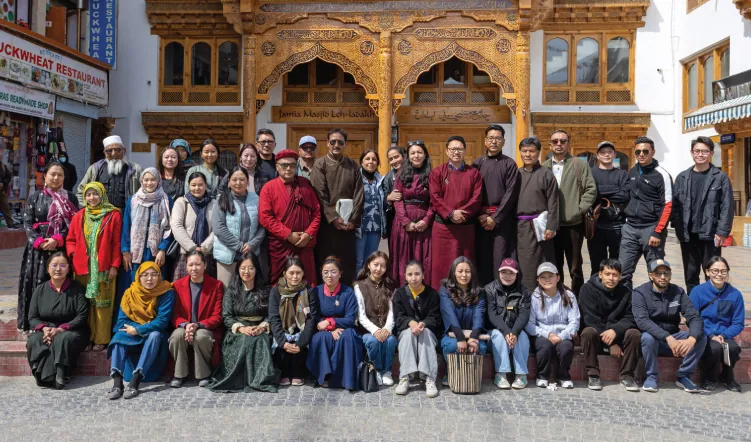
Community awareness initiatives are another facet of the Foundation’s endeavour to further the conservation cause in Ladakh. Under this umbrella, a seminar — with monks and village heads in the audience — was organised in collaboration with the Himalayan Cultural Heritage Foundation. Also, a conservation care workshop was held at Disket Monastery, among the oldest monasteries in the Leh area, and an on-site awareness programme in Saspochey village.
“The Shesrig Foundation’s efforts to preserve Ladakh’s heritage were a natural choice for us to support,” says Paroma Sadhana, programme manager, arts and culture, with the Tata Trusts. “They are committed to building expertise and awareness in a remote geography, and they have coped well with a series of challenges. The Foundation’s strength lies in the fact that it is led by art conservators from Ladakh, people best placed to advocate for the preservation of the region’s cultural heritage.”
One of those art conservators is Kunzes Dolma, a Ladakhi and a member of the Shesrig Foundation team. “I believe this project will grow stronger in the coming years,” she says. “It will increase community participation in conservation and build local capacity. With continued support, it has the potential to create a sustainable model for heritage preservation in Ladakh.”
Nilza Angmo, also a Ladakhi and another member of the team, views the initiative through the prism of Ladakh’s culture and traditions. “This programme plays a crucial role in preserving Ladakh’s unique identity,” she says. “It helps safeguard our monasteries, murals and heritage structures, all of which are integral to our history and our spiritual life.”