Cottoning on
Cotton farmers in multiple Indian states are reaping the benefits by banking on high-density planting systems to improve their crop yields and incomes
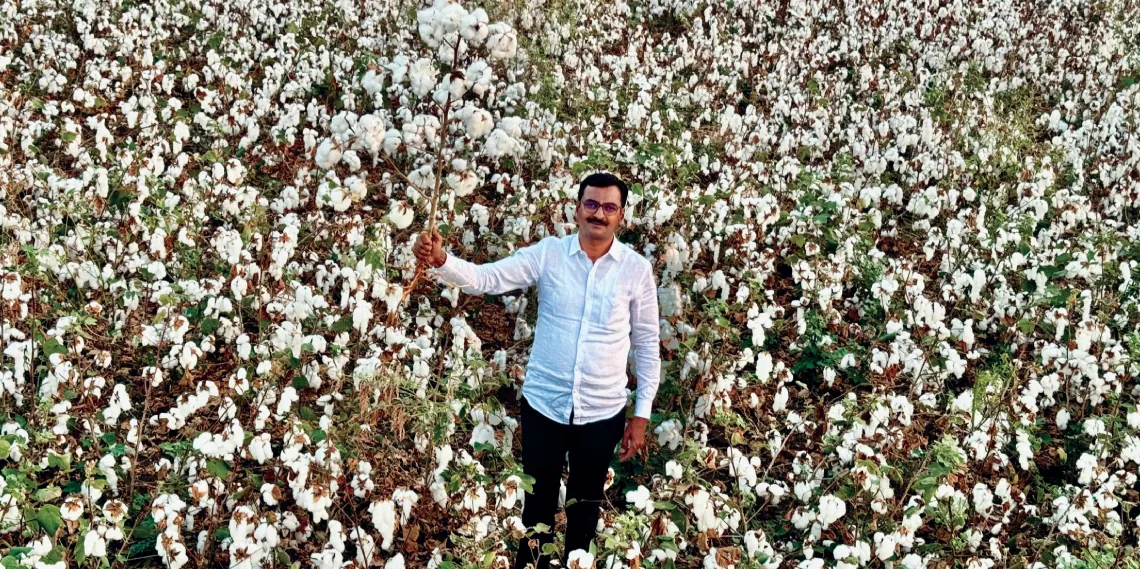
India’s cotton sector is undergoing significant change, marked by both pressing challenges and emerging opportunities. While the country continues to be the world’s largest cotton producer, recent years have seen substantial reductions in production levels and cultivated acreage. For many farmers, cotton no longer offers the same appeal it once did. Yet, as the story of Dinesh Gulabrao Kale shows, cotton continues to evoke resilience and possibilities.
Till a couple of years ago, Mr Kale would get a yield of 8-10 quintals per acre from his cotton farm in Sanglud village in Maharashtra’s Akola district. Then he learned of an initiative to increase cotton cultivation and enhance productivity with high-density planting systems (HDPS) and hybrid cotton seed varieties. The result: Mr Kale secured a yield of about 15 quintals per acre in 2024.
“The yield dipped in 2025 because of the excess rains, but my income from cotton is still higher than before,” says Mr Kale. “That’s why I have moved from soyabean cultivation to HDPS cotton on my entire 65-acre farm.”
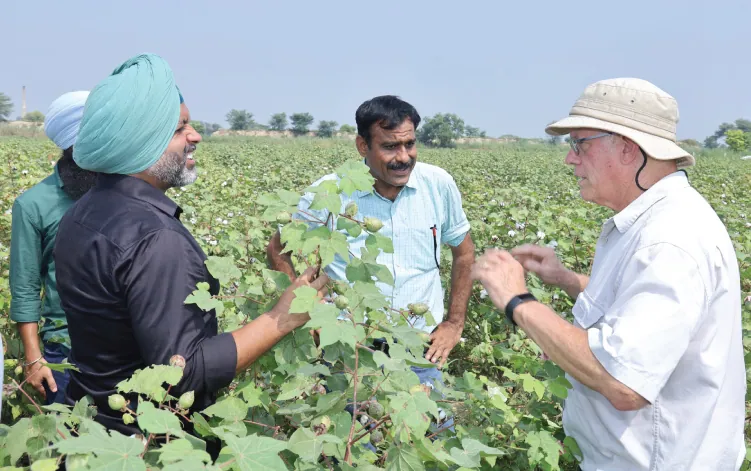
Mr Kale is one among more than 4,850 small and medium farmers who have benefitted from a cotton farming initiative that encourages a shift to HDPS. This allows farmers to grow nearly three times as many cotton plants per acre, with a faster harvesting cycle and lower maintenance costs. The transition can boost farming yields by 30-50% per acre, with a commensurate rise in income.
Among the forces behind this sunshine story are Team Athena, an agri consultancy, and Reviving Green Revolution Cell (RGR), an associate organisation of the Tata Trusts. RGR has, since 2025, been driving the ‘cotton mechanisation and innovation consortium’ (CMIC), which has brought together multiple stakeholders, among them farmers, seed companies, textile enterprises, academics and farm-equipment manufacturers, to increase cotton cultivation and yields.
CMIC is one of RGR and Team Athena’s initiatives to revitalise agricultural livelihoods by increasing farm productivity and profitability. A few years ago, it worked with cotton farmers to tackle the menace of pink bollworm, a pest that destroyed acres of cotton and nearly brought cotton farming to a standstill.
Partners aplenty
The CMIC effort draws inspiration from the success of a project run by the Confederation of Indian Textile Industry’s Cotton Development and Research Association (CITI-CDRA) along with the central government’s Ministry of Agriculture and Farmers Welfare and the Ministry of Textiles. Launched in 2023-24, the CITI special project on cotton reached 912 farmers in Rajasthan, 577 in Maharashtra and 3,354 in Madhya Pradesh, covering 3,160 hectares in 10 districts in three states.
The need to provide a leg up to India’s cotton farmers has been evident for the last few years. Although India accounts for nearly 25% of global cotton production and has the largest area under cotton cultivation — around 12 million hectares — it ranks a low 38th on productivity. This is because of the low adoption of mechanised planters and harvesting technologies.
HDPS: Pros and cons
Benefits
- Increased yield: HDPS can significantly boost cotton yields, with one study showing an average yield increase of 24% over traditional methods.
- Improved returns: Farmers adopting HDPS have reported higher returns, with one farmer earning an additional income of ₹30,084 per acre despite higher input costs.
- Reduced reliance on manual labour: HDPS enables mechanisation, reducing labour dependency and costs associated with harvesting and other operations.
Limitations
- Availability of quality seeds: Adoption of HDPS depends on access to high-quality seeds, which can be a challenge for farmers.
- Mechanisation: While HDPS facilitates mechanisation, the upfront investment on equipment can be a barrier for small-scale farmers.
- Regulatory framework: A streamlined regulatory framework is necessary to support the adoption of HDPS and ensure that farmers have access to resources, incentives, and support systems.
Cotton yields in India have declined by around 20%, from an average of 542 kg/ha in 2016-17 to 454 kg/ha in 2024-25 (the global average is 900 kg/ha). The good news is that the situation is far from irreversible.
Experts suggest that yields can rise to 800–1,200 kg/ha with advanced practices such as HDPS, precision irrigation and improved soil management. This is precisely where the CMIC-RGR initiative is directing its efforts: accelerating mechanisation in cotton farming to enhance cultivation and productivity.
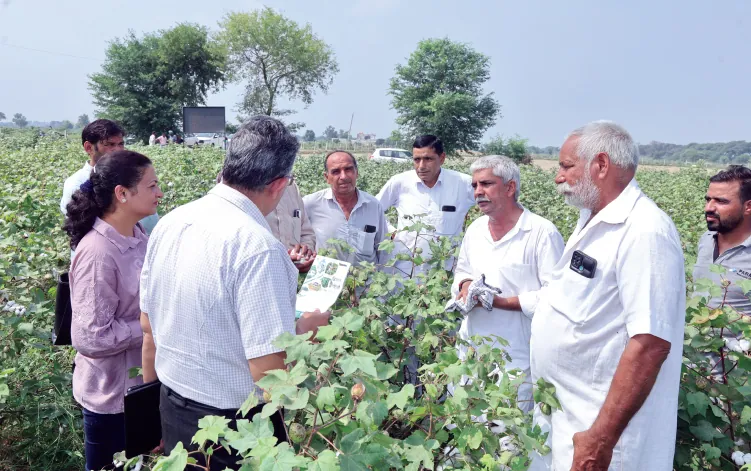
CMIC brings logic and muscle to the cotton value chain. CMIC-RGR has nine core members drawn from diverse sectors, including seeds, crop protection, fertilisers, machinery, textiles and finance.
Apart from Rasi Seeds, which helped conceptualise the consortium along with Team Athena, the members include seed research and development companies such as Mahyco and Seedworks International, crop solutions companies like Crystal Crop Protection and Meenakshi Agro Chemicals, equipment manufacturers Shaktiman Agro and Bajaj Steel Industries, as well as agribusiness multinational LouisDreyfus.
Recognising the need for world-class cotton and ginning expertise, the Consortium Secretariat brought on board Kater Hake, a global cotton production and high-density planting expert, and Marinus van der Sluijs, an international cotton ginning and fibre quality specialist.
Multiple businesses were chosen from each sector to reflect India’s commercial diversity and to facilitate non-competitive discussions, allowing CMIC-RGR to also advise national and local governments.
At the heart of the CMIC-RGR effort is the globally prevalent practice of HDPS. While dense plantations of high-yielding hybrid cotton enable greater productivity, they must be supported by complementary practices such as the use of plant growth regulators, harvest aids (defoliants), mechanical pickers and pneumatic planters.
CMIC-RGR members are promoting HDPS in cotton farming in India by addressing three key areas: Hybrid-seed genotypes, farm inputs, and farm mechanisation.
An HDPS cotton farm needs compact plant types with uniform boll maturity for efficient picking. CMIC-RGR aims to identify hybrid cotton-seed genotypes for each region based on specific soil and climatic conditions.
For instance, considering the agroclimatic conditions of Punjab, Rajasthan and Haryana, Rasi Seeds is developing region-specific HDPS cotton hybrids. These hybrids are designed to withstand cooler early-season temperatures and variable moisture regimes, ensuring stable productivity. They differ from the genotypes developed for western and southern India, which are optimised for hotter, semi-arid conditions and longer growing seasons.
Earlier, Rasi Seeds developed seeds suited to farmers in Maharashtra and Telangana while promoting HDPS there. Uduthala Venkatiah of Kalakonda village in the Rangareddy district of Telangana is one such farmer. Mr Venkatiah was incurring losses on his 15-acre cotton farm till three years ago, with yields of 5-7 quintals per acre. After increasing plant density by 30% with HDPS, yields have gone up to 11-12 quintal per acre. “I am satisfied with the output over the last two years; this year, I made a 10-15% profit,” he says.
Having prepared the ground, CMIC-RGR now hopes to expand HDPS to more cotton-farming areas. While the CITICDRA project grew to cover 5,160 farmers in 12 districts in Western India in 2024-25, CMIC-RGR is planning to scale this further by bringing around 10,000 acres under HDPS cotton farming in this region in 2026 (based on seed availability and project funding).
Potential unleashed
The potential of HDPS to increase cotton cultivation and yields is evident from the success of early adopter Dilip Thakare of Malwada village in Akola district. A prominent advocate of HDPS cotton farming at various government and industry forums, Mr Thakare first adopted the method a decade ago. He increased plant density by three times, leading his 70-acre farm to produce 15-18 quintals/acre against the earlier 5-7 quintals/acre.
“HDPS delivers a lot of benefits,” says Mr Thakare. “Earlier, 10 days after sowing, farmers had to fill the gaps where seeds had not germinated. This has reduced with HDPS. Plus, the crop matures faster, before the ringworm effect can set in. Weeding has also lessened.”
Mr Thakare has now become the face of what is being called the Akola model of HDPS cotton farming. He frequently travels across the country to educate fellow farmers. Meanwhile, building on his success with HDPS, he leased 500 acres in 2025 to undertake contract cotton farming for the Japanese brand Uniqlo.
For its part, RGR is seeding demo plots and conducting workshops and farm visits to promote HDPS farming. In September 2025, it convened industry leaders at a workshop in Delhi to discuss how they could explore ways of strengthening India’s cotton sector by improving productivity and farm incomes through industry collaboration. RGR has also been working on advocacy for government support and policy reforms.
Given its potential to increase yields and reduce costs, HDPS can help make Indian cotton more competitive in the global market, besides reducing import dependence in a protectionist trade environment. The ultimate goal for CMIC-RGR is to make cotton farming more attractive and sustainable for farmers.