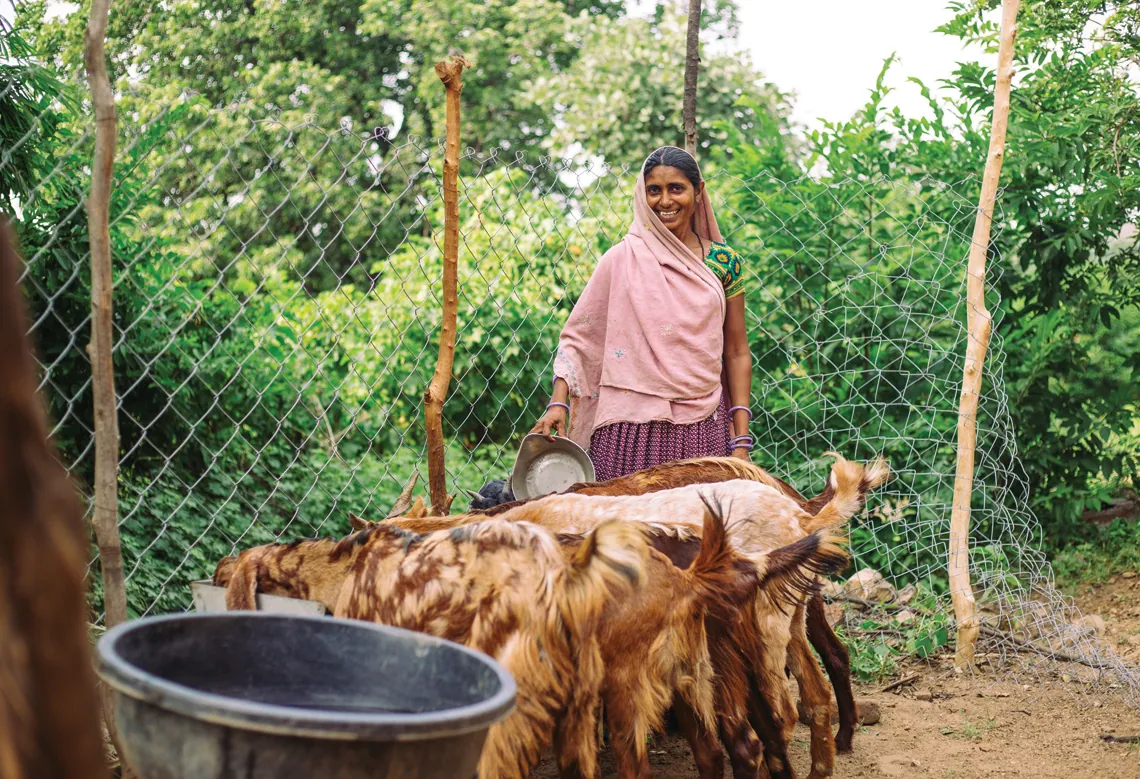
Herd start
Infusing science and technology into sheep and goat breeding is helping rural communities in three states improve the quality of their livestock and their incomes
The stray buck walking through Thandi Beri village in Rajasthan’s Sirohi district has no owner but, with an ear tag as identifier number, it is among the livestock categorised and counted by the local community. The ear tag is how the village tracks the goat’s value, not in terms of a possible selling price but for its breeding potential. This one is not a good choice and the ear tag tells the story.
Goat or sheep-rearing is an important source of income for marginal farmers across India with small landholdings, especially those living in arid areas. The genetic quality of the buck or doe is important here. Goats that can gain weight, produce more milk, are disease-resistant and climate-adapted can boost a family’s income by 50% or more. What tends to compromise matters is how the breeding happens.
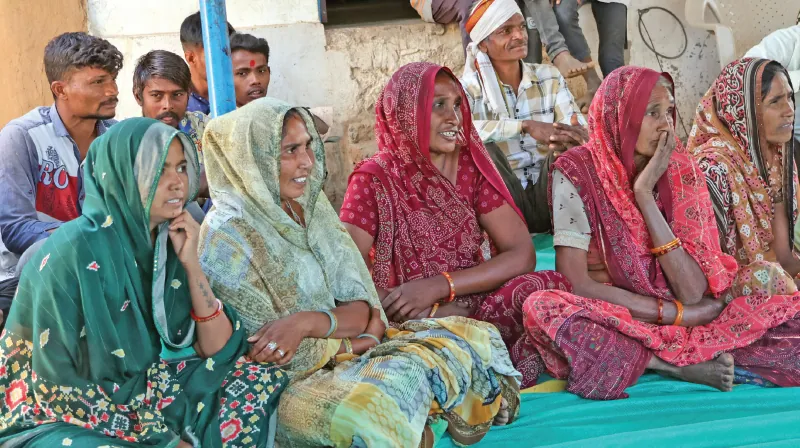
Breeding is more often than not random, with goat owners sometimes choosing bucks based solely on appearance or allowing their animals to breed with strays. This is the reality that a promising livelihoods programme of the Tata Trusts has sought to change, through awareness-building and, just as important, by getting the community to employ data and technology with their animal-breeding practices.
The Trusts’ community-based breeding programme (CBBP) was launched in Rajasthan and Gujarat in 2024, with Andhra Pradesh being added to the fold a year later. The programme has been introduced in a cluster of villages that were part of earlier Trusts’ programmes in animal management. In the south Aravalli region that overlaps with south Rajasthan and north Gujarat — this is home to the Garasiya Bhil tribe — CBBP has been introduced in about 25 villages.
The initiative is implemented by associate organisations of the Trusts, the Centre for microFinance (CmF) and Collectives for Integrated Livelihood Initiatives (CInI) in Rajasthan and Gujarat respectively, and the Vijayavahini Charitable Foundation in Andhra Pradesh. The knowledge partner is the Nimbkar Agricultural Research Institute, a sheep- and goat-breeding centre in Phaltan in Maharashtra.
CBBP is essentially about making the community aware of why pedigree and quality of livestock count. Like many of the Trusts’ programmes, the initiative is designed around sustainability, securing a commitment from the community, and encouraging women’s empowerment. It is driven in the main by ‘pashu sakhis’, women from the community who are taught basic animal husbandry skills.
The technology in the breeding programme, which is used to capture data on the goats, is from AbacusBio, a New Zealand-based agribusiness company. AbacusBio runs an app called Dtreo, which is currently used by CBBP to host data on about 4,500 goats and sheep.
Data decoders
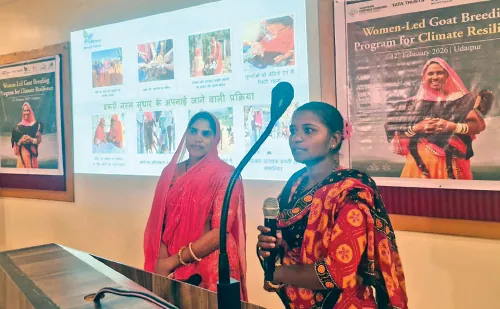
The pashu sakhis — there are 18 of them — have learned how to tag the goats and use tablets to upload the tag number and data of every animal in their care. The data includes a host of metrics: age, birthweight, girth, litter size, size of sire, milk production by its mother, etc.
Learning to flourish
Basu Bai, a tribal from Thandi Beri village in Rajasthan’s Sirohi district, started turning her life around in 2018 when she got two goats and decided to earn a little more by becoming a pashu sakhi. Six years later, she joined the community-based breeding programme (CBBP) run by the Centre for microFinance (CmF), an associate entity of the Tata Trusts. By that point, Ms Basu had learned about ear tagging, regular weighing, body measurement and how to select better breeding animals.
Her toughest challenge was entering data on the Dtreo app, using a tablet to manage the monitoring of the animal. “I refused at first. I have studied up to class 8 only and wasn’t sure I could do it,” she says. Those concerns were soon overcome as Ms Basu began gaining some useful expertise with training and support from the Nimbkar Agricultural Research Institute, the knowledge partner in the initiative, and the CmF team.
Ms Basu now manages the digital records of goats belonging to 215 households. She has challenged social taboos by understanding all about goats and breeding, even how to carry out castrations. Despite living in a traditionally patriarchal society, she has taken on the job, and this speaks of her resolve to have an identity of her own. Her family income has risen, from ₹10,000-₹12,000 a year from selling a couple of goats, to about ₹50,000-₹60,000 from goat sales and pashu sakhi services.
Ms Basu owns 12 goats and has established herself as a skilled and experienced goat rearer. Beyond her personal achievements, she has emerged as a beacon for change in her community.
High-scoring bucks are selected as breeders and low scorers are castrated and reared for sale for meat. Similarly, female animals with a history of healthy litters and good milk output are retained for breeding purposes. Selection of better performers for breeding improves the local gene pool with every successive generation. What’s noteworthy about the programme is that marginalised communities are learning to achieve this by using data and technology.
Having healthier animals can make a life-impacting difference to families living on the edge. Shantaben Babubhai Gamar should know. A goat rearer for seven years, Ms Gamar is also a resident of Boradiyala village, with a herd of 55 goats, including male bucks, female goats and lambs. Before joining CBBP, Ms Gamar earned around ₹40,000 annually from goat rearing. That figure has climbed plenty since. “We sold seven goats and earned ₹110,000,” she says, “and that was a big income jump for us.”
“Women farmers learning to monitor and evaluate local goats is empowering for them,” says Sushmita Parai, the Tata Trusts programme officer with CBBP. “Equipped with skills and technology, these women are role models in the community.”
Having access to a local pool of good breeders means that the goat rearers don’t have to buy expensive breeding bucks from elsewhere. “Also, there is the likelihood of unknown breeding bucks falling sick, dying of disease or being unable to adapt to local climate and fodder,” explains Dr Parai. “Using bucks from a known database reduces this risk.”
To prevent inbreeding, CBBP has set up a process whereby breeding bucks are rotated among the villages. While breeding is the key, the initiative looks at holistic animal health as well. It encourages timely vaccination, regular deworming, and proper nutritional care. The larger intent is to improve the overall productivity and resilience of the herds.
CmF and CInI are, meanwhile, working with the communities to set up farmer-producer companies to further enhance their income. Money aside, the initiative’s social impact is significant. It empowers rural women with knowledge and technology and puts them at the centre of community livelihood creation.