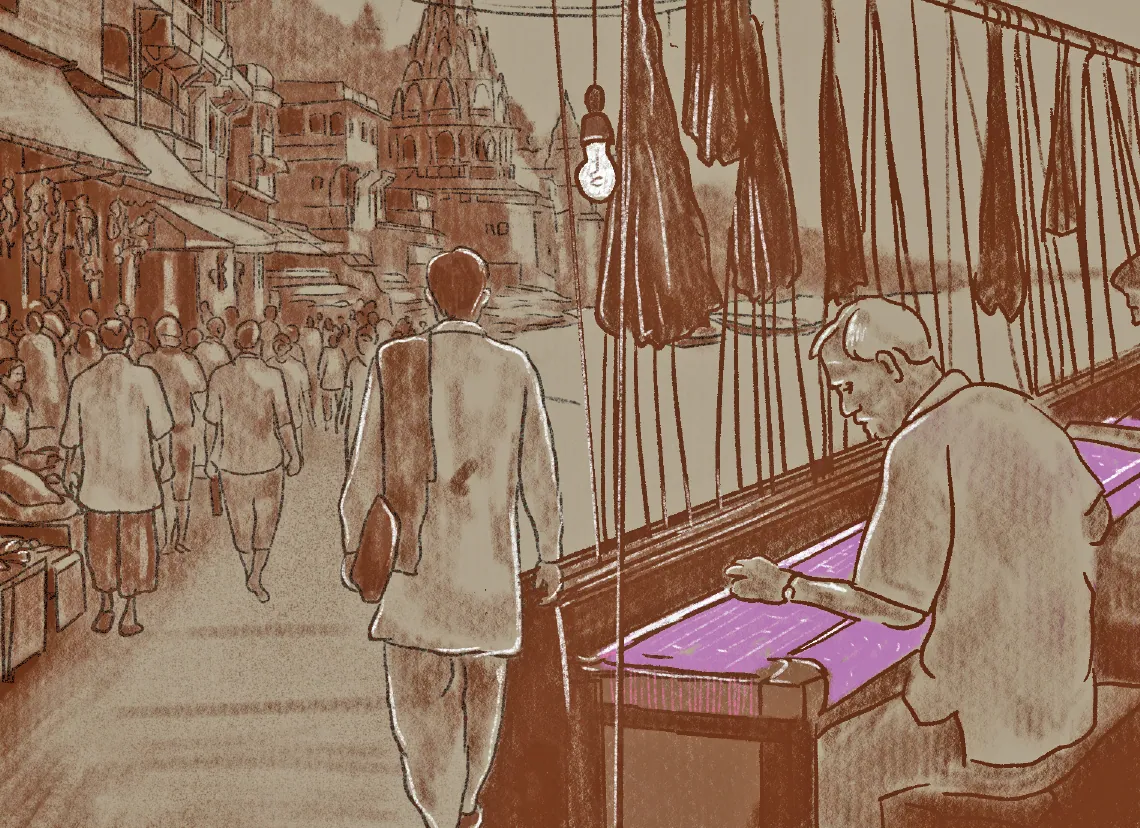
Tapestry of people and histories
A visual artist and illustrator based in Goa, Pakhi — she uses a mononym — is working on textiles and the stories wrapped in them for her project. These stories, retrieved from the archives of the Marg Foundation, Mumbai, will be the source material for an interactive website in an assignment that features 10 animated narratives, short-form videos and social media clips.
In terms of your evolution as an artist, what have been the benefits of working on the ‘Textile Stories’ project?
This project feels personal in many ways. I grew up in a family where textiles were treated like heirlooms, so I think I absorbed a fascination for this world quite subliminally from a young age. Over time, that fascination became more conscious in my own artistic practice.
I’ve always been interested in the emotional and narrative life of textiles, not just as objects of beauty but as carriers of memory, migration, labour, trade, revival, and identity. What this project has allowed me to do is delve much deeper into those intimate relationships between people and textiles. Each story I’ve worked on has opened into larger histories.
What is it about the project that you find interesting, and how complex is the undertaking?
What I find most interesting about the project is that textiles are never just decorative objects. They are storytellers, historians, sociologists and artworks, all at once. A textile captures time and place in an incredibly intimate way. Being able to move through these different stories has felt like slowly unveiling a much larger tapestry of people, histories, and relationships.
Among the stated objectives of this project is “to devise a visually rich platform” where the stories of India’s textiles can be made “accessible to a global audience...” How do you plan to accomplish that?
For me, the intention behind creating a visually rich and accessible platform is really about sparking curiosity and emotional connection. There is a certain everyday intimacy with textiles that I feel is slowly fading. Increasingly, Indian textiles are being absorbed into a very flattened luxury or global commercial market. What I hope this project can do is make the subject feel alive again.
What’s your view of the environment for emerging artists such as yourself in today’s India? What are the positives and the negatives?
I think it’s both an exciting and an exhausting time to be an emerging artist in India. There are far more possibilities now in terms of collaboration, interdisciplinary practice and the different formats through which art can exist and circulate. At the same time, there is definitely pressure to participate in a culture with a very short attention span and an almost constant demand for visibility and newness.
I think meaningful artistic work often requires slowness. Some of the most important works across history have emerged through long periods of observation, uncertainty, research and gestation. So, one of the challenges today is trying to remain truthful to your own rhythm while also navigating systems that reward speed and constant visibility. That balancing can be difficult.