What’s at stake for water’s sake
Contrary to popular belief, India’s water security crisis is not about scarcity — it is essentially a crisis of sustainability
India’s water security crisis is not so much about a lack of the precious resource as it is about making the most of funds already allocated to ensuring its availability. A public financing study covering Markapuram in Andhra Pradesh, East Singhbhum in Jharkhand and Dahod in Gujarat has sought to unpack this phenomenon.
The study, conducted by a team of independent research consultants led by Raman VR and Amulya Miriyala, presents an important finding: the financing architecture needed to maximise the value of public investments in rural water infrastructure and make these investments work sustainably is well within reach.
This article draws on field observations and public-finance analyses to examine how communities and gram panchayats (village councils) can leverage existing resources to address their water challenges.
India’s water sector is funded through multiple schemes: the Jal Jeevan Mission (JJM), Finance Commission grants, employment-guarantee programmes, irrigation projects and various initiatives by state governments. This fiscal structure presents lucrative opportunities to pool resources and enable convergence.
However, the funding streams in the structure tend to operate in silos. As a result, the sector falls into a capital expenditure (trap, even as critical lifecycle costs — maintenance, groundwater recharge and institution strengthening — remain largely underfunded. The study shows that this can be corrected within the existing allocations framework.
JJM has achieved considerable coverage in terms of providing ‘functional household tap connectivity’ to rural communities. East Singhbhum records 420 solar cluster schemes, in Markapuram 75-85% of the populace has household tap connections, and Dahod has 513 operational JJM schemes. This is a substantial base from which communities can work.

Kavin Malini, who has a background in economics and sociology, is with the analytics, insights and impact division of the Tata Trusts
Reliability in functionality
The challenge here is functional reliability. East Singhbhum’s solar power systems operate at 50% reliability. The financial and institutional mechanisms required to maintain these structures are not particularly complex. The study identifies exactly where to start, and the good news is that improving functionality does not require more capital expenditure.
The study indicates a capital expenditure trap, where visible infrastructure dominates while lifecycle costs remain grossly underfunded. Provisioning for operations and maintenance (O&M) is just 35-45% of requirements in Markapuram, 35% in East Singhbhum and 20% in Dahod. This is not in direct alignment with guidelines, which mandate annual O&M spending of 10% of scheme cost.
There are real consequences to this. Nonfunctional or partially functional systems, motor failures, unrepaired distribution leakages, and solar systems that do not deliver a reliable supply are all outcomes of insufficient O&M funding. In Markapuram, the gram panchayat diverts 15-25% of its maintenance budget from preventive work to address reactive demands to ensure effective service delivery.
Plugging this gap does not require new allocations. The Finance Commission component, if ring-fenced for O&M rather than capital works, could reduce the annual deficit in the district’s O&M requirement.
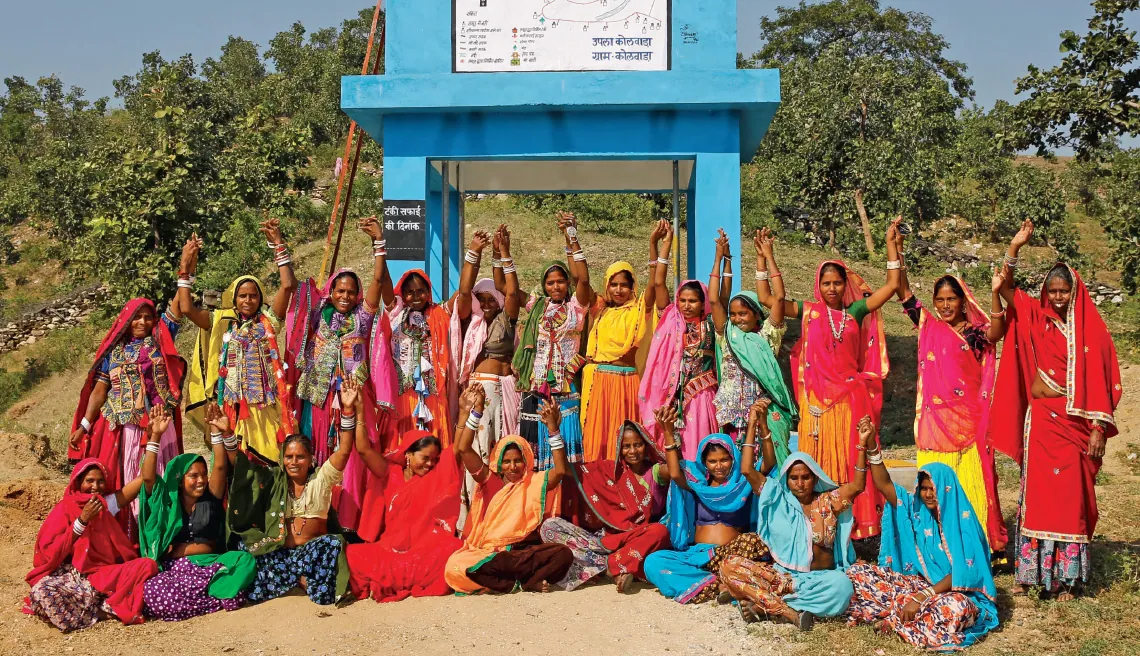
Institutional architecture for community water governance comprises village water and sanitation committees (VWSCs), jal sahiyas (community water volunteers) and self-help groups (SHGs). While these institutions exist in a formal sense, their operational authority requires further strengthening, particularly with training, remuneration and financial autonomy.
There is immense untapped potential in existing organisational capacity that can be directly connected to water governance. Bavka village in Dahod has 14 women’s SHGs with effective financial management capacity through dairy cooperatives. But none of these SHGs currently hold formal positions in VWSC functioning or tariff collection. Linking them would immediately strengthen both institutions.
Similarly, the jal sahiyas of East Singhbhum are community-rooted, water-focused entities who, with the right tools and remuneration, can anchor local water governance in ways no external agency can.
Composite gender and social inclusion scores indicate how much room there is to improve (Markapuram scored 1.37 out of 5 and Dahod 1.4). Making women the majority in VWSCs — as JJM guidelines already require — would bring the most knowledgeable water users into governance. Tariff collection, currently almost absent, becomes far more feasible when managed by trusted community institutions.
The drudgery borne by women in the matter of water is amplified by the system’s failures. Across all three districts, women remain primarily responsible for fetching water. In Dhadkibani village in East Singhbhum, women report spending 45-60 minutes each day collecting water during outages. This is time that would otherwise go toward agricultural activities, care work and income-generating activities.
The burden increases significantly for tribal women, who experience multiple intersecting forms of vulnerability. Markapuram’s tribal households, with smaller landholdings and limited savings, face greater exposure to borewell failures and seasonal migration.
System and source
Dahod, a predominantly tribal district, has Gujarat’s ‘tribal sub-plan’, allocating ₹49-₹74 crore per year for the district. This creates an opportunity for gram panchayats to improve the functionality of their systems and ensure source sustainability.
The social cost of failing rural water infrastructure falls disproportionately on women and marginalised communities. Redirecting resources toward where they are most needed is, therefore, both a financing reform and an equity-centred imperative.
One of the key findings of the study is that sustainable water security can be achieved within current fiscal allocations. The path forward calls for three interventions that gram panchayats are well placed to champion.
The first involves ring-fencing O&M funds through dedicated accounts at the village level. The second involves operationalising VWSCs as functional bodies with bank accounts, regular transfers, a formal integration with SHGs for tariff collections, and ensuring a majority of women members. The third involves establishing convergence mechanisms to integrate different funding streams.
MGNREGA, the central government’s job-guarantee programme, already directs 47% of its works budget to natural resource management in Markapuram. This is a ready entry point for aquifer recharge investments. The source sustainability window of 5-10% of the scheme cost for recharge can be activated through gram panchayat-level advocacy. These are administrative decisions; they do not require new capital.
Civil society organisations (CSOs) are uniquely positioned to support communities and gram panchayats in realising these opportunities. That includes facilitating the shift toward lifecycle-oriented financing, supporting community-led aquifer budgeting, and building the capacity of gram panchayats to absorb and deploy available funds.
The study’s analytical framework combines lifecycle costing, eGramSwaraj public expenditure data, and gender-equity-social inclusion analysis. It is designed as a replicable tool that CSOs can use with district and block-level administrations.
The ‘integrated financing gap matrix’, developed in all three districts covered by the study, provides gram panchayats with a structured way to identify which funds are available, which are underutilised and where O&M investments will have the best impact.
Strengthening institutional commitment among authorities to align fiscal resources with sustainability and equity goals is essential. Importantly, investments have to accompanied by adequate maintenance, empowered institutions and effective governance frameworks. Sustainable progress depends not only on creating infrastructure or systems, but also on strengthening long-term capacity and accountability.