Future sense
Nobel Prize Dialogue India 2025 was the setting for a collection of brilliant minds to explore ideas illuminated by knowledge and humanism
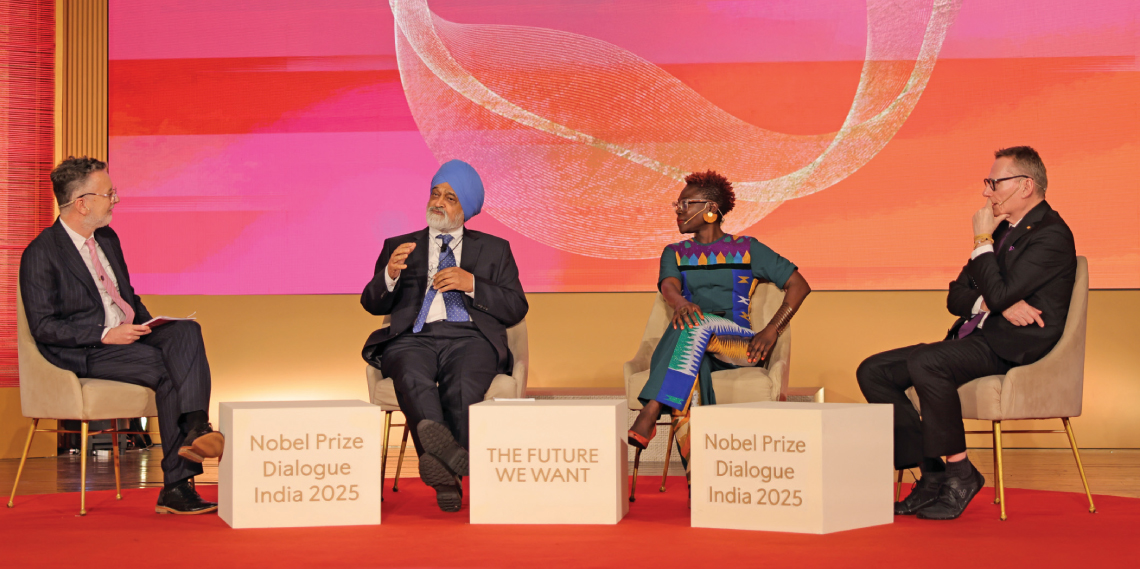
The theme — The Future We Want — set the tone at the recently concluded Nobel Prize Dialogue India 2025 for a distinguished panel of global thought leaders to explore how investments in knowledge, creativity and youth can make for a world more inclusive, sustainable and equitable.
Organised by the Tata Trusts in partnership with Nobel Prize Outreach as a double-header event — hosted in Bengaluru on November 3 and in Mumbai on November 5 — the Dialogue covered an extensive canvas, from society, science and economics to the challenges of climate change, healthcare and urbanisation.
The standouts in the collection of speakers were James Robinson, who shared the Nobel Prize for economic sciences in 2024, and David MacMillan, joint winner of the Nobel Prize for chemistry in 2021.
Joining them in conversations were Montek Singh Ahluwalia, former deputy chairman of the Planning Commission of India; physician-scientist Gagandeep Kang, a stalwart in the field of microbiology; Tolullah Oni, public health expert, urban epidemiologist and clinical professor with the University of Cambridge; Jayaram Chengalur, director of the Tata Institute of Fundamental Research; and Kush Parmar of 5AM Ventures, an investment firm that supports life science companies.
The Dialogue is a biannual affair held in two countries every year. This is the first time it has been staged in India and the response from those in attendance, at packed houses in both Bengaluru and Mumbai, reflected the enthusiasm with which it was received.
In his inaugural address at the Bengaluru edition of the event, Siddharth Sharma, chief executive of the Tata Trusts, articulated the possibilities that lay ahead for people everywhere. “The future envisages justice — social, economic, and political,” he said. “To achieve this, we must empower youth and create ecosystems fuelling innovation for those who need it most.”
The Dialogue featured presentations and panel discussions on two subject heads: ‘Institutions and cities: engines of human progress’, and ‘Next big thing — the science that will shape our future’. The first had presentations by Mr Robinson and Ms Oni, followed by a panel discussion where they were joined by Mr Ahluwalia and moderator Owen Gaffney from Nobel Prize Outreach.
Mr Robinson spoke about his sphere of expertise — the criticality of institutions and their impact on national prosperity — the fluid exchange of ideas that characterise the modern world, and the crisis of liberal democracy. Ms Oni explored the connection between health and urban infrastructure while explaining why she thinks hope, as opposed to wishful thinking, can be a driving force for change, and the logic of giving youth a chance to shape the future. The pragmatic Mr Ahluwalia, among the architects of India’s economic liberalisation of the early 1990s, dissected the complexity of tackling humankind’s multifaceted development challenges.
The ‘next big thing’ topic at the Dialogue saw Mr MacMillan and Ms Kang — the first Indian woman to be elected a fellow of the Royal Society, London — making presentations before being part of a panel discussion that also involved Mr Parmar and moderator Mr Chengalur.
Mr MacMillan illustrated the importance and the potential of organocatalysis, for work on which he shared the Nobel Prize, startling everyone with his contention that we are “one catalytic reaction away from solving climate change”. On his maiden visit to India, Mr MacMillian has clearly fallen in love with the country, its colours and cultures. “It’s been mind-blowing,” he said. “There’s a real sort of bubbling confidence and aspiration… It feels like this is India’s moment — and India knows it.”
Ms Kang highlighted the health threats that India faces in communicable and noncommunicable diseases and then went on to praise the country’s pioneering efforts in vaccine development and the production of generic drugs. Mr Parmar emphasised the benefits that innovative science and technology, particularly from an Indian perspective, can deliver to humanity and the planet.
Collaboration is the key in all of this, said Hanna Stjärne, executive director of the Nobel Foundation, in her address. “It has been truly inspiring to listen to and interact with students and experts,” she added. “By reflecting on common challenges, exchanging new ideas across boundaries and learning from one another, we create a dialogue that makes a difference.”