The call of chemistry
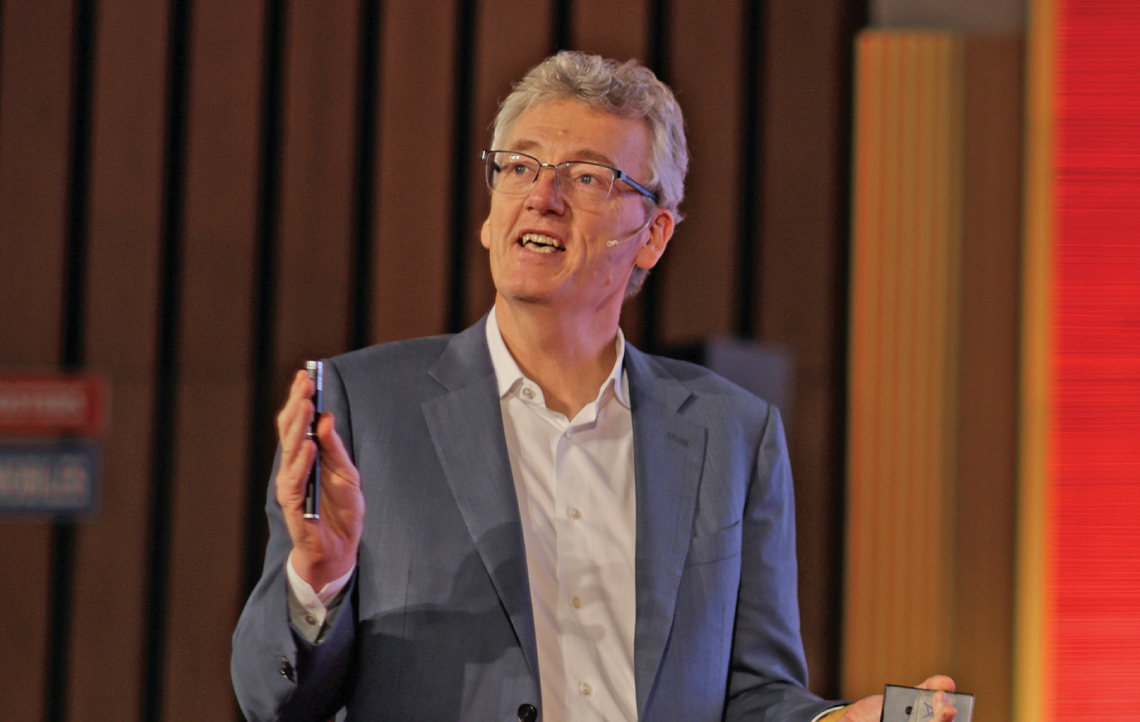
And so the story goes: David MacMillan was in bed when the call came through from the Royal Swedish Academy of Sciences informing him that he had won the Nobel Prize. He thought it was a prankster and went back to sleep. It was only later, when he read about it in The New York Times, that the reality of it sank in.
Scottish-born, settled in the United States and currently a professor at Princeton University, Mr MacMillan shared the 2021 Nobel Prize in chemistry with Benjamin List “for the development of asymmetric organocatalysis”. This is a kind of catalysis — a critical process in chemical reactions — that is less expensive, more environmentally friendly and with path-breaking applications in industries such as pharmaceuticals and energy.
The 57-year-old Mr MacMillan spoke to Christabelle Noronha on the sidelines of the recently concluded Nobel Prize Dialogue India 2025, hosted in partnership with the Tata Trusts in Bengaluru and Mumbai, about organocatalysis and its uses, India’s potential as a chemistry hub, and the need to support young scientific talent. Excerpts from the interview:
What is it about chemistry that got you interested in the subject?
When I was a child, it was always about the future and the idea that we could create the unknown. I went to university to study physics and I was terrible at it. Luckily, I had taken chemistry as a second course. This was organic chemistry — which people had told me would be very difficult — and I loved it. I had a one-hour train ride to university and every day I would sit and read the textbooks. It was like a revelation, so interesting and different from everything else I was studying. I always tell people that I did not find organic chemistry; organic chemistry found me.
You shared the 2021 Nobel Prize for developing organocatalysis, a novel and efficient method to build molecules. Pharmaceutical research was one sphere where this method was primed to have the biggest impact. Has that potential been realised?
I think so. It has become a concrete part of how pharmaceuticals are manufactured. Pharmaceutical companies are very clever; they will figure out the best way to make a drug, which is usually also the cheapest, has minimal environmental impact, and generates the least waste. Organocatalysis is very good in that context.
I have spoken about this molecule [that was used] for a migraine treatment. It was a molecule that Merck was working on as a cancer medication. It involved three catalytic reactions, one organocatalytic and two biocatalytic reactions, both environmentally friendly. The company is scaling these up right now.
When we teach the fundamentals, we make it dry and difficult instead of interesting enough to inspire young people, showing them there is chemistry in everything around them...”
Your work has enabled applications in what is called ‘green chemistry’. What exactly is green chemistry?
Green chemistry is a descriptor that came along in the 1990s, and different people have different ways of looking at it. In a general sense, it is the idea of using things that are better for the environment and more sustainable.
From my point of view, organocatalysis has lots of potential environmental benefits. As a young chemist, when I was performing experiments in the lab, I could not understand why we were not using organic molecules to do catalysis. It did not make sense, and that is why we became interested in doing it, because we could see the potential advantages. Does it come under the green chemistry canopy? It probably does, most of the time.
You have said that organocatalysis can help mitigate the damage caused by climate change.
Scientists and chemists are not great at communicating where we are, but we are actually one catalytic reaction away from solving the climate change crisis. When you say that, people get surprised and say, “That can’t be true.” But when you explain it to them, they understand and ask why it’s not happening already.
Scientists are working on it, but this is a difficult catalytic reaction to invent. People understand what the reactions are, and they know it is feasible. We even have proof of concept, but the problem is: how do you develop a catalyst that can work at scale and is both affordable and accessible?
What we need is lots of work, lots of research and validation, to make this catalytic reaction big enough so it helps solve this problem. While some governments, policymakers and administrations are getting behind this, many others are going in the opposite direction. It’s almost like the whole world is involved in a very slow car crash and everyone is either looking out of the rear window or sitting at the back playing a video game.

What about countries where scientific research and funding are on the upswing? What can India learn from them?
India is primed to do research that is going to benefit the country in productive ways. India has been incredible with respect to manufacturing and being the pharmacy of the world. Also, the country has a large and successful chemistry community. There is no reason why those same scientists and chemists cannot work on manufacturing and move into innovation.
That is going to need government support in spheres such as biotech. China made this leap and is now doing extraordinarily well in biotech. In my opinion, India can be as successful as China, if not more, but it will need government and regulatory support. Funding has been good in India and the government has been supportive, but you need to accelerate this.
You moved from Scotland to the United States to pursue postgraduate studies and then stayed on. What is it about America that makes it the chosen destination for scientific talent?
That is such a hard question. I grew up in Scotland. I lived in rainy Glasgow till I was 21 and then left for California to do my PhD. I arrived in California on a Tuesday evening when it was sunny and beautiful, and my world completely changed. I was a working-class kid and, all of a sudden, I was living in a Southern California apartment complex that had a jacuzzi, a swimming pool and tennis courts. My world was turned upside down.
There were other advantages as well, especially for a young person coming from the United Kingdom, which is quite hierarchical in terms of who can be successful. In the United States they don’t care whether you are Chinese, Indian or Scottish. What matters is how good you are. It is one of the reasons that drew me to the country.
I was able to go to America and get an incredible education, find academic jobs in the best schools, receive funds to put together a fantastic research group, and go on to win the Nobel Prize. Very few countries in the world provide the opportunity for all of this. Do I still feel that way about America? Despite the political situation, which I’m sure Americans will sort out, I do think it is an amazing country.
Students at the school level often complain about how complex chemistry is and are consequently indifferent to it. How can the understanding of, and about, chemistry be conveyed better?
This is a great question — and a real concern. My 20-year-old daughter is in college doing organic chemistry and she complains about it being tough. I think the way we teach it is not optimal; we can do a better job. Like other subjects and other types of chemistry, organic chemistry is still being taught the same way it was after the Second World War.
We have not progressed; we have forgotten how much chemistry and catalysis impact our world right now. When we teach the fundamentals, we make it dry and difficult instead of interesting enough to inspire young people, showing them there is chemistry in everything around them, from the phones that they use to the medicines they take.
It is just traditionalism, because in science we are always taught to be serious, to stick to the facts. But that is not the way the modern world works. I feel that improved communication and teaching could do a better job with chemistry education.
Everyone thinks that big ideas in science and chemistry require a lot of resources and infrastructure. That is just not true. Great concepts and ideas come from between your ears.”
The Tata group has been a steadfast supporter of research and learning. How best can philanthropies and other civil society institutions contribute to furthering the cause of science, particularly in developing countries?
The Tata group is pretty unique. If other organisations could think like that, it would be a huge step forward. If you ask an average person anywhere in the world if research is a good thing, they would agree. Then, if you tell them that in most countries research funding is drying up, they would also agree that that should not be the case.
But federal governments — including in the country where I live, the United States — are beginning to remove funding from the machinery of research. In that situation, organisations can play a bigger role in ensuring that funding for research in the world continues and moves forward.
What would be your counsel for young Indian scientists making their way in the world while also seeking research breakthroughs and discoveries?
I visited the Tata Institute of Fundamental Research while in Mumbai and I was really impressed by the energy, enthusiasm and passion of the young scientists there. I don’t know if I would give them any counsel; sometimes the last thing you need is for an older person to tell a younger person what to do.
I have a research group of 45 people and I’m often asked how I manage it. I say, “Badly.” One of my main jobs is to get out of the way of young people who are doing things that are exciting and different.
The only counsel I would give is to say that it is important to believe in what you are doing, even when everyone tells you it is not.

You have been quoted as saying that great things can be achieved in chemistry without large amounts of money or equipment.
Everyone thinks that big ideas in science and chemistry require a lot of resources and infrastructure, and that is just not true. Great concepts and ideas come from between your ears. We won the Nobel Prize for a chemical reaction that cost about 3 cents to perform. Anybody in the world could have performed that experiment in any country in the world. Having lots of money does help, but I do think that some of the best ideas are elegant, simple and far from obvious.
How are the evolving tools of technology, particularly in the context of AI, enhancing research in chemistry?
AI in chemistry is being used to optimise things, to try and understand how to make chemical reactions better. Perhaps your reaction is working a little but you can use AI to rapidly find out how to make it work really well. That is very useful.
The problem is that AI does not invent new reactions, and it’s not clear if it could anytime soon. For the moment, we need plenty of creative people — young people particularly — to get involved with invention. An invention is usually an idea not based upon any information you have had previously; it is just an idea that comes from a different direction.
I do believe that invention is where organic chemistry will still be the domain of humans, but I could be wrong.
Is it true that when you heard of your Nobel Prize win, you thought the caller was a prankster? How has winning the Nobel changed your life?
Yes, I thought it was a prank call and went back to sleep. The prize has changed my life in so many ways. I had heard that from other people before and used to think it was ridiculous, but nothing has been truer.
The Nobel changes your life in unimaginable ways. I am sitting in Mumbai doing this interview after four of the most amazing days of my life. And this is all because of the Nobel. There are so many aspects of my life now that allow me opportunities and the privilege of doing things I could not have done previously. It has been remarkable.
‘The Future We Want’ is the theme of the Nobel Prize Dialogue. What is your wish for the future of humankind and our world?
My wish for the future is what most people want if they come from a reasonably equitable country. Number one is empathy; people need to care about one another. I am in a privileged situation, but you have to care about people who are not as privileged for whatever reason.
I think equity is really important. If AI could be used to achieve that, it would be spectacular. Most of us come from cultures where respect for our elders is important. I want the world to hold onto that. Respect for people is what allows civilisation to work.