‘There is no such thing as a perfect society’
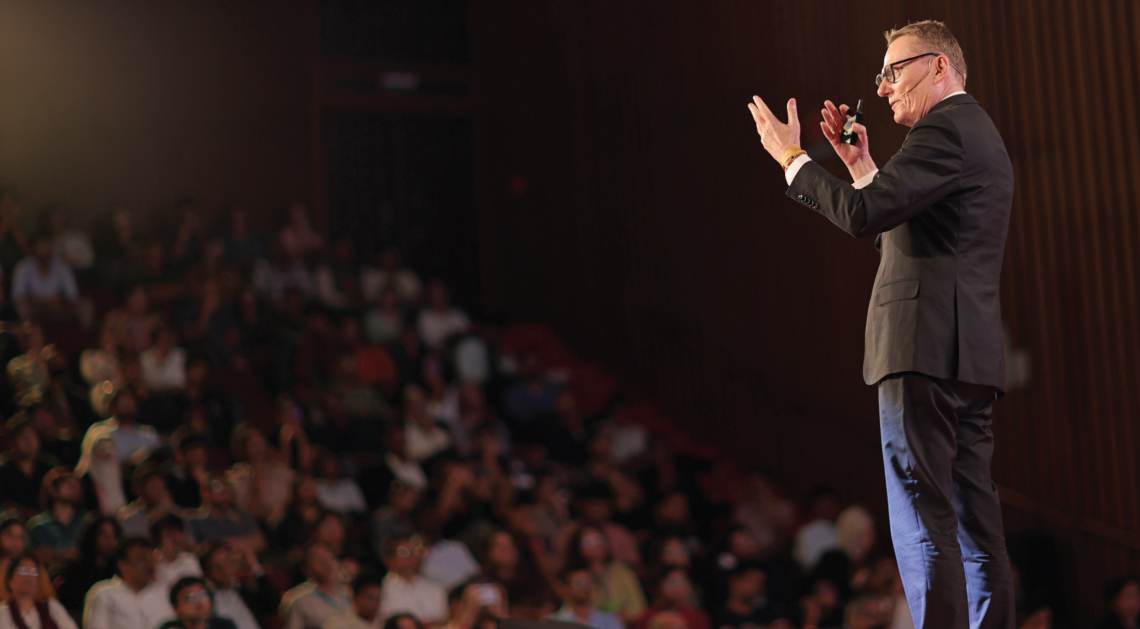
“I am not even sure that I’m an economist,” says James Robinson with the flourish you would expect of a Nobel laureate. ‘Social scientist’ is more to the liking of the 65-year-old Mr Robinson, who shared the 2024 Nobel Prize in economic sciences with Daron Acemoglu and Simon Johnson for their research on the relationship between inclusive institutions and national prosperity.
An alumnus of the London School of Economics and Yale University and currently a professor at the University of Chicago, the British-American Mr Robinson is also the coauthor, with Mr Acemoglu, of the well-received Why Nations Fail and The Narrow Corridor, both of which explore concepts that have shaped societies for good and bad.
One of the featured speakers at the recently concluded Nobel Prize Dialogue India 2025, hosted in partnership with the Tata Trusts in Bengaluru and Mumbai, Mr Robinson speaks here with Philip Chacko about his work and how it explains the modern world. Excerpts from the interview:
You shared the Nobel Prize in economic sciences for your research on the correlation between state institutions and national prosperity. What are the lessons here for a country such as India?
Economic growth is associated with inclusive institutions that create broad-based patterns of incentives and opportunities. What guarantees that is, in some sense, inclusive political institutions. The most obvious challenge in India is that you have had a caste system. This has been a fundamental barrier to inclusion, in the economic sphere, in the social sphere and in the political dynamics of the country.
What we emphasise a lot [in our work] is the role of innovation and ideas. Where do innovation and ideas come from in society? They come from the creativity, energy and inspirations of people. If you have a system where people are locked into a particular profession because they are born into a particular jati [subcaste], then that’s an enormous impediment to innovation and the efficient allocation of resources. That’s exactly what Mr [Bhimrao] Ambedkar talked about.
‘The Future We Want’, the theme of the Nobel Prize Dialogue, is about crafting a world that’s more inclusive, sustainable and equitable. What are the essentials that need to be in place for that to happen?
Our work is about politics; it is about whether society is inclusive or not. That is not something that geography determines; it is something that humans themselves decide to do: how they construct their institutions and their society.
What would tend to give you an inclusive society? History does not suggest you can get an inclusive economy on the whim of a narrow elite or when you have power concentrated. Power has to be broadly distributed and the state has to be effective enough.
History does not suggest you can get an inclusive economy on the whim of a narrow elite or when you have power concentrated.”
In this context, how do you explain what China has achieved?
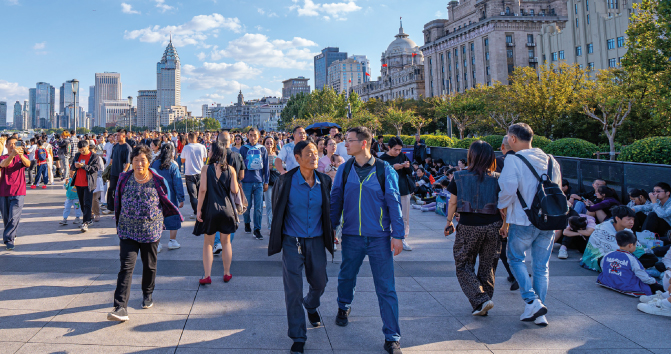
China works and it does not work. The transition to economic growth in China, which happened after 1978, was a transition to more inclusive economic institutions and the dismantling of the socialist economy. If you look at the first wave of innovation in agriculture and the household responsibility system, it was about allowing people to make a residual claim from their efforts.
That is one of the basic ideas of economics: to create incentives. So the Chinese economy becomes much more inclusive and that’s what creates this rapid economic growth. But the political system stays extractive and, yes, the state is powerful, but that is part of what you need to stay inclusive.
There is no precedent in world history of a country with the kind of personalistic dictatorship you have in China becoming economically successful. But there are many examples in history of what we call extractive economic growth, where you may be at the right place at the right time, sitting on some natural resource base or whatever (think about the absolutist monarchies in the Persian Gulf).
Our prediction is that China does not have an enduring model of how to become a wealthy, prosperous country. I cannot predict, though, how it will go into reverse.
“Development differences across countries are exclusively due to differences in political and economic institutions…,” you and Mr Acemoglu have argued. How has that conclusion gone down with economists and policymakers?
A lot of our work is about politics and the problem of poverty. And it is about the perverse political incentives that keep countries poor; this is not a technological problem. That is a difficult story to tell policymakers. I don’t really engage very much with policymakers. I am an academic and my view of the world is complex. I don’t judge the success or failure of my ideas based on whether they transform politics or policy.
What we in the social sciences do is revive some simple ideas that will allow people to see what many countries have in common. For instance, we examine different countries — North Korea, Uzbekistan, Sierra Leone, Colombia… — these countries are different in many ways but here is what they have in common: they are all poor and they are all poor because they have extractive institutions.
The policy advice you may give to Uzbekistan will be very different from the policy advice you give to Colombia or to India. Our theory does not lend itself to a simple way of talking about policy. I can talk about inclusion — great, but how do you actually make a society more inclusive? It is about the details, the details of the institutions and the political incentives. You have to immerse yourself in these details, but I am only an academic; I teach students.
How can ordinary citizens help in making institutions stronger, particularly in the face of powerful political interests that prevent that from materialising?
I think it’s about what it is that creates a transition from extractive to inclusive institutions. Take the example of Taiwan, where the Kuomintang government decided to open up the system and make society more inclusive. It was the country’s elite doing that, being forced to do it because of the geopolitical situation, the threat from China and the desperate need for support from the West and the United States.
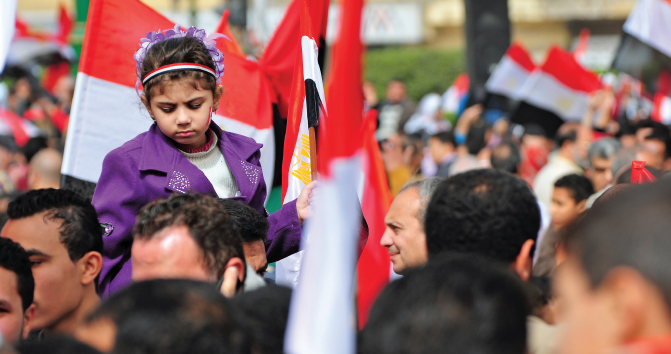
These transitions towards more inclusive institutions are mostly driven by society, by the collective action of the people who suffer. At the beginning of our book, Why Nations Fail, we write about the Arab Spring, which was about people protesting against extractive institutions and trying to make society more inclusive. That example, in itself, shows how difficult it is because in not one of those Arab societies was there a successful transition towards an inclusive society.
There are always incentives to try to make the system more extractive, but if we look at the world over the last 100 years, it is now more inclusive than before. The idea of human rights, the liberation of women, the rights of homosexuals — it seems to me that the big picture is one of spreading inclusiveness and prosperity.
You and Mr Acemoglu also write that a free society is attained when the power of the state and of society have evolved in equal measure. How can that be made possible in a country of diverse ideologies and fragile systems?
It is difficult. I work in Africa a lot and many social scientists say that the continent is so diverse ethnically that you cannot really have people cooperating to make the state work in the collective interest. But then, people have multiple identities; the notion that you have just one identity is fallacious.
You can build identities, you can create new ones, and you can find ways of bringing people together. That is part of the political project to build an inclusive society, which is essentially about finding identities or issues that bring people together and give them something in common.
The development challenges confronting nation-states emerging from colonialism have led them to make “mistakes” consciously, you have said. Could that have been avoided?
Well, I don’t know; I think we said that to be provocative. But it remains that institutions have been constructed to guarantee that a country will remain poor. Think about North Korea — they chose poverty there because that’s the way the communist party runs and controls society, ensuring that most people will have no incentives and no opportunities. You can never have any success when a society is organised so, and that suits the people running the country because it perpetuates their power.
But there are exceptions, India under Jawaharlal Nehru and Tanzania under Julius Nyerere being standouts. These were genuine attempts to build inclusive societies, to move on from the past and from colonialism. Having said that, the political problems that colonialism left behind were very difficult to solve. Some did, like Botswana in Africa; others could not, leading to economic decline and military regimes. In Tanzania itself, Nyerere’s party has degenerated into a repressive kleptocracy.
The United Kingdom’s role as a colonising power in India is contentious, to say the least. How can these two countries come to terms with their past?
The history of the world is very messy and very complicated; there are no good guys and bad guys. How you move forward from that, while kind of recognising the responsibility of colonial powers, is what counts.
India is a big player in the world. The United Kingdom is not, although it thinks it is. The future belongs to India, so I don’t think Indians should care much about the British. Honestly, I think the world is going to be dominated in the future by India and China, and possibly the United States, depending on what happens in the next decade.
You have drawn upon fieldwork in many different countries for your research. Which memories stay in your mind of discoveries made along the way?
The history of the world is very messy and very complicated; there are no good guys and bad guys. How you move forward from that... is what counts.”
Well, many, many; I don’t know where to start. It is simultaneously about all the pat ideas I had, which I realised were quite ridiculous once I started talking to people and going to places. It made me realise how terrible these ideas were, but then you also got some amazing ideas and hypotheses.
When I was an economist it was all about mathematics, writing papers and things like that. I felt life is too short for that. You are trying to understand what goes on in the world. I found that everywhere is fascinating.
I have been working in Eastern Nigeria for the past six years and I find the region amazing. Eastern Nigeria was never unified politically; every village is sort of independent and so you have this staggering variation in culture and institutions from village to village. I am passionate about Colombia as well. I worked there for 30 years and my wife is Colombian.
You spoke in your presentation [at the Nobel Prize Dialogue] about the world being at an inflection point, about the crisis of liberal society. What could emerge from this?
I don’t know, really. Something much worse could happen or something much better. There is no such thing as a perfect society. The evidence from the last 150 years, however, shows that liberalism is capable of reinventing itself for the better. That’s what happened in the United States in the late 19th century with the robber barons, with Franklin Roosevelt and the emergence of the welfare state, and with the birthing of social democracy in Sweden in the 1930s.
Human beings are very good at rationalising hierarchy. What I see at the moment is the extraordinary rapidity with which people rationalise more hierarchical relationships and a more autocratic way of making decisions. People will adapt to that like chickens with their pecking order.
My personal opinion as a social scientist is that there is no end to history. Human society oscillates between different models; there is no reason to believe that it couldn’t happen again. If you can clarify that, it shows what the stakes are to recreate a more egalitarian society.
Homo sapiens originated in East Africa and spread all over the world, and they created these incredibly different societies, cultures, technologies, etc. I feel optimistic about the future because we, as human beings, have created all this stuff out of nothing.
Economics has been called the dismal science. You surely think otherwise, or do you?
I am not even sure that I am an economist; I have not had a position as an economist in the last 26 years. I left economics and took a job in political science because, for me, it was more freeing intellectually.
I know we got the Nobel prize for economics, but the work for which we got it is about institutions, about politics, and it rests heavily on anthropology. Our work is interdisciplinary. I reckon that the best thing about the recognition is that it is a prize for the social sciences going forward.