
Where research is the centrepiece
The trailblazing Tata-Indian Institute of Science Postgraduate Medical School, and the Bagchi-Parthasarathy Hospital embedded within it, is primed to transform healthcare in the country
There’s much about the Indian Institute of Science (IISc) that sets it apart, the rarefied air of its Bengaluru campus a reminder of all that the country’s leading centre for learning and research has going for itself: a singular heritage, the brightest of scholars, sustained excellence and alumni with outstanding accomplishments. And that air is poised to get more rarefied still.
The upcoming Tata-IISc Postgraduate Medical School, with the attached Bagchi-Parthasarathy Hospital, is a path-breaking undertaking that aims to provide a platform for cutting-edge clinical research and the indigenous development of medical technologies.
Affordable and high-quality healthcare is at the heart of an endeavour primed to foster interdisciplinary research, seed a new generation of physician-scientists, and enable collaborations between the medtech industry and startups.
It may seem like a lot for a newly minted institution, but this is no ordinary enterprise. The first of its kind in the country, the School is a transformative effort to blend complementary elements, fuel a confluence of basic sciences, engineering and medicine under one roof, and drive research and innovation in healthcare.
Spread over 1.5 million square feet and estimated to cost about ₹13 billion (1,300 crore) when completed, the School has plenty of goodwill and well-wishers on its side. The Tatas have been steadfast supporters, with a clutch of group entities contributing to the cause: the Tata Trusts, Tata Consultancy Services, Tata Steel, Tata Sons, Indian Hotels and Tata Capital. The Hospital project has been funded by the families of Subroto Bagchi and NS Parthasarathy, cofounders of infotech company Mindtree.
The 832-bed Bagchi-Parthasarathy Hospital is expected to be fully functional by July 2026. It’s in the order of things that this precedes the commencement of academic programmes at the School, which is slated to start accepting doctorate students in July 2027, with the year’s gap essential for the necessary patient population to add up. The intent is to have an annual intake of about 35 students in the initial years before raising the number to 75.
The brainchild of IISc’s director, Govindan Rangarajan, and his colleagues, the idea of the School was sparked by the Covid pandemic, a dark period during which India had to grapple with shortages of medicines, vaccines, oxygen and more. The project proper kicked off in 2022, with the two years leading up to it cementing the essentials of what it would take to create an institution for the present and the future, serving the national interest and plugging a gap that has long compromised India’s healthcare ecosystem.
“There’s this brick wall staring at us,” says Navakanta Bhat, dean, division of interdisciplinary sciences at IISc. “We have excellent hospitals and our medical institutes train doctors to become very good clinicians, but we do not have an adequate cadre of clinical researchers or healthcare innovators crafting new solutions. The School is a response to that.”
Mr Bhat adds that the School is a natural progression for IISc given its legacy, its nation-building character and its prowess in science and engineering research. “Interdisciplinary collaborations are what we are after because innovations and discoveries happen at the intersection of different disciplines. We figured that if anybody can pull this off, it is IISc.”
It was clear from the off to the folks at IISc that the School would be for postgraduate studies only. “We do not want to start an MBBS programme because our focus is on clinical research, just as in engineering and the sciences,” explains Mr Bhat. “We have always been known as a postgraduate research institute and we have a history of collaborating with clinicians.”
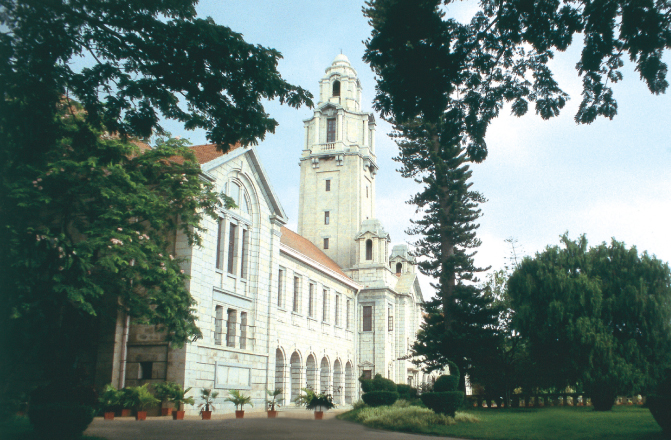
A legacy that endures
T he Indian Institute of Science (IISc) was born of Jamsetji Tata’s belief that for India to climb out of poverty, its finest minds would have to be harnessed.
The founder of the Tata group pledged ₹3 million — half his personal fortune — to set up IISc, drew up a blueprint of the shape it ought to take, and solicited the support of everyone from the then viceroy of colonial India, Lord Curzon, to Swami Vivekananda to turn his vision into reality.
Aided by the generous donation of a 371-acre land parcel by the rulers of Mysore State, IISc came into existence in 1919, five years after Jamsetji Tata’s passing. The institution has fulfilled its promise in full in the time since, becoming the foremost source of engineering and technological excellence in the country while nurturing the talent of scientists such as Nobel laureate CV Raman, Homi Bhabha, Vikram Sarabhai and CNR Rao.
“What advances a nation or community is not so much to prop up its weakest and the most helpless, as to lift the best and most gifted, so as to make them of the greatest service to the country,” said Jamsetji Tata. IISc is an illustrious example of how that can be accomplished. It helped in the creation of other scientific institutions and organisations in India, including the Tata Institute of Fundamental Research and the Atomic Energy Commission.
The Tata legacy continues to burn bright at IISc, the upcoming postgraduate medical school being the latest example.
Questions aplenty
The question was, how does an institution with no experience of a medical school or a hospital go about building both from scratch? With precious little in India to base its concept on, IISc had to look elsewhere for a blueprint. That meant similar setups across the world, university hospitals such as Stanford Medicine, Harvard Medical School and Johns Hopkins University School of Medicine among them. “These are all hospitals embedded in interdisciplinary universities, with research labs where faculty and students can pursue clinical research,” says Mr Bhat.
From drawing board to design and construction, a host of points had to be clarified. What sort of specialties does a postgraduate programme require? What about research equipment? And, importantly, how can the facility be customised for the Indian context? IISc has found the answers to these and other matters while executing its plans for the School with precision, in no small measure thanks to its credentials, capabilities and commitment.
The academic centrepiece of the School will be an integrated dual-degree MD-PhD (doctor of medicine-doctor of philosophy) programme that combines two learning streams. The other dual-degree programme is MD-MPH (doctor of medicine-master of public health) and MD-MTech (doctor of medicine-master of technology).
The objective is to educate a new breed of physician-scientists and medical technologists in battling the ill-health that India is burdened with: infectious diseases such as tuberculosis and malaria and noncommunicable diseases like diabetes and hypertension. The broader objective is for the School to serve as an exemplar that can be replicated in the country.
The imperative is to equip India to cope better with its public health challenges. That cannot happen in an environment where research output in healthcare is dismally low. The Western world, for its part, pushes mostly for innovations that apply to its populace, or those that can be seriously monetised. In the circumstances, the onus is on India to work on discoveries for its — and the developing world’s — problems.
“We have India-specific issues, tuberculosis, for instance. I don’t think the West is too interested in tuberculosis; it’s up to us to find solutions,” says PS Anil Kumar, dean, administration and finance, at IISc. “Then there’s affordable healthcare, which is a worldwide concern. A medical school with clinical research competencies can be a big help in tackling such issues.”
Affordability and quality of care have been key factors in the shaping of the Bagchi-Parthasarathy Hospital. There will be a roughly 50-50 split in patients receiving treatment free of cost and those who pay — though much less than corporate hospital rates — to fashion a self-sustaining model.
“Diagnosis and therapy will be common for both sets of patients, which means the quality of care will be the same, but one group will subsidise the other,” says Mr Bhat. “Crucially, patient hospitality will be the cornerstone of the hospital. We are putting together the best of digital and communication technologies to ensure that patients are well-informed about their care and treatment; they will be part of the decision-making process.”
IISc’s medical school-hospital prototype will surely translate into Indian clinical researchers no longer having to feed on morsels, and there are a bunch of additional benefits on the horizon: public health initiatives, citizen-centred healthcare delivery models, vaccine development, AI-enabled healthcare, precision medicine, health data science and analytics, and, far from least, integrative medicine that draws on traditional systems such as Ayurveda.
Integrated approach
“We are keen to integrate traditional knowledge systems with modern science and come up with healthcare solutions that are uniquely Indian,” adds Mr Bhat, who is just as keen on the inventive and the original. “We want India to go beyond being a manufacturer of generic medicine. We want the next blockbuster drug and the next breakthrough medical equipment to be made in the country. That’s the reason for developing a startup incubator in the School.”
“Our intent is to marry science and medicine, to build bridges between our faculty in engineering, chemistry and physics and bring a multidisciplinary approach to research problems that originate in a clinician’s mind,” says Usha Vijayraghavan, dean, division of biological sciences at IISc. “That’s an ecosystem you will not find anywhere in India as of now.”