Advantage artisans
Antaran is building a sustainable ecosystem for handloom weavers by combining tradition, enterprise and high-end technology to enhance authenticity and value
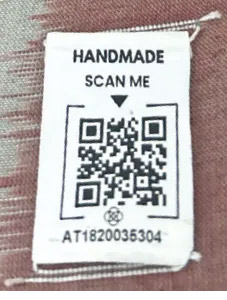
It seems incongruous to see a QR code on fabric woven with a handloom in one of India’s remote villages. This digital identifier is adding authenticity to the craft of India’s traditional handloom weavers, helping artisans like Sudhanshu Mohan Das build their business.
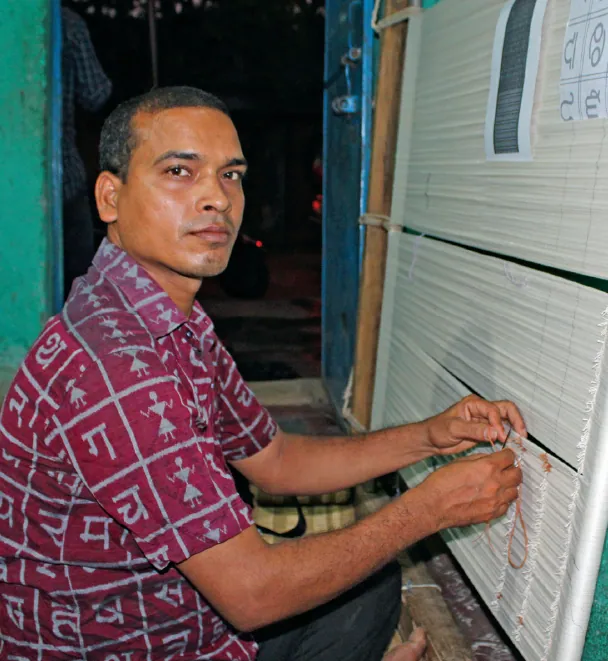
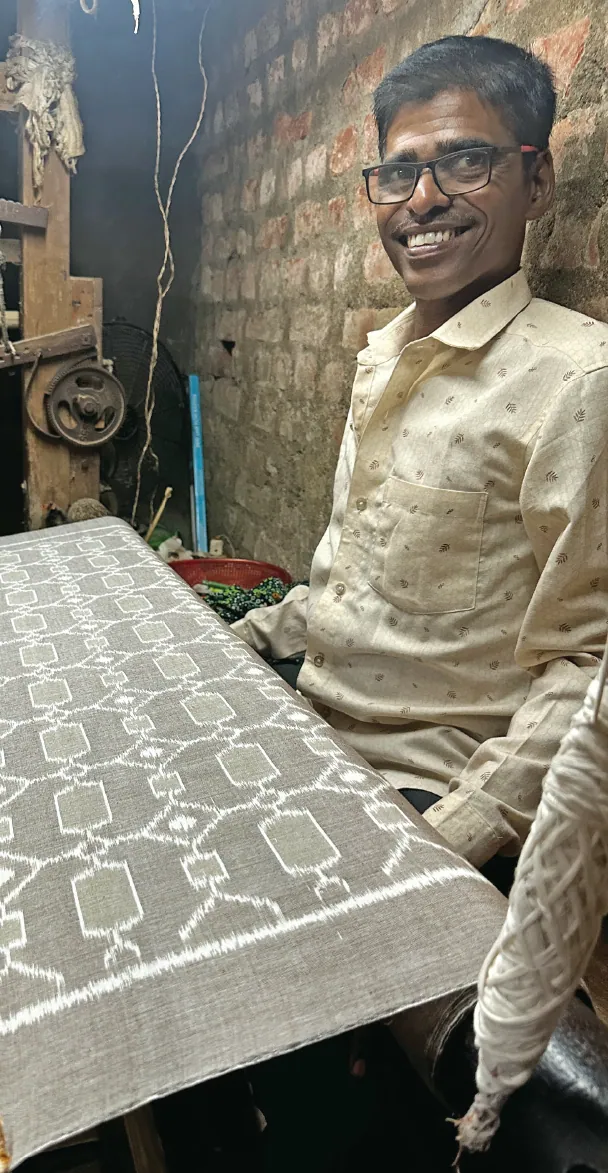
Mr Das, who hails from Maniabandha in Odisha’s Cuttack district, is a master of the single-weft Ikat technique, a weave specific to handlooms and not easy to replicate on power looms. Lending Mr Das and his compatriots a hand is Antaran, the crafts-themed livelihoods programme of the Tata Trusts.
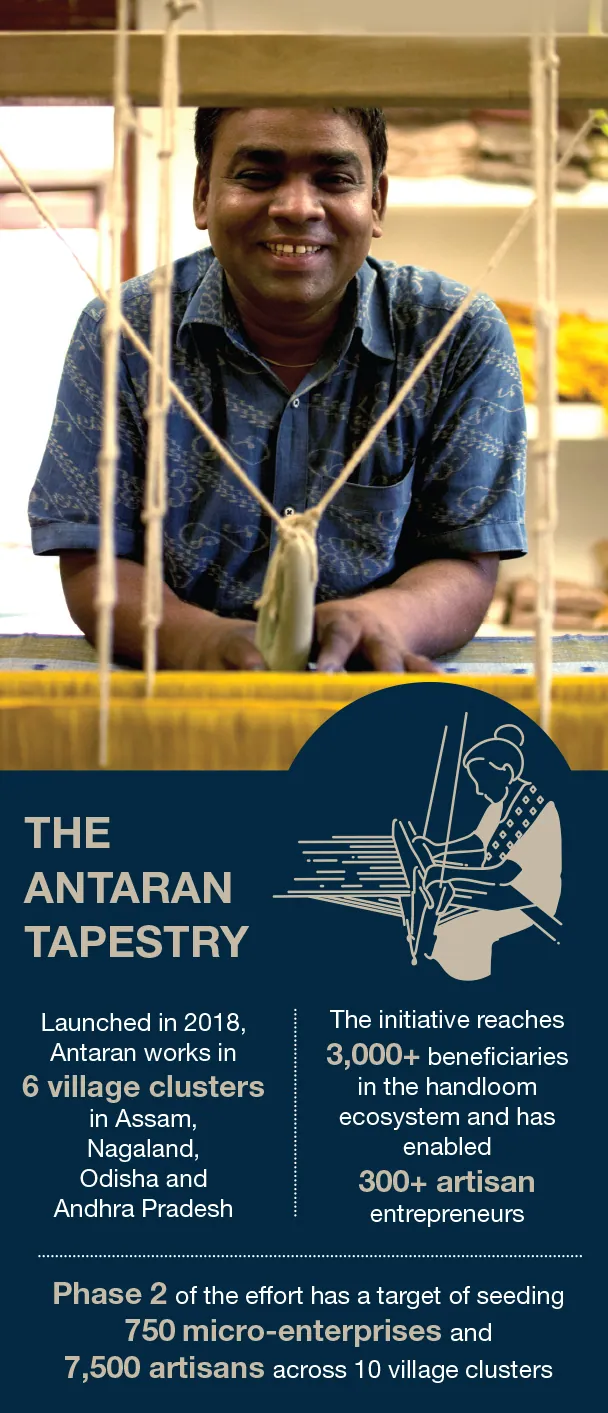
Launched in 2018, Antaran enables and encourages artisans to become entrepreneurs, providing them with the tools and the technology to reach far-flung markets.
The initiative covers six handloom clusters across nearly 250 villages in four states, benefiting more than 3,000 artisans, in its first phase, through capacity building and ecosystem development interventions delivered through incubation and design centres in each cluster. The ongoing second phase aims to reach 7,500 artisans across 10 clusters through a similar approach.
Assam’s Eri silk, Nagaland’s loin-loom weaves, Odisha’s Tussars and Maniabandha Ikats, and Andhra Pradesh’s Venkatgiri silks and Kalamkari hand-painted sarees are among the exquisite fabrics that these artisans fashion, and they have Antaran to bank on to keep their pre-loom, on-loom and post-loom processes in fine fettle.
Digital marketing provides an example of how Antaran has rejigged the field for those in the programme. Mr Das uses Instagram to draw customers to his traditional Nuapatna weft Ikat silk sarees. “The Antaran sessions taught me to photograph my products in different ways to make my sarees stand out,” he says.
Antaran has paid particular attention to the entrepreneurship component in the programme, the objective being to groom 750 artisan-entrepreneurs. Its team works on aspects such as design support, market linkages and business education, while strengthening the craft ecosystems to support artisans in navigating the modern marketplace.
The Hyderabad-based International School of Business and the Indian Institute of Technology, Guwahati, were roped in to fine-tune educational inputs for Antaran’s grassroots entrepreneurship development model. Improving incomes, driven by artisan-led enterprises and creativity, is the goal of the model.
A device that makes sense
Kosha, the Bengaluru-based startup behind the traceability solution used for this pilot project, works with more than 1,100 artisan-weavers and some 150 buyer brands.
Kosha uses an IoT-enabled device called WeaveSENSE to map the process and more behind the creations of its artisan-weavers. The device tracks the motion of the handloom and its signals are then processed to identify various underlying signatures, including productivity and point of origin.
This captured data is integrated into a QR label (called WeaveProtect) that can be embedded into a fabric at the time of weaving. “The WeaveSENSE technology uses a combination of sensor-based IoT, cloud computing and decision models to achieve its functionality,” says Vijaya Krishnappa, cofounder of Kosha. The organisation also has another technology, FibreSENSE, which helps weavers source authentic raw material.
Kosha has been collaborating with Antaran to solve operational challenges. To address trackability in long rolls of fabric, where a single label may not work, QR tags are attached at predetermined intervals along the fabric.
The cost benefits of the IoT technology, especially from a weaver’s point of view, are another issue that the project has addressed. For example, the IoT sensor initially came with a rechargeable battery that increased the device’s cost significantly.
“We reengineered the entire hardware and software to run on simple coin-cell batteries that weavers could easily afford,” says Mr Krishnappa. “Also, the platform subscription has been amended such that there is no fixed cost to weavers; they pay per label.”
For Kosha, the uphill task has been to demonstrate the need for this tech adoption. “Large brands and players still sell handloom and power-loom products together without differentiation, and they are hesitant to certify the authenticity of their products,” adds Mr Krishnappa. “For pure handloom brands or artisans, however, this is a brand differentiator. We have seen a high rate of adoption when the buyer brand mandates that weavers use them.”
Kosha believes its technology for authentication and traceability solutions can help the handloom sector better position its premium products. With changing customer buying dynamics and a shift towards more environmentally conscious consumption choices, authentication may be the tipping factor for the handloom sector to grow in the coming days.
Income boost
Before the Antaran intervention, weavers in the initiative tended to work for local traders, earning an average of about ₹70,000 a year. Today, these weavers engage directly with buyers across the country, with premium retail brands such as Taneira, Nalli Silks, Reliance Swadesh, Taj Khazana, Fabindia, and iTokri, and leading designers as well, enabling stronger market linkages and greater value realisation.
Up to 80% of the artisans’ products goes to institutional business-to-business buyers — and this pays for enhancing crafts-based livelihoods. Today, Antaran’s weaver-turned-entrepreneurs manage their own teams and clock an average revenue of ₹1.16 million a year.
Antaran’s latest phase is all about building a sustainable, sector-wide ecosystem with a wider base of weavers, the goal being to nurture 750 micro-enterprises and directly impact the lives of 7,500-plus artisans across 10 clusters.
Antaran has started showcasing products from these at clusters at leading trade platforms like Bharat Tex, India’s largest textile trade fair, and seeding collaborative entrepreneurship models alongside individual artisan-owned organisations, on the lines of farmer-producer companies.
“Invigorating traditional crafts and restoring their relevance was only the first step,” says Pankaj Shah, mentor to the Antaran programme. “The larger vision is to transform the handloom sector by nurturing artisan-entrepreneurs and enabling creative artisans to build sustainable enterprises.
“Traditional techniques need to find new relevance in contemporary markets while retaining the integrity of the craft, enhancing their value and economic viability, so that the knowledge and creativity behind them are recognised.”
Art is about authenticity and that’s where the IoT-based QR coding project comes in. This is an Antaran pilot for loom-based tracking so that buyers can trace the fabric back to the artist. The tech partner is Kosha, a Bengaluru-based startup that uses patented IoT (internet of things) and AI technology for supply-chain transparency and authentication of handmade textile products.
The authenticity factor is crucial. India’s handloom sector has taken a hit on the credibility front due to a trust deficit: dupes sold as ‘genuine’ handmade textiles, power loom knockoffs, quality issues, etc.
Struggling to survive
“India’s weavers have been struggling to survive with their hand-woven craft,” explains Mr Shah. “A lot of handloom techniques have been copied on power looms, and this has been one of the biggest challenges that weavers have faced in the last seven-eight decades.”
In the collaboration with Kosha for IoT tagging, a sensor-activated device is embedded in the loom (this tracks who has woven it and when). The end product gets a tamper-proof label with a QR code that is woven into the fabric. Customers are not only privy to the individuals behind their fabrics, but also to the process.
The IoT project was piloted across three handloom clusters, Maniabandha (Ikat) and Gopalpur (Tussar) in Odisha and Venkatagiri (fine cotton, silk) in Andhra Pradesh. Technology benefits only if weavers see a bottom-line impact, and that is what Kosha has delivered. “The price difference between genuine and fake handloom products can be anywhere between 50% and 100% of the product cost,” says Vijaya Krishnappa, Kosha’s cofounder. “With this project, weavers are seeing an increase in demand and sales.”
The Antaran effort is unique for two reasons: artisans are trained to become entrepreneurs who have their own brands, and they operate the technology themselves. “The IoT tagging gives producers a greater sense of ownership in incorporating authenticity credentials into their products,” adds Mr Krishnappa.
While the IoT tagging is a path-breaker, there is a larger objective here. According to Mr Shah, the future of genuine handloom products is going to be about verifiability and traceability. With Western markets becoming more sensitive to source traceability and carbon footprints, a product’s development must be completely transparent. A verifiably low carbon footprint gives early tech adopters in the handloom sector an edge over competitors.
Antaran believes the handloom sector can benefit from adopting the ‘digital product passport’ concept, giving every handloom product a unique digital identity embedded via a code or chip.
This provides traceability, documenting the origin and type of raw materials used, details about the weaver, dyer and finisher, the processes used, blockchain-verified authenticity, and essential warranty and care instructions.
“If we start to explore global markets for our products, we need to be prepared for compliance,” says Mr Shah. For artisans like Mr Das, that means using technology to market the singularity of his products and the sustainable production methods that go into their making.
Challenges aplenty
Practical, technical and market challenges remain. For instance, a standard warp length is about 60 metres; a single tag at the beginning of a roll will be lost once the fabric is cut into pieces for individual garments. Finding a tamper-proof way to weave tags at regular intervals without disrupting the fabric’s aesthetic is difficult.
Too much transparency can also be an issue. While direct-to-consumer buyers prefer the appeal of artisan stories, business-to-business buyers often hesitate to disclose their sourcing supply chains. Another wrinkle: artisans fear that posting their work on social media will lead to their designs being copied.
“A significant barrier in online marketing is the apprehension of plagiarism,” says Anwesha Mohapatra, a programme officer working with the Maniabandha cluster. “Artisans view their creations as unique art. They know that inferior copies of their work will negatively impact the valuation of their authentic products.”
That leaves modern marketplaces as a reality to be navigated. Artisans, equipped with smartphones, IoT sensors, and a direct line to their customers, will be able to get more visibility for their craft and, ultimately, a fairer price for their work.
Mr Das is happy that his craft is reaching a wider audience via his Instagram profile. “A customer from Pune who had purchased two sarees from me was so happy that she sent me a handwritten note complimenting my work, along with a box of chocolates,” he recalls.
Stories of this kind validate what the Tata Trusts are seeking to do with Antaran. “There is a difference between wage-earners and kalakaars,” says Parwez Alam, who leads Antaran. “We are trying to, along every step of the way, bring back that kalakaar into the picture.”