Support and solace for those locked up
A long-running collaborative programme has been a boon and a balm for inmates in Maharashtra’s prison system
When Raghav Shankar arrived at Thane Central Prison in Maharashtra 10 years ago, he was a healthy, self-assured man with a thriving business. Charged with murdering his wife of 20 years — Mr Shankar claims he was framed — incarceration has broken his back and his spirit.
Now 72, Mr Shankar has a permanent hobble, diabetes, prostate problems and very few teeth. His two children abandoned him years ago, and with no family to speak of, where will he go after his release? “I’ll live on the streets if necessary,” he says, tearfully. “But if I don’t get bail [pending his appeal], I will die in here.”
Mr Shankar is a convict, with an appeal against his conviction pending in the High Court, and in that sense he is an undertrial — a term with a particularly subcontinental connotation — which means he is imprisoned in limbo as his case winds its way through India’s criminal justice system.
Raju Yadav, a 38-year-old migrant worker from Bihar, is also an undertrial, and he has a stranger story to tell. Mr Yadav did manage to get out of jail, but he fell victim to an administrative error.
Mr Yadav had moved to Punjab 12 years ago to work as a farmhand, taking his family along. In 2016, he was arrested for killing a coworker in an altercation. During the Covid pandemic, he was granted a furlough and asked to report back after 45 days. When he did so at the local police station, they turned him away, saying it was not yet time. The police had miscalculated.
Mr Yadav’s furlough was indeed up and soon a team from Mumbai arrived in Punjab to bring him back. “I could have easily run away and disappeared, but I didn’t do that,” says Mr Yadav. “I want a fair trial. But now, thanks to a police mix-up, I’m viewed as a jailbreaker. This will definitely affect my chances of release.”
Mr Shankar and Mr Yadav are victims of a system that is caving in under its own weight, being punished on account of delays by the courts. “I have served more than my time,” says a bitter Mr Yadav. “Why am I still here?”
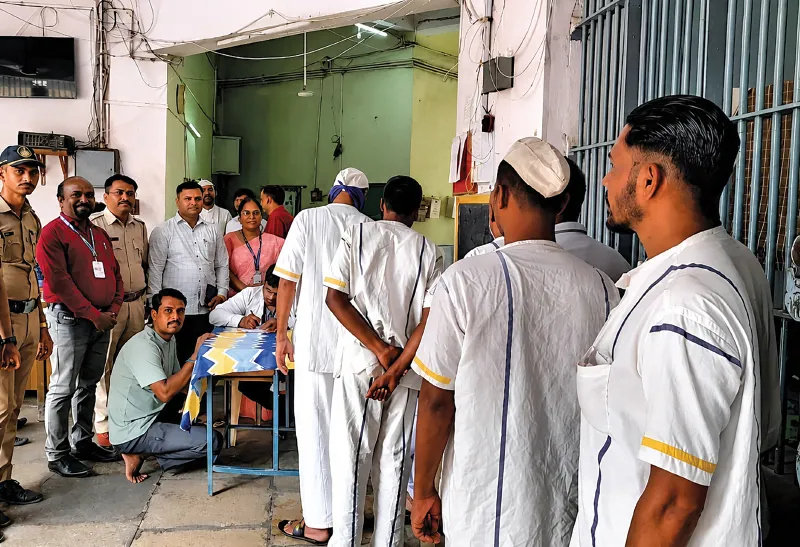
With nearly 4,000 inmates at the Thane Central Prison, well beyond its official capacity of 1,111 prisoners, it would be easy to forget about people like Mr Shankar and Mr Yadav. But the social workers of Prayas — a field action project of the Centre for Criminology and Justice at the Tata Institute of Social Sciences (TISS) that is being supported by the Tata Trusts — won’t allow that.
In search of bail
“We have put in several applications for legal aid for both men,” says Amar Sawant, a social worker with Prayas. “But, in all these years, their appeals have been heard only once or twice, and their government-appointed lawyers are long gone. We will continue to push for them to get a lawyer who can at least get them out on bail.”
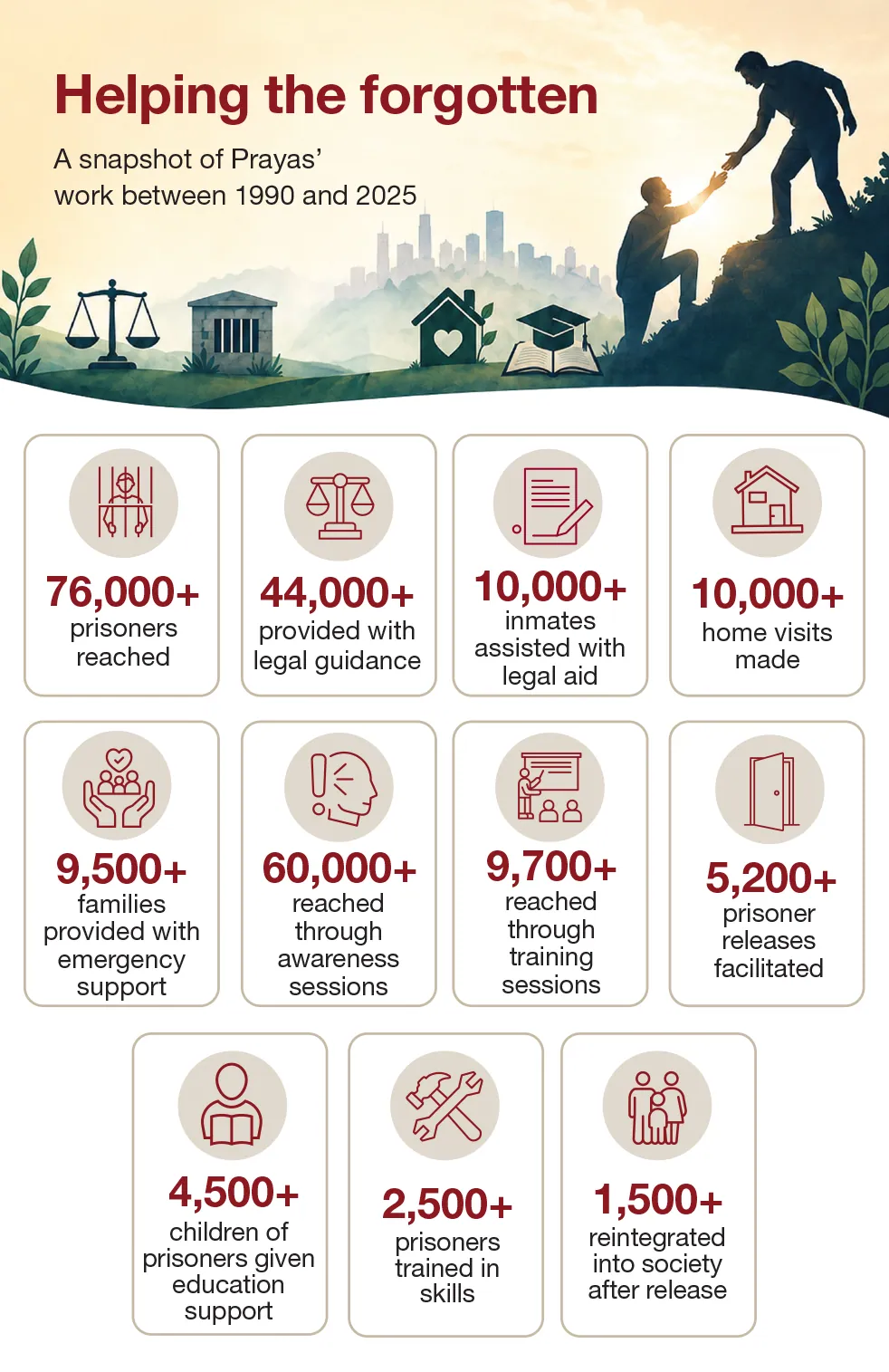
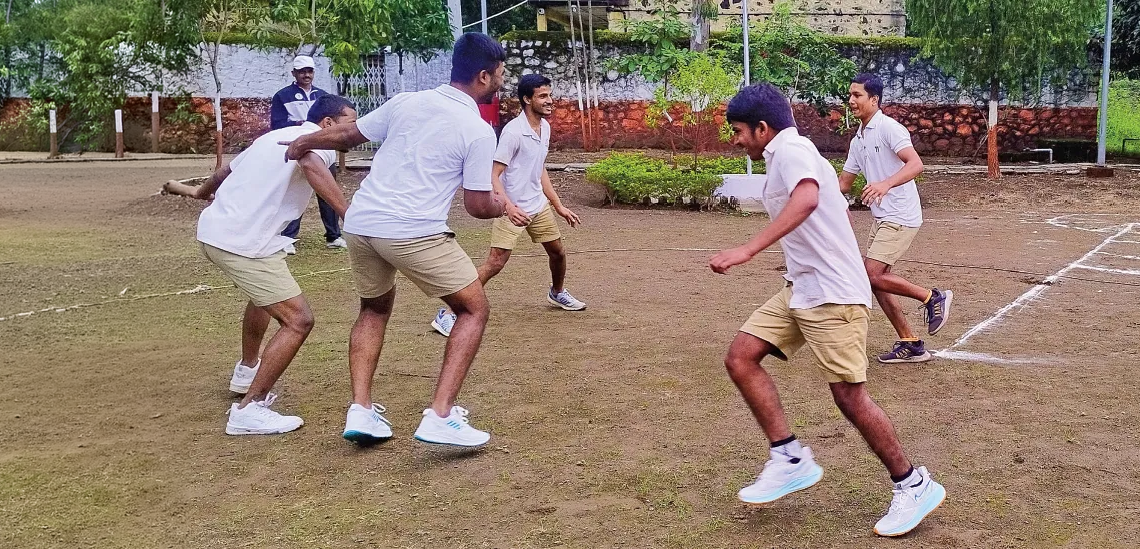
Under Prayas, 13 trained social workers, Mr Sawant among them, have been deployed to five central prisons of Maharashtra (Thane, Pune, Nagpur, Nashik and Chhatrapati Sambhaji Nagar) and the borstal school at Nashik, a reformatory institution for young male adults convicted in serious offences.
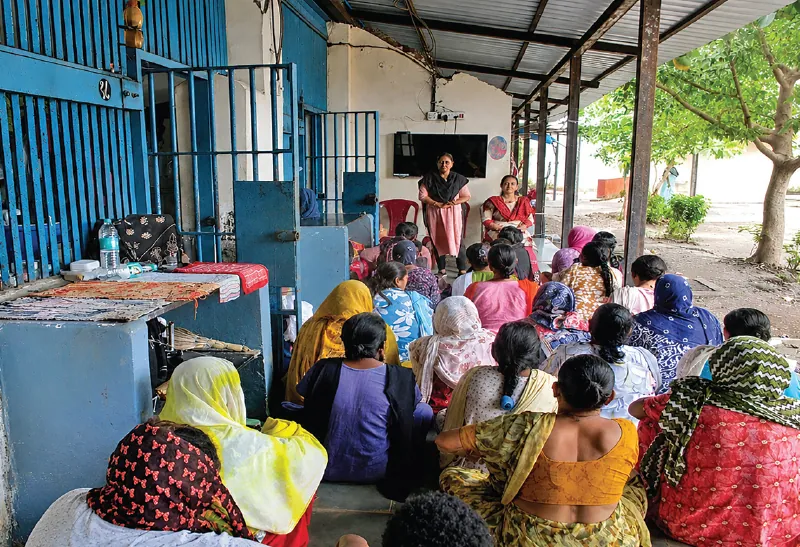
The Prayas team works with undertrial and convicted prisoners and their families, women rescued from sexual exploitation and/or housed in shelter homes, children in conflict with the law, and poor people who need assistance in navigating the court system.
The team provides legal aid, supports mulakat (family visitation) services, and works closely with inmates’ children to secure quality education for them. In cases of extreme hardship, Prayas also offers temporary monetary assistance.
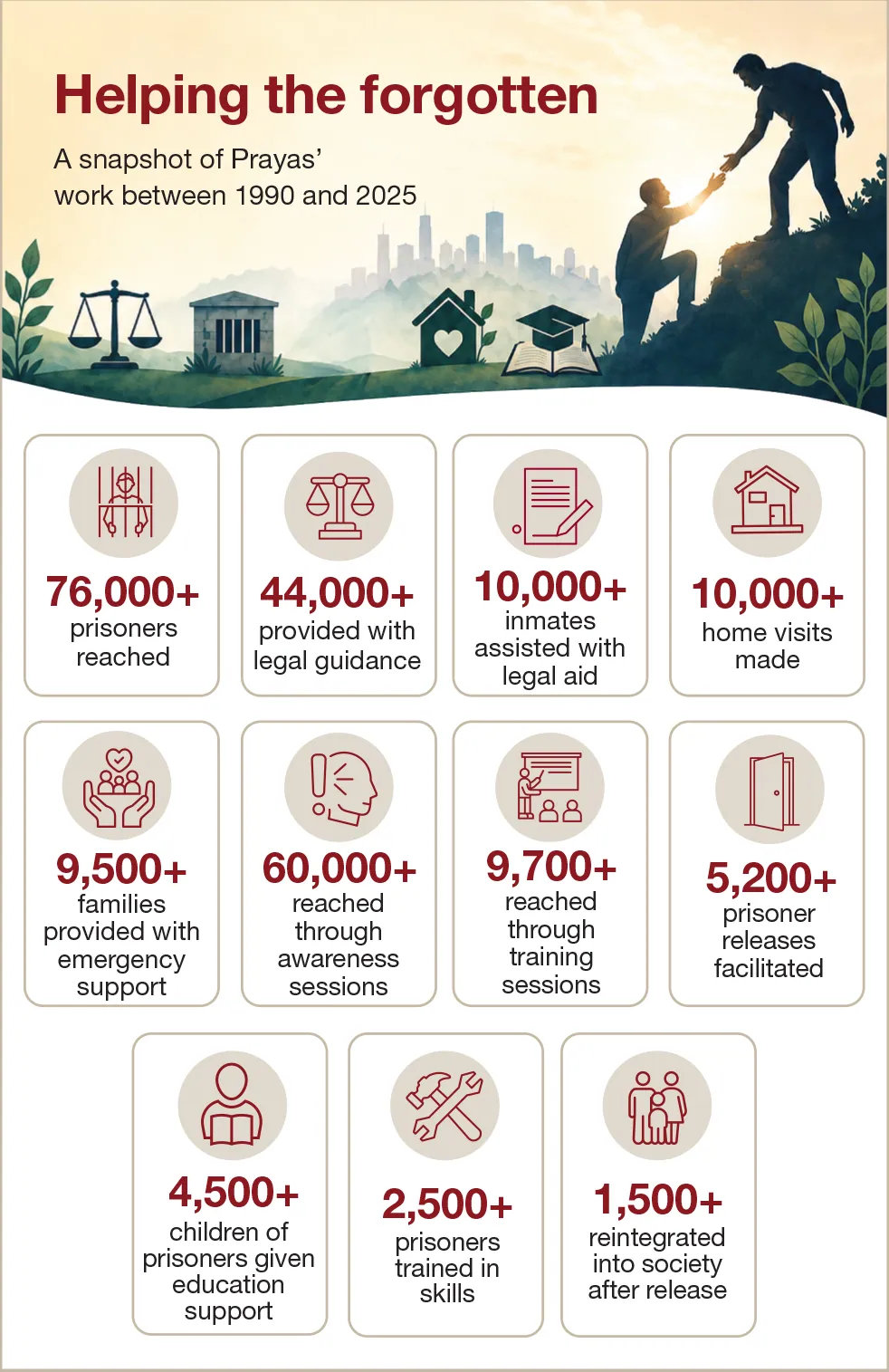
Additionally, it coordinates with partners to provide creche facilities for children whose parents are in prison, offers mental health support through therapy, legal aid and counselling, and organises health camps, awareness sessions, and skills development and vocational training for prisoners.
By coordinating these services and maintaining continuity of support, Prayas serves as a vital bridge between the prison system, inmates, and their families. Its social workers act as mediators between the prison administration and the inmates, providing socio-legal and rehabilitative services.
“As the police or prison administration, there are limitations to what we can do,” says Kailash Bhavar, senior jailor at the Thane Central Prison. “We can look to the well-being of our inmates, but we can’t help with legal aid or family matters. For these and many other tasks, we need social workers, and Prayas’ staff are doing exemplary work.”
Providing any kind of assistance is a challenge because of the sheer numbers. Maharashtra’s prisons, with 143% occupancy across 60 jails, have the fifth-highest occupancy rate in India. [The national average is 112% and Delhi tops the list at 194%, states the Prisons Statistics India Report, 2024] Approximately 80% of these people are undertrials, many of them low-risk cases who might benefit much more from being released.
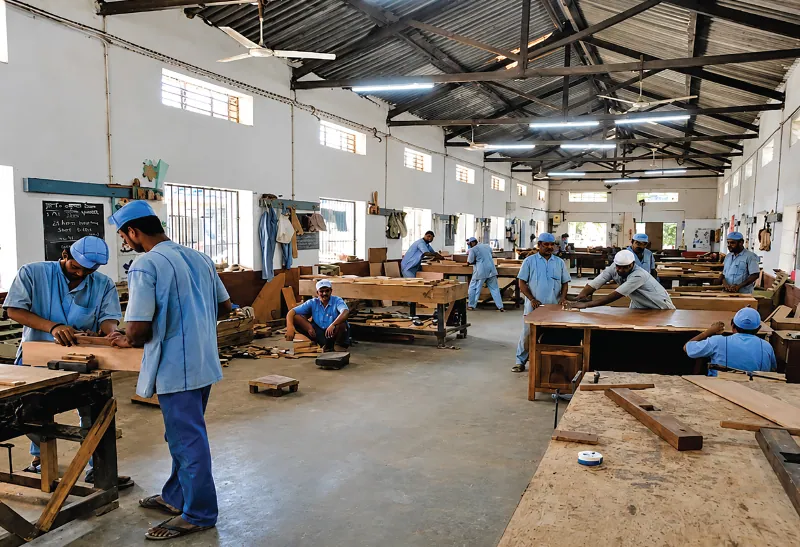
“The overcrowding has worsened over the years in Maharashtra’s prisons,” says Vijay Raghavan, project director at Prayas. “An increasing crime rate has brought about a corresponding increase in the prison population. Also, many undertrial prisoners are either unable to get bail or remain in custody despite getting bail on account of a lack of suitable sureties or the ability to pay the bail amount.”
Losing out legally
The absence of competent legal representation for those from poor and marginalised communities means their cases drag on, and irregular contact with families exacerbates the delays. “In this context, the role of social workers and legal aid bodies becomes very important,” adds Mr Raghavan. “Social workers can provide a range of socio-legal and psycho-social services, including arranging legal aid.”
Legal aid is the most sought-after service. “Social workers identify undertrial and convicted prisoners in need of legal aid when they accompany the superintendent on their daily rounds,” says Kalpana Katare, project coordinator with Prayas. “The superintendent refers cases to them based on requests from prisoners.”
This certainly helps people like 23-year-old Maya Bose, who is from West Bengal and is currently lodged in a Mumbai prison. During a recent round by the superintendent and Prayas staff, Ms Bose approached them to “sort out” her bail matter so that she and her four-year-old daughter could return home.
Ms Bose was arrested eight months ago when her husband defrauded a person while using her bank details. “I still don’t understand what happened or how I got trapped,” she says. “When the Mumbai Crime Branch transferred us here, I had to bring my daughter along because there was no one to leave her with. Now she thinks this jail is her home. I feel terrible about that; neither of us deserves to be here.”
Ms Bose has been granted bail — thanks in part to Prayas — but can’t provide the ₹25,000 surety. She wants help to convert this into a cash payment instead, a step that will require another round of court hearings and applications to authorities, says Reshma Bhoite, the Prayas social worker managing her case.
It has become easier now, says Ms Bhoite. When Prayas first began its work in prisons more than three decades ago, government-appointed lawyers were paid poorly. Till 2023, a legal aid lawyer received an honorarium of ₹750 per hearing, subject to a maximum of ₹7,500 per case. “With such a meagre amount, you can hardly find good lawyers who were committed to helping people, especially those from the margins,” adds Mr Raghavan.
In 2023, the National Legal Services Authority (NALSA) — the statutory body formed to ensure free legal aid for those who need it — established the Legal Aid Defence Counsel (LADC) system, whereby public defenders are paid a regular salary upwards of ₹45,000 per month.
The improved pay has brought in better lawyers, who are mandated to visit prisons and connect directly with inmates. “This has reduced the burden on Prayas’ social workers as far as arranging lawyers and following up on cases is concerned,” adds Mr Raghavan. “Now we act as the link between the undertrial and LADC.”
In 2025, the state passed the Maharashtra Prisons and Correctional Services Act, which has a provision for setting up a prison development board and further facilitating the process of legal aid, aftercare and rehabilitation of prisoners. Advocacy by Prayas has been a help here.
The programme has a sound post-release support structure. Once the prisoner is out, the social worker follows up on their requirements, arranging temporary shelter, and helping with access to healthcare, immediate relief in terms of travel expenses to go home, ration subsistence, house repairs, clothes, etc.
Livelihoods and counselling
When this phase is over, the focus shifts to long-term livelihood issues, like vocational training, seed money to start a venture, as well as counselling to readjust to family life. Sometimes, cases are referred by prison authorities, especially in instances of mentally disturbed or elderly released prisoners who have weak family support.
The Tata Trusts-Prayas partnership began in 1991 and continued until 2019. The Trusts’ latest support effort, which kicked off in 2025, looks to develop Prayas into a centre of excellence.
“Over the years, we have supported Prayas in various interventions in different prisons,” says Anirudh Menon, manager, institutions portfolio, with the Trusts. “Now the focus is on building this centre of excellence that can embed social and rehabilitative work into India’s prison systems. This way, legal aid, rehabilitation and jail reforms can be fortified.
“Prayas aims to expand its field interventions, research, training and policy advocacy. It now has the potential to take on a leadership role by institutionalising its work, mentoring new organisations, mobilising resources, and leveraging technology for a more structured approach to criminal justice reform. By becoming a centre of excellence, it will enhance policy engagement, drive systemic change, and build a sustainable model for rehabilitation and social reintegration.”
Prayas has plans, too. “We aim to institutionalise the role of social workers across prisons in Maharashtra,” says Mr Raghavan. “If realised, this would be the first endeavour in India targeting prisoner welfare and rehabilitation at scale. Maharashtra has 36 prisons — 60, if you count the open prisons — and we want to put social workers in all of them.” While Prayas will continue to hire and train social workers, it is hoping that their wages will be paid by the government (rather than philanthropic partners).
Prayas has been approached by other states to conduct a similar programme for their prisons. “If our work is to be sustainable, we need government support,” says Mr Raghavan. “We have kept a structure for expansion ready; we’re just waiting for the right time to roll it out.”
Names of prisoners have been changed to protect their identity.