‘India can lead the global solar revolution if…’
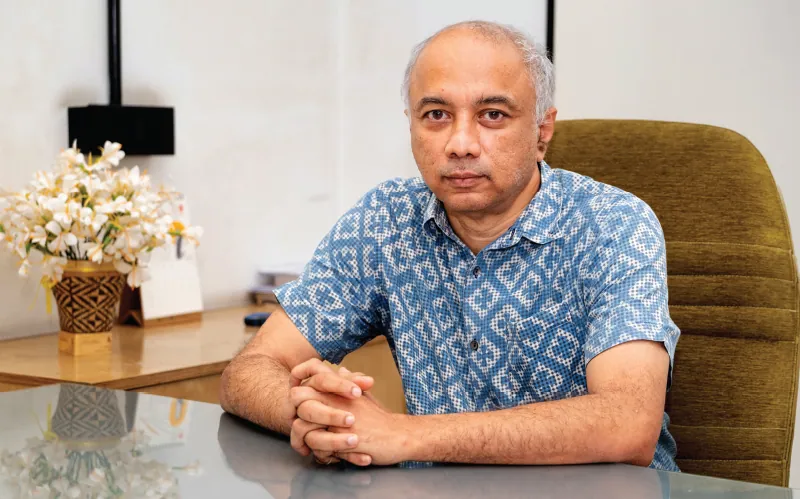
For social entrepreneur and 2011 Ramon Magsaysay award winner Harish Hande, it was a field visit to the Dominican Republic during his years as a doctoral student at the University of Massachusetts, USA, that changed his outlook. Surprised to find poor Caribbean villagers using solar lighting, Mr Hande wondered why India’s rural folk couldn’t do the same. That thought would, in 1995, lead him to set up SELCO, a rural energy service company headquartered in Bengaluru.
Mr Hande’s objective, then and now, has been to deliver solar power to India’s underserved communities and to catalyse development outcomes through sustainable energy. In this interview with Labonita Ghosh, he advocates for innovation to create aspirational, energy-efficient machines, devices and even buildings. That, he believes, is the fuel needed to power the country’s transition to sustainable energy.
How does the right kind of delivery of sustainable energy to the poor enable improvements in their lives and livelihoods in the long term?
Sustainable energy is like adding salt to your food to make it tastier. The food, whether rice, dal (lentil) or roti (flatbread) — which in this case represents livelihoods, health, etc — is the most important thing; the salt improves it.
Let’s take the example of a large dairy. It includes cows, a cowshed, fodder, milk, a storage facility, and equipment for making milk products. Sustainable energy can help ease the way for every element here. With water shortage affecting fodder quality, we can have solar-powered hydroponics to grow feed. Heat stress in the cowshed, which makes cows produce less milk, can be managed with a design that allows for airflow, continuous lighting with solar and a cooler environment. Solar-powered milking machines can reduce the drudgery of the task, while solar-powered cold storage keeps the milk from spoiling. Sustainable energy plays an important role in all of these.
How can you align the objective of long-term sustainability with eco-friendliness when advocating for alternative energy?
We don’t use the phrase eco-friendly. We have worked with government ministries of rural development, housing and women and children to create savings from an energy perspective. There are three things to this. First is finding better market linkages for existing livelihoods. Second is to create and adopt more future-resilient livelihoods through technology and innovation. Third is improving the overall ecosystem for the incubation of enterprises to happen.
In the ginger trade, for instance, you need highly-efficient, solar-powered equipment to help with drying, slicing and dicing. Alongside this, you can have a small unit designed for optimal sunshine and airflow (to help with the packaging). Instead of using words such as ‘environment’ and ‘sustainability’, we want to work towards decreasing the dependence on diesel, electricity and other traditional sources of energy by automatically opting for climate- and eco-friendly interventions.
How do you also create an enabling and inclusive environment for the adoption of more sustainable energy sources? Is there enough investment in innovation, government support or even demand among farmers for this?
Government policies for increasing livelihoods already exist. What we need is for more organisations and philanthropies to support projects on a long-term basis, rather than shorter-duration CSR [corporate social responsibility] funding. If we get flexible resources to experiment with, we can be more innovative. These innovations can then be scaled up using government funds.
Government policies for increasing livelihoods already exist. What we need is for more organisations and philanthropies to support projects on a long-term basis...”
To cite an example of our approach, we decided to undertake some 100-odd interventions, selected by gender, community marginalisation or livelihood, to launch innovations. It’s like a relay race where SELCO is the first and second runner, while the third could be another organisation and the fourth is the government. When you know all the runners, you can design a programme accordingly. With CSR funds, we throw the baton away after the first leg and cannot finish the race. We fail with multiple projects because we have no clue who the other ‘runners’ [stakeholders] are.
Programmes need to be designed with the end goal in mind. If I make a 10-km railway line, will it get connected to the 2,000-km Bengaluru-Delhi line? That’s what I have to keep in mind. If we take the livelihood missions available in different states, there’s huge scope for innovation. The idea is not to depend only on the government or criticise it by saying nothing is being done; we have to look for alternative champions as well.
Given the recent global fuel crisis, do you think this is a good time to advocate for sustainable sources of energy?
The movement was always there. Today, electricity supplied by the state is highly subsidised, and the state is losing money on this. However, the issue is not about supply but about creating more energy-efficient machines and appliances. Our Indian Institutes of Technology, though, would rather work on the latest apps, which means we must look to foster and support our Industrial Training Institutes (ITIs) for this. The US and Germany have succeeded as innovation hubs mainly because of their vocational schools.
The idea is not to depend only on the government or criticise it by saying nothing is being done; we have to look for alternative champions as well.”
There are brilliant innovators everywhere, even in the smallest towns and villages. How do we bring this non-English-speaking innovation class to the fore? A roti-rolling machine inventor from the bylanes of Ahmedabad may not have the same access to design resources as a white goods company, but philanthropic capital might help him get his product out.
Do you find the government focusing more on renewables now?
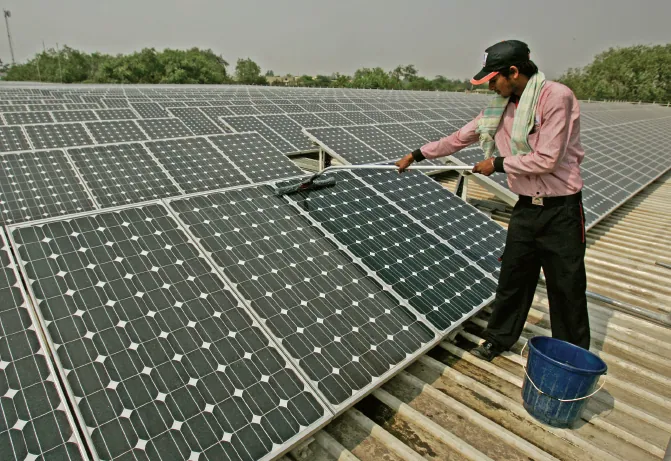
We began working in the solar space in 1992-93, and every government since then has pushed for alternative energy sources. We are the first country to have a cabinet position for renewable energy. We have one of the largest programmes for individual solar use in the Prime Minister’s Surya Ghar Yojana. Where we lack is in user-centric thinking. Where can a millet grinder from rural Karnataka get a grinding machine that runs on solar power? There’s no research in industry for this, or even for things like efficient cookers, solar-powered sewing and silk-weaving machines.
We need to invest in incubation centres that will build machinery that small-scale farmers can use for the next 20-25 years. And we need to design them to be aspirational and energy-efficient. When we introduced our roti-rolling machine, we never had to say it was solar-powered or environmentally friendly. The entrepreneurs who had invested in it with bank loans were able to pay them off in a short time by making 500 or more rotis in a day.
Has India realised its solar energy potential? And how do we compare with other countries in the sustainable energy space?
When it comes to China, with whom we usually liken our social and economic conditions, we are fighting the wrong battle. China is looking at the supply side, that is, how many solar panels it can manufacture. Instead of trying to compete on that front, we should be looking at how many people we can convert to using renewables. Our aim should not be so much to generate 700 gigawatt of solar energy but to get 700 million people to use it.
Also, these models are replicable in many other parts of the world. Sierra Leone can have a solar-powered health centre. The ginger processing plant will find takers in upper Ethiopia, while Tanzania would certainly benefit from having turmeric processing units in every rural home. If the solar technology we create for the women of Dharwad can be used in parts of Ethiopia, we — and not China — will be the leader in the global solar revolution.
Hydro, biogas and even wind energy have huge, unrealised potential in our country. We have to incubate innovation and technology and look at fortifying the demand side.”
If we can double or triple the incomes of rural families, or let the maternal mortality rates of women in Meghalaya drop because of a reliable and energy-efficient labour room, the conversation shifts. Now the World Health Organization is interested in knowing how we achieved this. That’s the conversation India needs to be a part of; that’s why we have to shift our focus from the supply side to the demand side.
We’ve talked largely about solar energy. What about other forms of renewable energy? How is India doing on hydroelectric, biogas or even nuclear energy?
We can do much better in the micro-hydro space. Micro-hydro sites have immense potential in the Northeast and the Himalayan region. But here, too, financing gets in the way of innovation. Entrepreneurs who want to set up a pico or micro grid must bear the costs of transmission and distribution lines. If the capital expenditure for the entire system gets subsidised by the government or industry, it will increase the successful adoption of these energy sources.
With biogas, we have to transform its image in India. We associate biogas with just cow dung, but many new developments have taken place over the years (there are 10 different products in the biogas space with improved mechanisms). Gender has played a role here as well: the women of the house were the ones to collect the cow dung and use it to generate biogas, and then clean up after. In my uncle’s village in rural Karnataka, a lot of men were not able to find wives because people refused to get their daughters married into a household that ran on biogas.
A home with two cows will need a certain kind of biogas unit as opposed to an ashram with a full cowshed that intends to draw its entire energy for cooking from biogas. The dairy cooperative Amul, along with its 18 member unions, is planning to set up 30 large, compressed biogas units across Gujarat. It also intends to roll out 10,000 household-level biogas units to reduce farmers’ dependence on fossil fuels and boost their incomes. All of this has come about because of a whole ecosystem of project-based thinking.
Hydro, biogas and even wind energy have huge, unrealised potential in our country. We have to incubate innovation and technology and look at fortifying the demand side. If the demand for them increases, so will the prevalence of these other forms of sustainable energy.
How are different states in India faring as far as the adoption of renewable energy is concerned? Which states are doing better, and which ones need to do more?
When it comes to solar usage by individuals, bigger states like Maharashtra, Karnataka and Rajasthan are doing well. In the last 15-20 years, Maharashtra has operationalised the use of solar in the health sector, while Karnataka has drawn on this to improve livelihoods. Odisha and West Bengal need to do better with utilisation.
In Odisha, where poverty levels are high, the adoption of renewables would have a great impact. In West Bengal, there will be an immediate transformation if sustainable energy is decentralised and used for livelihood enhancement, with the capex for the interventions being shared by multiple owners who can collectively benefit from a bump in their household incomes. But I believe that the next level of decentralised, end-user growth will take place in the Northeastern states.