A lodestar shows the way to change
The IWMI-Tata Trusts collaboration — 25 years and going strong — has employed research findings and field pilots to craft groundbreaking solutions in the rural livelihoods sphere
There has been a distinct change in the profile of India’s small and marginal farmers over the last couple of decades. Farmers across the country have adopted modern agricultural practices and discovered new streams of income while tapping the potential of solar energy and making the most of irrigation technologies.
Some of the transformative measures behind these advances can be traced to the efforts of an initiative that has fused scientific expertise, global experience, field experimentation and policy engagement to drive improvements in rural livelihoods — the IWMI-Tata Water Policy Research Program (ITP).
Started in 2001, ITP is a collaborative endeavour involving the Colombo-based International Water Management Institute (IWMI) and the Tata Trusts. ITP has concentrated on five interlinked elements in its research domain — water, agriculture, energy, environment and livelihoods — to provide solutions that boost farmer incomes. Importantly, it has helped shape rural development initiatives of governments and donor organisations through policy research and analyses.
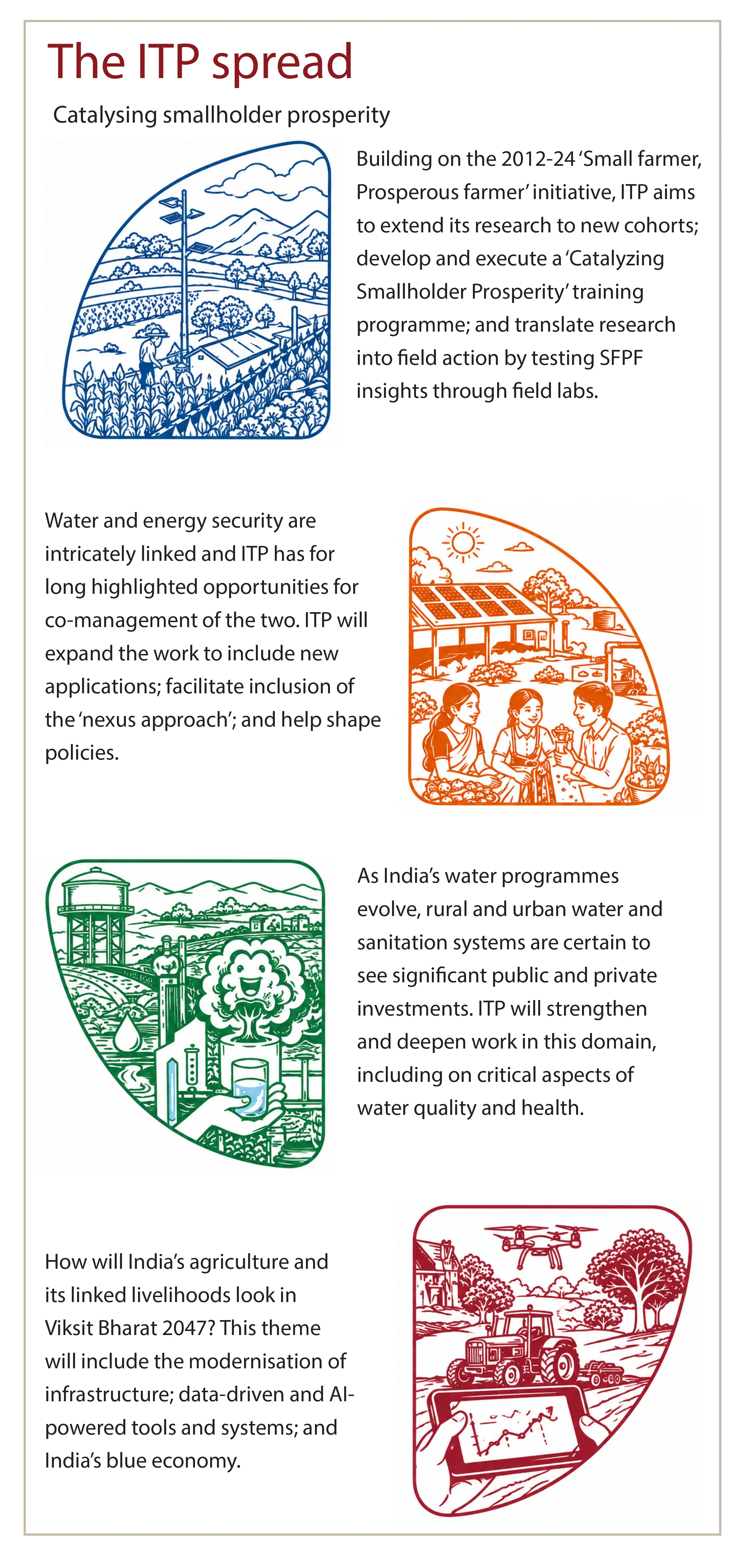
The ‘small farmer, prosperous farmer’ (SFPF) initiative, launched by ITP in 2012, is an instance of how research findings have been translated into tangible results on the ground. The challenge was to not only ensure access to water, but to use the resource to fuel smallholder prosperity.
SFPF-compatible interventions in the tribal belt of Dahod district in Gujarat, covering about 45,600 marginal farmers with landholdings of between 1.5 and 3 acres, included a compact of interventions around water security, irrigation efficiency, yield improvement, crop diversification and market specialisation. The annual income of about 60% of the farmers thus empowered rose to about ₹125,000, and 20% of them pulled in ₹250,000 and more.
Lessons for all
SFPF offered programme design and policy formulation lessons for civil society and government initiatives aimed at enhancing the well-being of small and marginal farmers, especially in the tribal context. Down the line, SFPF laid the groundwork for the Tata Trusts’ wide-ranging Lakhpati Kisan campaign, which covers hundreds of thousands of households in several Indian states.
Energy-irrigation nexus
Gujarat once faced a situation where its water and energy challenges were deeply enmeshed. Farmers relied on subsidised farm power connections to draw water for irrigation, driving up energy consumption and anarchy in rural feeders, as domestic, agricultural and commercial connections shared common feeders. That led to supply rationing, power thefts, and unhappy farm and non-farm consumers.
Worsening the condition was a combination of depleted aquifers, a near-bankrupt electricity board, and powerful farm lobbies resistant to metering and consumption-linked power tariffs. A solution — any solution that worked — was the need of the time, and the IWMI-Tata Water Policy Research Program (ITP) delivered just that.
ITP recommended that electricity utilities tailor farm power supply to better fit farmers’ requirements. Implementing this “intelligent rationing” of farm power, ITP argued, would leave both farmers and electricity utilities better off.
The government responded to the suggestion and, through a rewiring of rural feeders, invested $260 million to separate agricultural and non-agricultural feeder lines across the state.
Combined with institutional reforms in the electricity bureaucracy, Gujarat’s Jyotigram Yojana led to an impressive agrarian boom, reducing farm power subsidy, making the state’s electricity utility viable and improving groundwater governance. The net result — a happier citizenry in the countryside.
Informing water and livelihood programmes and policies is what ITP does best. “Our research has inspired and shaped critical government projects and investments in several states,” says Shilp Verma, ITP’s programme leader and IWMI’s deputy country representative for India.
ITP is driven by a team comprising young researchers, in the main, that collaborates with a network of some 250 partners from across India, among them a host of grassroots organisations. “Over the last 25 years, IWMI and the Tata Trusts have invested around $8 million [approximately ₹76.5 crore] in ITP. In return, even by the most conservative estimate, ITP’s research has inspired and influenced development investments worth more than 1,000 times this investment,” adds Mr Verma.
Some of ITP’s early work highlighted the ubiquitous interlinkages between water and energy in India’s rural landscape. “ITP was among the first to posit that the fate of India’s water and energy economies is intricately linked, that energy policies not only impact groundwater use but also offer a potent instrument for governance,” explains Mr Verma. This need for a ‘co-management’ approach won ITP the United Nations’ best water management practices award in 2014.
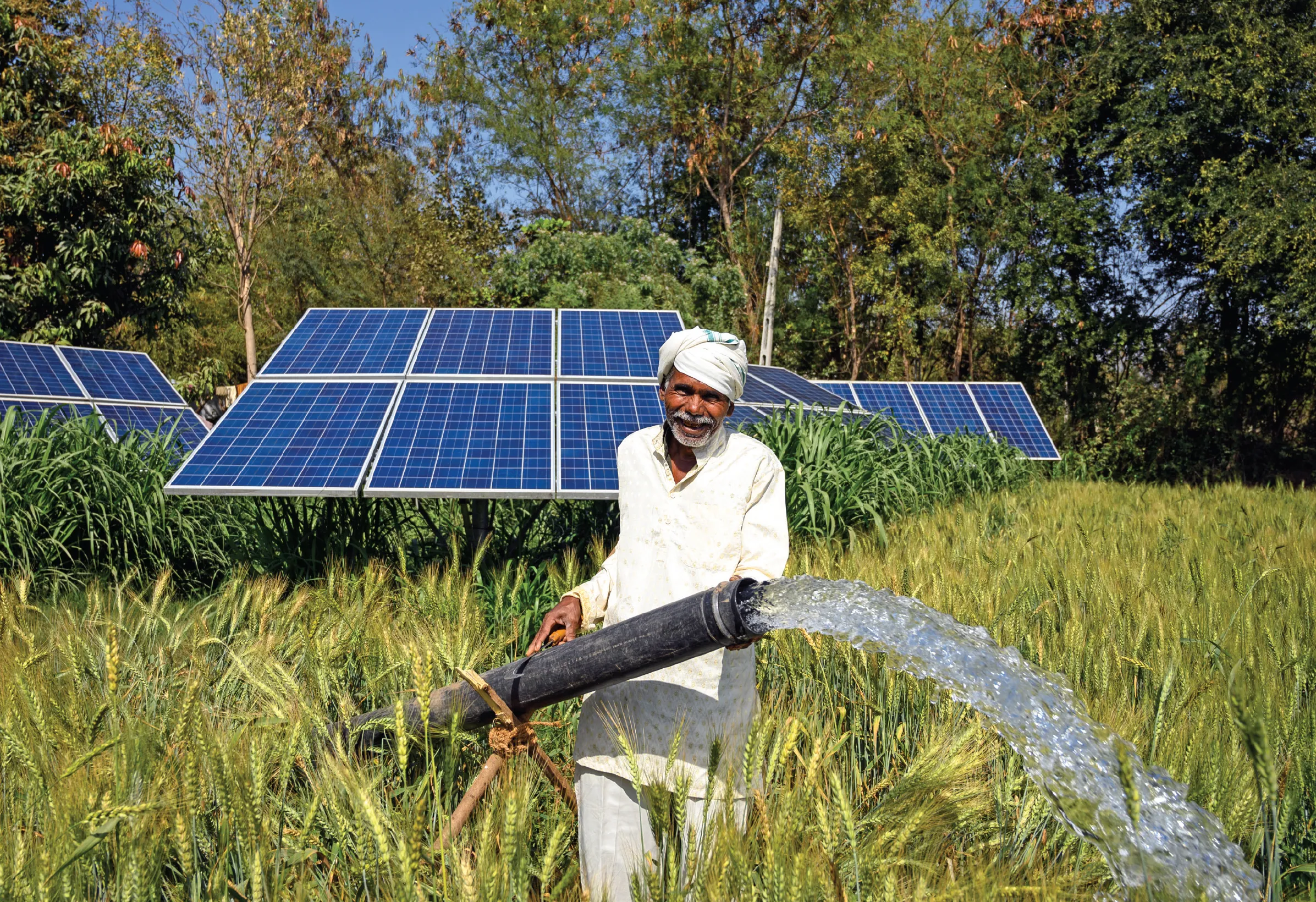
A large part of ITP’s success can be attributed to its flexibility and its ability to explore new research themes, its pioneering work in solar irrigation being a standout example. In 2016, ITP initiated a field pilot in Dhundi, a village in Gujarat’s Kheda district (see Dhundi sparks a revolution on facing page) that became the inspiration for the state’s SKY (Suryashakti Kisan Yojana) initiative and a key component in the Indian government’s PM-KUSUM campaign.
The pilot and ITP’s pioneering work around solarisation in agriculture also spurred IWMI’s global work on this theme, especially across Asia and Africa.
Solar entrepreneurs
Another ITP pilot that drew attention unfolded in Chakhaji, a village in Bihar’s Samastipur district. In 2016, in a place where diesel pumps dominated the irrigation economy, ITP partnered the Aga Khan Rural Support Programme to create a cadre of solar irrigation entrepreneurs and catalysed buyer-friendly solar irrigation service markets.
Using a network of buried pipes, each solar entrepreneur delivers irrigation-as-a-service to scores of farmers, reducing fossil fuel costs and improving cropping intensity. Insights from the experiment shaped the now-famous Solar Didi model, which has women from self-help groups take up solar pumps as micro enterprises.
ITP stays relevant because it has evolved alongside the ecosystem it operates in, crafting solutions that address the many challenges in India’s complex water and agriculture domain. The research underpinning all of this has benefitted a slew of Tata Trusts programmes in different parts of India, including in the Himalayan region and in the Northeast.
In the Northwest plains — India’s breadbasket that spans regions of Punjab, Haryana, Uttar Pradesh, Rajasthan and Gujarat — years of unsustainable agricultural practices have eroded and degraded land and water resources. ITP has explored ways to combat this crisis through efficient irrigation, crop diversification and climate-smart, groundwater-benign expansion of solar applications.
ITP’s work in the central Indian tribal belt helped incubate the Trusts’ associate organisation, Collectives for Integrated Livelihood Initiatives, which works with underserved village communities to improve agricultural practices, expand irrigation coverage, develop animal husbandry and provide better market linkages.
In the floodplains of the eastern Gangetic and Brahmaputra basins — covering parts of Uttar Pradesh, Bihar, West Bengal, Odisha and Assam — the challenges are different. Despite high rainfall, abundant aquifers and fertile soil, the region’s agricultural productivity is low due to small and fragmented land holdings and the damage caused by errant monsoons. Here, ITP has devised practices and systems that tackle the productivity problem head-on.
Rooted in research and problem-solving, ITP’s accomplishments have been cemented at the confluence of science, policy and field action. With 25 years of experience, expertise-building and commitment to bank on, to the Program has proven its worth. And there’s more to come.
Dhundi sparks a revolution
Farmers in Dhundi in Gujarat’s Kheda district once relied on diesel generators to pump irrigation water. Then an intervention by the IWMI-Tata Water Policy Research Program (ITP) lit up the lives of these farmers.
In 2016, an ITP team approached Dhundi’s farmers and convinced them that solar pumps would deliver enough water for their farm needs. The icing on the cake was that any power that their panels generated but was not used for pumping groundwater could be sold to the state’s electricity utility at an attractive tariff. Within months of commissioning, participating farmers were loving their solar pumps.
More farmers joined and ITP helped organise them into the world’s first Solar Pump Irrigators’ Cooperative Enterprise, which pooled and sold its surplus solar energy to the local power distributor under a 25-year agreement. The distibutor meters, monitors and pays money to the cooperative, which distributes the revenue based on how much each member has contributed.
“Farmers and their families have not only got rid of the noise, fumes and cost of diesel, but are also earning thousands of rupees selling solar energy,” says Rahul Rathod, an ITP consultant.
The Dhundi venture has shown how solar power can deliver ‘climate-proof’ income. Farmers make as much as ₹7,000 per month by selling surplus solar power and Praveenbhai Parmar, a Dhundi farmer who owns about one acre of land, is an example. “Once I started selling electricity, I was able to buy a cow within a year,” says Mr Parmar, whose incremental income means he can afford to send his two children to a private school.
Dhundi’s farmers have also put the land under the solar panels to good use. “We thought the panels will take up a lot of land, but we found that crops could be cultivated under these panels,” says Udabhai Chavda, who has nine solar panels on his 3-acre spread.
The Dhundi pilot has provided a water-energy blueprint that the Gujarat government’s Suryashakti Kisan Yojana and the central government’s PM-KUSUM scheme have adopted. Whatever angle it is viewed from, the shift to solar energy has been a winner for Dhundi.