‘Our ideas work on the ground’
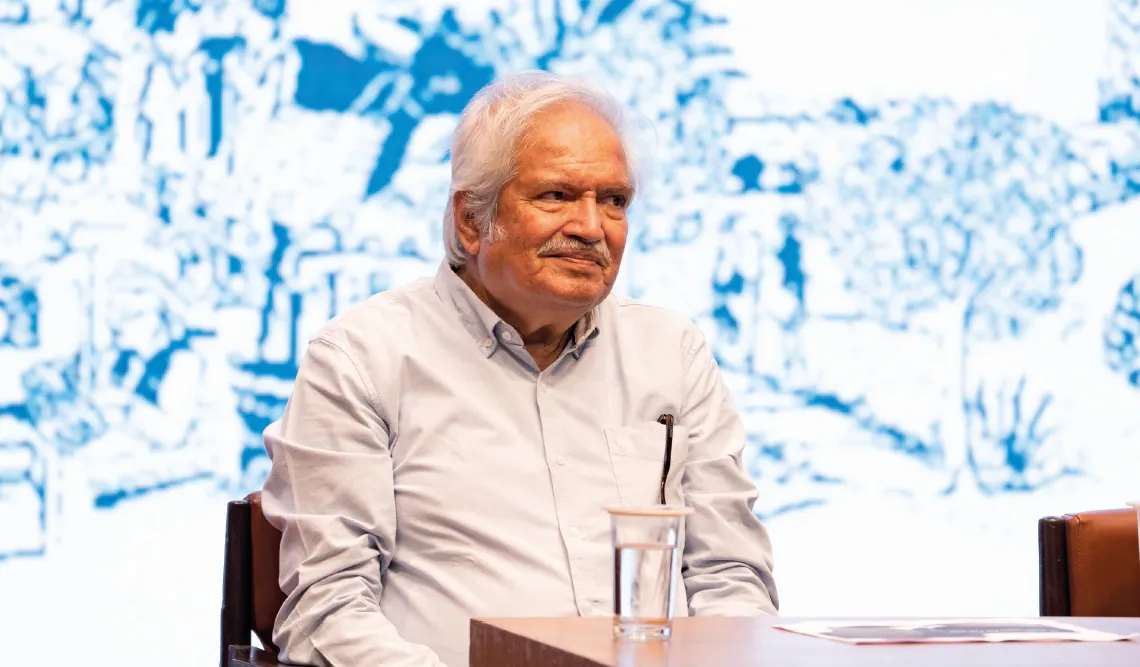
The water-energy-food-livelihood nexus is Tushaar Shah’s abiding concern, the multiple-element fulcrum of his wide-ranging body of study and research. An economist, rural development maven and public policy specialist, Dr Shah is an emeritus scientist with the International Water Management Institute, Colombo, and professor emeritus at the Institute of Rural Management Anand in Gujarat.
Dr Shah’s principal research interests are water governance and farmer organisations, two spheres in which his work has triggered on-ground change and shaped policymaking. He is also the architect of the International Water Management Institute-Tata Water Policy Research Program, a collaborative endeavour aimed at “converting science into policy action”.
The Anand-based Dr Shah speaks here to Philip Chacko about India’s water-energy equation, what bedevils it and what can smoothen its flow. Excerpts from the interview:
It has been said that we in India don’t think of water as a collective problem. What’s the way to draw the larger community into the conversation and the water crisis that confronts us all?
I think there’s a need for more extensive and ambitious education and training programmes for ordinary people to engage them in water governance issues. Where state governments are more active in water governance, I surmise that people have a greater interest in these issues. We have seen that in states such as Gujarat, where community organisation for local water harvesting has worked wonders in Saurashtra and north Gujarat.
There are things in the water sector that only governments can do, like with large irrigation and water supply schemes. The problem in our country is that state governments and their agencies have not really been effective in involving people in managing water systems. Governments and people often work at cross purposes, and that creates disruptions in water supply systems and poor water services.
There are political issues as well. For example, most political leaders resist cost recoveries from people; they want to give everything for free. Municipal water and irrigation water are provided free without any measurement. In China, by contrast, they insist on full cost recovery for the water services provided. That’s how water operations become self-sufficient once you build the necessary infrastructure.
You have paid particular attention to farmer organisations in your research work over the years. How are these organisations responding to the multiple challenges in the country’s agriculture ecosystem?
The response of farmer organisations depends a lot on how their agriculture is organised. Because of the agrarian system we have, farmer organisations are able to play a prominent role. But we expect that over the next 50 years more and more people will move out of agriculture. Landholding sizes will then increase and we will probably have a new system with great local participation.
The government has promoted farmer-water-industry associations, but the response from the farmers’ side to this has been poor. Most water-user organisations in India are defunct and the performance in much of the rest of the developing world is not much better.
The situation is different in countries such as the United States and Australia, where land holdings are large and where irrigation systems serve up to 50 farmers apiece. In these places it is possible to bring all the farmers into a classroom and negotiate with them. That would be impossible in India, where a group of farmers can add up to a million.
In India there is this perverse relationship between irrigation and energy activity that has created some positive impact but a much larger negative impact.”
The water-energy-food-livelihood nexus is another of your research interests. What exactly is this about?
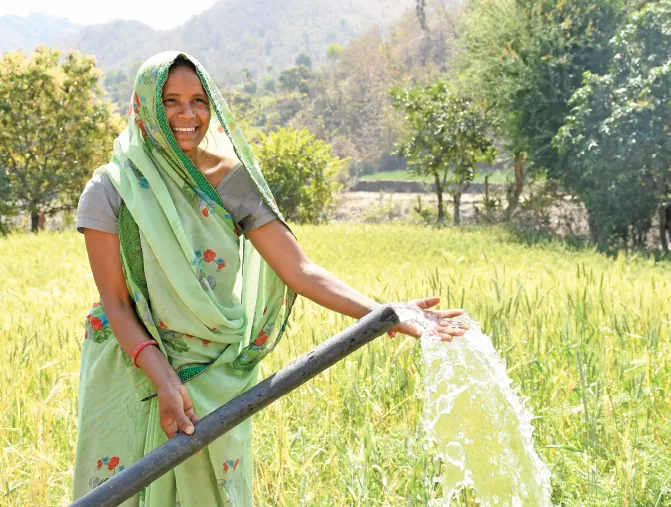
In India there is this perverse relationship between irrigation and energy activity that has created some positive impact but a much larger negative impact. In the 1950s and 1960s, there was hardly any overuse of groundwater in our country. Then came easy and cost-effective technologies to access groundwater — diesel pumps and tubewells — and we could replace bullock bailers and increase the rate at which groundwater is pumped out.
Groundwater irrigation became common, but the cost of the energy used for the pumping would grow into a big issue. States and their newly formed electricity corporations started by trying to stimulate the use of energy by farmers and other consumers, with politicians devising innovative ways to encourage farmers to use more energy in agriculture. One of these ways was popularising electric pumps, and they did that by providing subsidies to farmers on electricity as well as equipment.
In the 1970s, Tamil Nadu began offering farmers free power, with meters removed so they could use as much electricity as they wanted. This led to a boom in demand for power connections; farmers got one, two and even three connections. All they had to do was dig boreholes and they had free energy to pump.
The burgeoning groundwater economy that followed was patently unsustainable. Farmers came together as a political group to avail and insist on subsidies. Every time a government tried to impose some kind of electricity tariff, farmers would become a political threat.
The first time something different happened was when Narendra Modi became Gujarat’s chief minister. He did not touch the existing connections. Farmers who already had subsidised power connections, he did not touch them, but those taking new connections had to pay a tariff, albeit a highly subsidised one.
India has now become the groundwater overuse champion of the world; every year we extract more groundwater for agriculture. Electricity companies are in the red, unable to recover the cost of the power. There are many electricity boards — Rajasthan is an example — to whom no bank is willing to lend because they are accumulating large losses from agricultural power subsidies. Basically, our electricity supply network has been bankrupted.
If we were to accept a 10% reduction in food production, then we could actually restore an environmentally sustainable and financially viable water-energy-food system. That will happen only if we find politically acceptable ways of changing our equation on power consumption and tariffs.
In 2000, we argued with the Gujarat government that if we are providing farmers with highly subsidised power, then we need to ration the supply. That was an acceptable way of not only reducing power subsidies but also groundwater overdraft.
The government implemented such rationing through a scheme that put hundreds of thousands of farmers on special agricultural feeders. The move put a cap on groundwater extraction in Gujarat while massively reducing subsidies to farmers.
How would you describe the enduring collaboration between IWMI and the Tata Trusts? What has it delivered?
The International Water Management Institute-Tata Water Policy Research Program [ITP] has crafted water and energy solutions based on evidence and logic. We have seeded pilot projects to demonstrate that the ideas we are proposing actually work on the ground. An example is the Sardar Sarovar Project [the multi-purpose river valley development scheme on the Narmada River that provides irrigation and hydroelectric power generation to Gujarat, Madhya Pradesh, Maharashtra and Rajasthan].
We argued that instead of laying open canals, Gujarat should change to a buried pipeline network. The Gujarat government finally agreed with us and the idea of pipelining last-mile distribution took off. That’s what has led to Punjab redesigning its irrigation system to use buried pipelines for water delivery services to farmers.
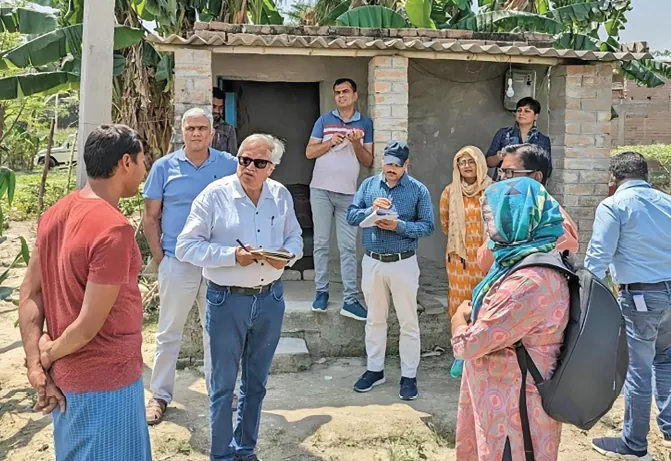
Similarly, we showed that solar energy in Indian agriculture could turn around the entire energy-water-food-nexus. We demonstrated this in Dhundi, a small village in Gujarat’s Kheda district. We gave nine farmers access to solar power, organised them into a microgrid, and got the electricity board to enter into a 25-year agreement with the farmers.
Farmers could use any amount of energy they wanted, but got incentivised to conserve energy and water by paying for solar energy export to the grid. In the same village, you have electric pump owners using heavily subsidised power — never a good idea — and solar farmers generating their own energy and selling excess power to the board.
As a research programme, the most we can do is create evidence to support our ideas, but we need a champion to push these ideas. What we have found is that every once in a while there comes a powerful politician who puts long-term benefits over short-term political advantages. Mr Modi was one such politician.
Sujit Gulati, then the additional chief secretary in charge of energy, picked up the ball and ran with it. He said, “One village is not enough; let’s do the project in 400 to 500 villages and see what happens.” He put a lot of his energy behind the idea and made it work.
I am really hopeful that the partnership with the Tata Trusts progresses further. Ours is a modestly funded initiative but it has secured a whole lot of support.
China is decades ahead of us in matters related to water and energy. All the problems we are facing now, they have faced since 1995, and they have emerged out of that.”
On the issue of water, climate change has emerged as a principal villain. Are we, as a country, doing enough in dealing with what is a clear and immediate threat?
We are doing a great deal but not in the water sector, though there’s plenty that can be done there. In a situation where rainfall is going to be more and more unpredictable, the crucial adaptation factor is water storage that minimises evaporation. Groundwater governance is emerging as a powerful and robust response to climate change.
ITP’s case for solar pumps is a response to the threat of climate change. This is a way of reducing carbon emissions as well, while putting in place a financially sustainable model where groundwater can be conserved and solar energy promoted.
In the 1990s and 2000s in Gujarat and Punjab, to give two examples, a lot of resources were invested in water-harvesting structures. Now we have other states doing the same with institutional support. Telangana stands out in this context.
The problem is that we have, nationally speaking, a water bureaucracy that does not perform well enough. It is not easy to hold this bureaucracy accountable, one reason being that many state governments have not paid much attention to it.
With reference to the rapid and messy urbanisation that India is experiencing, water will surely be an ever-more critical factor. Given the reality, what would your advice be to city dwellers and city planners?
ITP has traditionally focused on agriculture — that was our mandate — but over the past eight-nine years we have been exploring urban issues. Urban infrastructure is a huge challenge and one important issue here is water metering. I think it requires a certain amount of political courage to actually enforce this, but there’s no other way of managing water demand.
In terms of policymaking, how best can India deal with its water woes? What can we learn from other countries in this context?
We have tried to draw lessons from around the world on what we should do, but then our situation is much different from anywhere else. Many solutions that work well in other countries do not fit our setting.
The exception to this rule is China, a country that offers very useful solutions. China is decades ahead of us in matters related to water and energy. All the problems we are facing now, they have faced since 1995, and they have emerged out of that. That said, the political system in China is different. It’s hard for us to easily replicate what China has accomplished.