The Tata Trusts’ enduring commitment to creating and supporting high-quality institutions is finding newer forms of expression

COVER STORY
Cooling it down
Residents of Mira Bhayander and Chandrapur in Maharashtra have found relief from urban heatwaves thanks to pinpointed solutions
The women of Shiv Shakti Nagar, a settlement in the Mumbai suburb of Mira Bhayander, didn’t like being home much. With their menfolk off to work and their children leaving for school, they would try to finish their household chores before the sun came up, then head to a nearby park. At night, entire families would sleep in the open.
The reason: sweltering conditions inside homes because of the heat-island effect in the Mira Bhayander sprawl, which faces the brunt of rapid and barely planned urbanisation. There has been a 50% increase in built-up areas in this suburb over the past 30 years.
That, coupled with rapidly depleting green cover and changes in building materials, has led to an unbearable rise in temperatures inside homes. Unauthorised construction has worsened matters, with many low-lying areas getting flooded during monsoons because natural drainage systems have been compromised.
In 2025, the Tata Trusts and the Aga Khan Agency for Habitat (AKAH) launched a programme to provide cooling solutions in Mira Bhayander and Chandrapur — the industrial hub in eastern Maharashtra — to counter extreme heat and build climate resilience.
Working with 200 households in each place — in Shiv Shakti Nagar, Navghar and Mandvi Para in Mira Bhayander, and in Panchasheel Chowk in Chandrapur — the programme starts with hazard mapping to identify heat spots and vulnerable buildings through analyses of temperature data in different neighbourhoods. It then moves to heat mitigation through the adoption of various cooling solutions that reduce temperatures and improve ventilation systems in homes.
The final stage includes flood mitigation and water conservation through the rejuvenation and recharging of wells and other water bodies. Alongside, there’s disaster management training for the community to cope better with devastating heatwaves and floods.
“The settlements in Mira Bhayander have dense clusters of homes,” says Bigrai Narzari, program officer, urban inclusion, with the Trusts. “Houses share walls, have low ceilings and very poor ventilation. Roads and pavements here are concretised and the roofs are usually made of asbestos sheets. All of this causes heat to be absorbed and trapped. We decided to retrofit the houses using heat-resilient materials.”
Click to enlarge
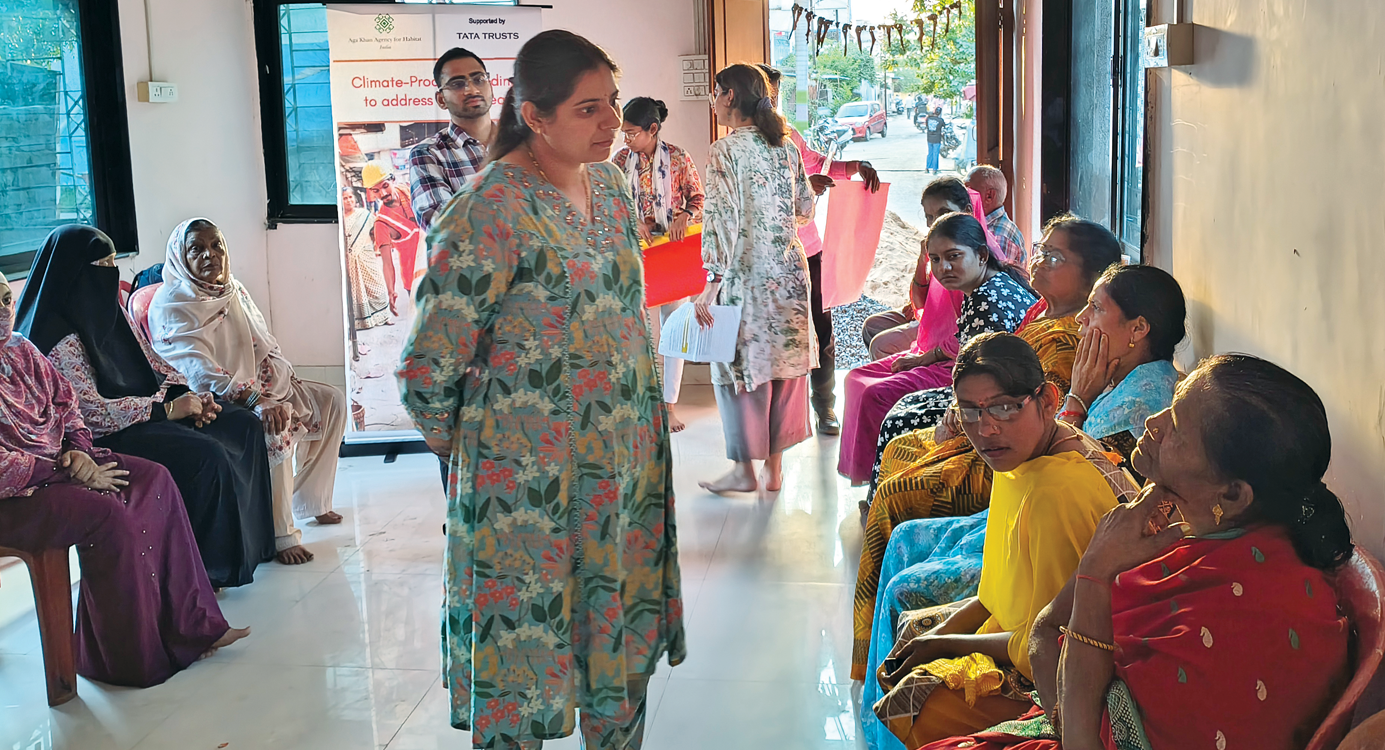
A ‘listening workshop’ being conducted in Panchasheel Chowk in Chandrapur to understand the community’s perceptions of heat and seasonal changes
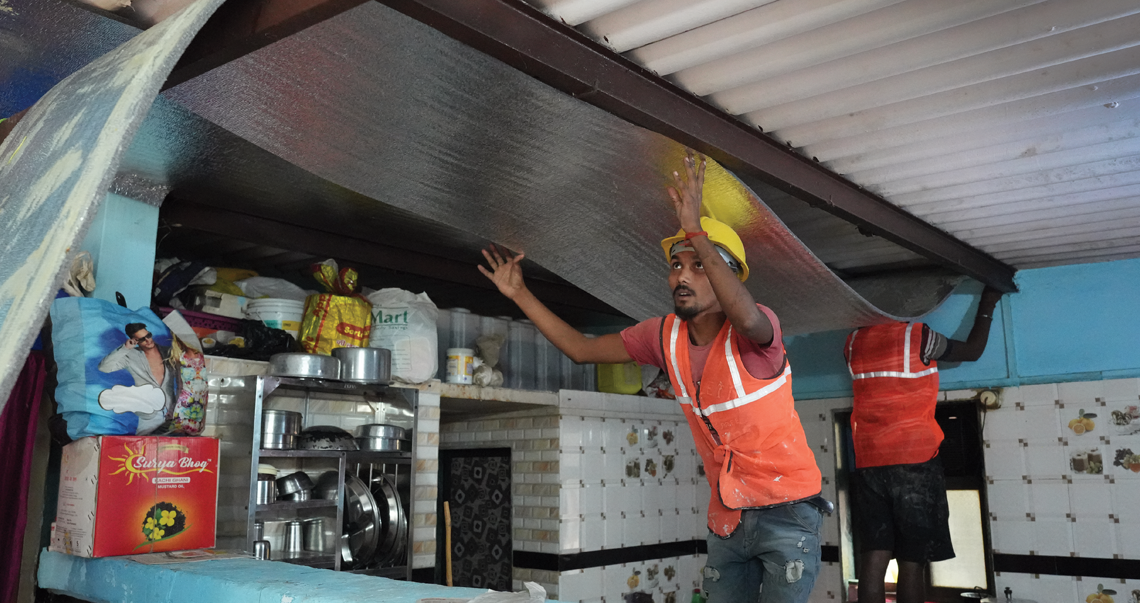
Two roofing solutions have been implemented in Mira Bhayander: adding a layer of insulating aluminium foil or woodwool (made from wood shavings) boards to ceilings. Sustainable and low-maintenance, these densely packed ‘under-deck’ solutions are installed on the inside of houses, just under the roof, to protect them from Mumbai’s rains.
“There are settlements in Mira Bhayander which are more prone to heat and flood stress,” says Abolee Muranjan, programme manager with AKAH. “We started with three of them. Woodwool and alu-foil have provided a 2-5 degrees of reduction in temperatures indoors, but they can only be used in homes that are structurally stable and do not have any water leakage issues.” In homes that required forced air circulation, AKAH created ventilation holes in the walls and equipped these with exhaust fans.
The initiative began with frontline workers from the settlement identifying mahila mandals (women’s cooperatives) to lead the effort. ‘Listening workshops’ were conducted to understand the challenges and the community’s adaptability to these. The locals reckoned they had no option but to live with the heat and flooding. They had tried, unsuccessfully, to find solutions on their own, to little effect.
Rita Sharma, a 44-year-old homemaker from Shiv Shakti Nagar, was more than happy to try out the programme’s solutions. Her 300-sq-ft tenement is shared by six people. “The heat was making us constantly sick,” says Ms Sharma. “My children would have rashes all over their faces and bodies, and they would frequently get fever.”
Homes ahoy
Drones are the unlikely allies in a programme that employs eye-in-the-sky technology to help provide land rights to 1 million slum dwellers in Odisha’s urban centres
READ MOREThe Sharmas opted for the alu-foil solution and this has considerably reduced the temperature inside their home, while also making it brighter by reflecting light. “My life is no longer regimented by the heat: waking up early and racing to finish my chores before it starts getting hot,” adds Ms Sharma. “Now my kids stay indoors more often, and I can cook, clean and work on my handcrafts business at any time of the day.”
Similar is the story of Lakhmi Gupta, a neighbour of the Sharmas, who had a tough time when she moved to Shiv Shakti Nagar two years ago. “I was not at all prepared for the heat and was ill for a month,” says the 35-year-old homemaker and tailor. “The house was so hot I had to send my young children to their grandparents every day, and nights were scarcely better.” A few months ago, AKAH installed a new woodwool ‘ceiling’ and Ms Gupta’s home has cooled miraculously since.
The heat aside, conditions in Chandrapur are much different from Mira Bhayander. Dwellings are larger in this district headquarters, which is surrounded by reserve forests. But it still suffers from heat stress, with peak temperatures in the high 40s (it is among the top 10 places in India with the maximum number of 40°C-plus days in a year).
Click to enlarge
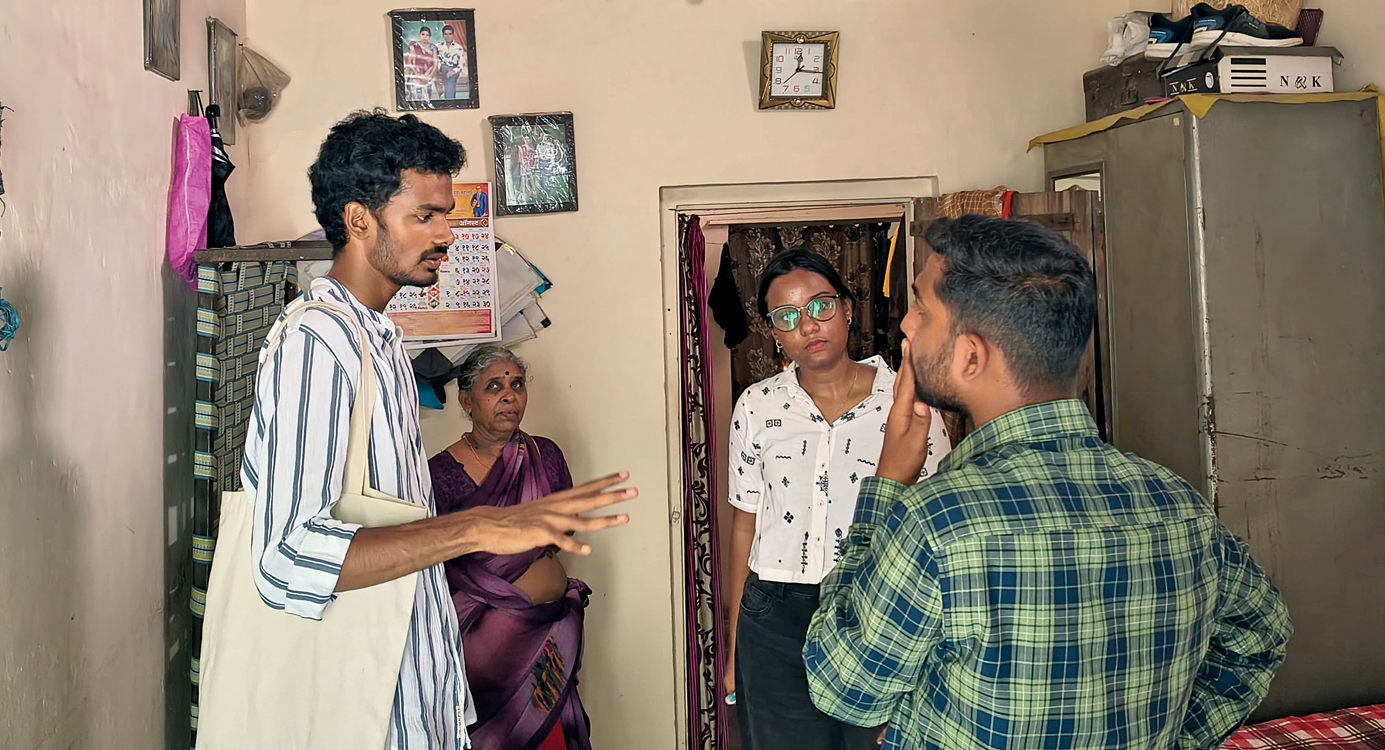
A member of a technical team speaks to residents of a home in Panchasheel Chowk while assessing indoor heat conditions and possible solutions
Chandrapur’s informal settlements house about 40% of the city’s population, some 128,000 people in total. It has been identified as a high-priority area with respect to heat-related illnesses. The city also experiences water scarcity due to overextraction and insufficient recharge. Paradoxically, it also has to cope with flooding during the monsoons.
Three heat-reduction solutions have been implemented by AKAH in 200 homes in Chandrapur, where most dwellings are well ventilated and have cement, tin or galvanised iron sheets as roofs. The concrete homes are now roofed with a layer of China mosaic tiles, which are heatproof and water-resistant. Homes with tin or galvanised-iron roofs receive several coats of solar reflective white paint on the outside and an underdeck layer of mineral wool insulation.
That’s how it is at the home of Mukunda Bawne, a retired security guard. The 75-year-old first arrived in Chandrapur in the 1970s and remembers it to be lush and cool. “But there has been so much construction and industrial activity in the last 10-15 years, this place has become tremendously hot,” he says. “It was torture.”
Things changed drastically for Mr Bawne. The roof of his 500-sq-ft home is now coated with white solar reflective paint, and a mineral wool insulation layer has been added to the ceiling. “I haven’t had such sound sleep in years,” he says of his improved living conditions.
Mira Bhayander and Chandrapur highlight a near-catastrophic climate challenge for Maharashtra as a whole. The Climate Vulnerability Index (published by the Council on Energy, Environment and Water) rates it among the five states most at risk from extreme climate events. In the 2023 January-September time span, Maharashtra suffered 106 extreme weather events, which jumped to 142 during the same period in 2024.
Meanwhile, there is one problem that remains to be resolved in both Chandrapur and Mira Bhayander: shortage of water. “Our heat solutions can reduce temperatures substantially, but the main issue will always be about water availability,” says Ms Muranjan. “We will soon be introducing permeable grass pavers that will help in water absorption.”
The idea is to secure a 20% increase in green surfaces with the use of the grass pavers, alongside a 3-4 mm rise in groundwater levels over five years with the recharge of water bodies.
Homes in these two project areas have already become more habitable with heat reduction solutions. With the increased green cover and water availability, the situation promises to get better for Chandrapur’s denizens.
Related articles
The well-being of Mumbai’s sanitation employees — an invisible workforce the city turns a blind eye to — is at the heart of Mission Garima

Mission Gaurav was a blessing for 1.37 million migrant families during the pandemic, but its true impact goes beyond the numbers and the immediate need

Bringing the children of migrant workers in Maharashtra's sugar belt back from the cold and into the formal education system has fetched encouraging results