A booster dose for
hands-on learning
With a policy push that should lead to vocational education becoming mandatory in schools, India is on the cusp of an exceptional reform of far-reaching consequences
India’s education ecosystem could surely use some good tidings, and this one centres on an idea whose time has finally — and formally — come. Vocational education being embedded in the country’s schooling structure from grade 6 to higher secondary may not seem extraordinary at first sight, but there is no exaggerating its potential as a means of tutelage that can better prepare students for the world beyond the classroom.
There is nothing especially new about making vocational education a mandatory subject in schools, yet the concept has fared fitfully on the realisation scale in India. That is changing as the recommendations of the National Education Policy (NEP), 2020, and the National Curriculum Framework for School Education (NCFSE), 2023, on starting early with vocational education get closer to being implemented in right earnest.
There is no doubt about the manifold advantages of bringing vocational education into the school syllabus, and with marks for it as well. The tools and outcomes of ‘technical and vocational education and training’ (TVET), to nail its global nomenclature, go the distance in moulding well-rounded students: hands-on learning, career clarity, self-confidence, original thinking, respect for labour, skills enhancement, practical knowledge and more.
Lagging behind
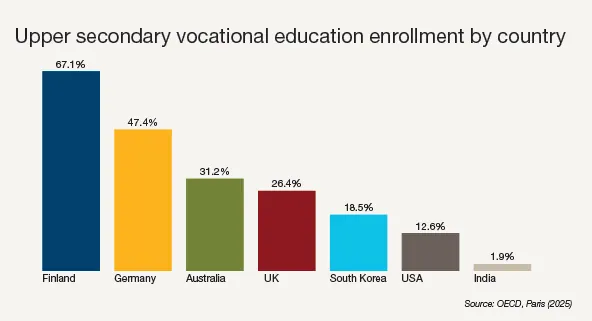
For all its positives, TVET has lagged in India for a range of reasons, from limited access and inadequate infrastructure to sociocultural biases and a general disdain for something perceived as only for the academically weak. That may explain why, according to a report by the Paris-based Organisation for Economic Co-operation and Development, India has only 1.9% of its upper secondary students enrolled for TVET, far behind countries such as Finland (67.1%) and Germany (47.4%).
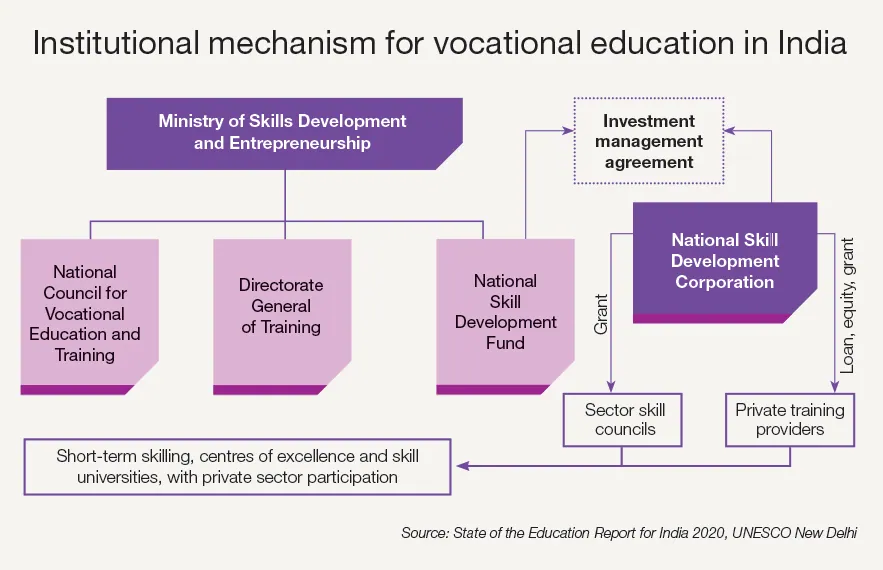
“Vocational education in schools can be defined through three different applications,” says Raj Gilda, the cofounder of Lend A Hand India (LAHI), a Pune-based nonprofit that the Tata Trusts are collaborating with to bolster the TVET cause. “The first is getting students eligible and ready for the job market. The second is applied learning: do gardening and you understand botany better, do carpentry or electronics and the laws of physics become clearer. The third is overall life skills like teamwork, communication, creating more with less and customisation.”
Considered in its entirety, TVET offers benefits that pave the way from schooling to employment and much else. Why then the hesitancy in embracing it? “There’s been a narrow viewpoint [in India] on vocational education,” adds Mr Gilda, “The widespread thinking is that this is not for my son or daughter, that it’s for the economically poor or only for backbenchers who are not academically inclined.”
There is a history to such thinking, says Yogesh Kulkarni, founder of STARS Forum, another nonprofit that the Tata Trusts are supporting to promote vocational education in schools. “The outlook of planners and politicians in newly independent India was that vocational education was a throwback to the past, a kind of baggage,” he says. “They wanted a ‘modern’ education system, learning through books, studying English and all that.”
This worked fine at that point, adds Mr Kulkarni, because jobs were available for those getting a mainstream education. “Then we started understanding the limitations of book-centred learning. Research on cognitive development came into the picture, as did the importance of learning while doing, of giving school students exposure to, and the experience of, different vocations and hands-on training.”
The growing appreciation of vocational education’s value in the schooling environment has led to the NEP-NCFSE push, the clearest signal yet that a tipping point has been reached. “There was a time when we had to sell the idea of vocational education,” says Mr Gilda. “There were plenty of questions about adding to an already crowded timetable, about overburdening the child, about making this a board exams subject.”
Having TVET as an essential component of the curriculum, rather than as another after-school activity, was always the objective, adds Mr Gilda. Getting there was not plain sailing. “Finding space in a school student’s timetable is akin to finding housing in Mumbai — extremely difficult — but now we have everyone on vocational education’s side: students and parents, school managements, policymakers and funders. There has been a huge shift in thinking.”
Mr Kulkarni reckons that barriers remain in preventing vocational education from translating its potential into gains for students. “There are two principal challenges; one relates to implementation and the other to perception,” he says. “The aim is not to turn a grade 6 class into a mini-ITI [Industrial Training Institute], but to develop competencies in children and to expand their horizons. This message has not percolated enough or been propagated enough.”
“Vocational education has to be an integral part of schooling and it should ideally be supervised by the headmaster,” explains Sunanda Mane, LAHI’s cofounder, “and critically, the mindset of the teacher has to change. He or she should be able to convince the school management, the principal and the parent of the need for this.”
Vocational education is like an iceberg, adds Ms Mane. “One-eighth is what we see and make the child do; seven-eighths is about things like observation skills, communication skills, analytical skills, exposure to the outside world, what I like and what I don’t like. That’s what children require to make an informed choice about their future.”
Closing the gap
NEP envisioned expanding access and exposure in vocational education to cover 50% of eligible students by 2025. NCFSE, meanwhile, has underscored the necessity of high-quality, age-appropriate and gender-equitable vocational education within schools. The 50% target is still far away and the cause is the distance between policy and on-the-ground implementation. The efforts of LAHI, STARS Forum and the Tata Trusts in vocational education are directed at bridging that distance.
It’s going to take time and patience for vocational education to claim its deserved place in the school syllabus, says Ms Mane. “You cannot change the entire education system all of a sudden because it’s gigantic and it’s bureaucratic. And then there are these increasing demands on students: learn yoga, learn ethics, learn about climate change… And the burden here is on teachers as well.
“Also, several elements have to come together for vocational education to make an impact. Apart from the space for it, you need tools and equipment, raw material, customisation to suit local conditions, a connect with the local community or employer, and proper assessments. It’s pretty complicated and resource-intensive.”
Mr Kulkarni, a member of the team that developed the NEP framework for vocational education, is convinced that even schools with moderate resources can make optimal use of it.
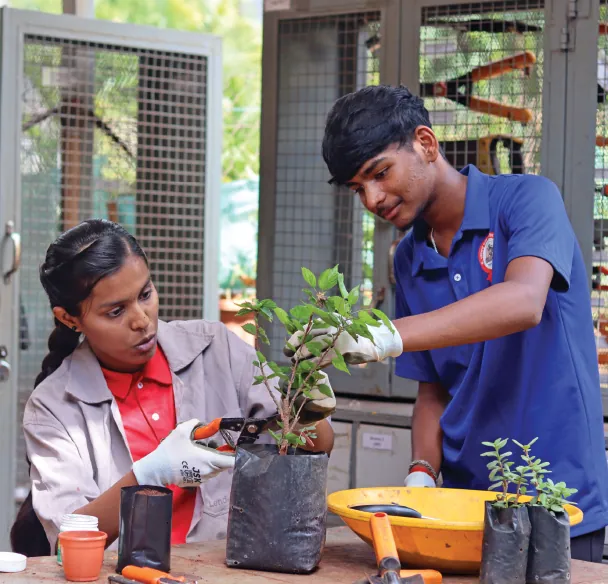
“The resources part will sort itself out once demand, from schools as much as parents, starts rising,” he says. “More importantly, NCERT [the National Council of Educational Research and Training], which sets the curriculum; the people in charge of funding and administration; the boards that conduct examinations; and the state and central governments — all of these entities have to be on the same page for vocational education in schools to take off.”
As and when that happens, one obvious benefit will be greater gender equity in India’s workplaces and within its formal workforce. “Offering gender-agnostic [TVET] modules in schools enables girls to get exposed to different vocations. For many of these girls it’s a novel experience and they thoroughly enjoy it,” says Ms Mane. “What this will surely lead to is more women in the workforce, women who are vocal and who can negotiate well in life, women who have agency. That would be an outstanding outcome.”
Adoption agenda
For the Tata Trusts, being involved in India’s TVET journey sits perfectly with their mandate to help plug gaps in the education sector. “Vocational education is a key area of reform in secondary education, but its adoption and roll-out has been limited,” says Amrita Patwardhan, deputy head of programmes at the Trusts. “Very little experience or understanding exists among school educators on how to integrate vocational education into the curriculum. The Trusts are, therefore, proactively identifying suitable partners to develop models, methodology and resources for vocational education in diverse settings.”
Supporting LAHI and STARS Forum is, in the context, an endorsement of their credentials. “Both these organisations can play a vital role in further developing vocational education in India,” adds Ms Patwardhan. “They are ahead of the curve, have the potential to emerge as hubs for vocational education, and can pilot interventions on the ground.”
Mr Gilda believes India is on the cusp of a giant reform in school education with TVET. “We are the only country in the world where this is being made mandatory up to grade 10, and that’s a very progressive step. The government has provided the policy; it is up to civil society and citizens like us to make the best of it.”