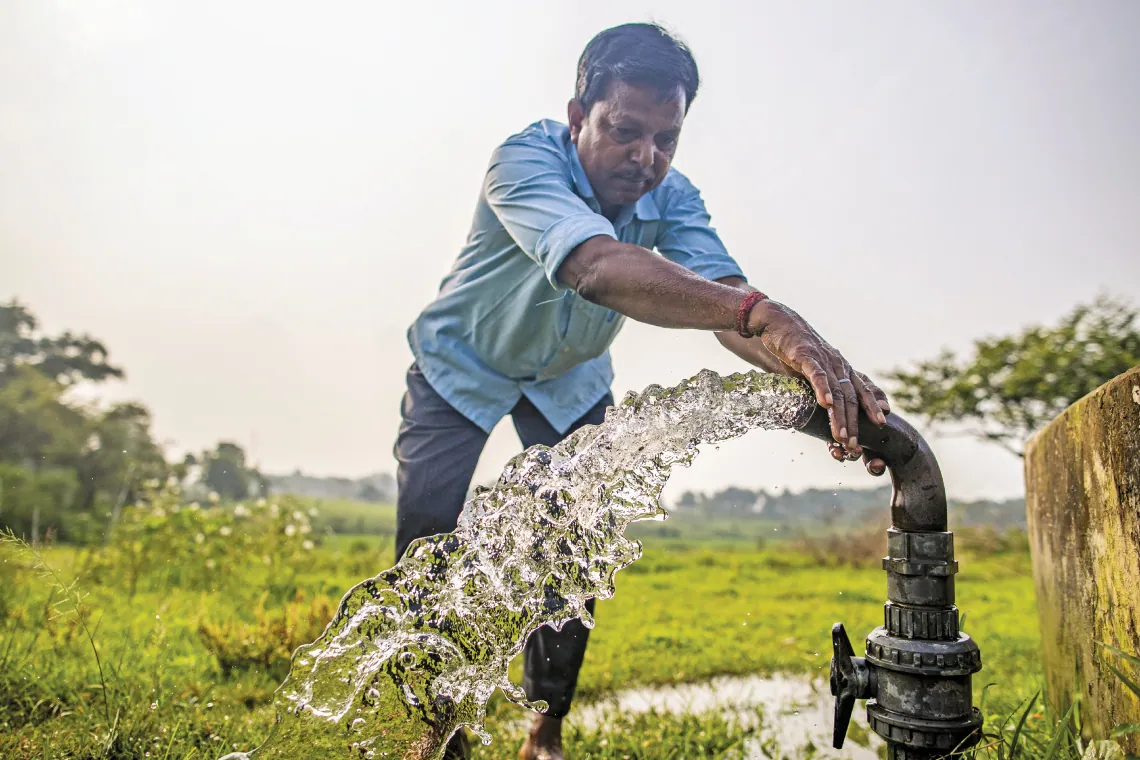
Power progress
Solar solutions are enabling tribal and marginalised farmers in Jharkhand to think differently in their quest to secure livelihood gains
Chandu Nag has come to believe in the safety of numbers, and that was not how it used to be for the 50-year-old tribal farmer from Bhursu village in Jharkhand’s Khunti district.
Five years ago, at a time when she was struggling to make ends meet for her six-member family while squeezing out a living from her meagre agricultural plot, Ms Nag was reluctant to join a farmers’ collective and share her limited resources. She saw the other farmers as competitors who might undercut her.
“That was despite most of my 3-acre land holding going to waste,” says Ms Nag. “I would grow rain-fed paddy during the monsoon season, and that was it for the whole year.” Anything more was impossible in the face of severe water scarcity. This blight routinely stymies smallholder farmers in Jharkhand’s tribal regions, which also have to cope with the large-scale migration of menfolk seeking daily-wage labour in the nearest urban hubs.
While farmer-producer companies can help with market linkages and technology, and self-help groups can facilitate access to credit, farmers like Ms Nag who live in the remote areas often can’t access these benefits. Increasing yield from whatever agricultural land they own is the only option available to them.
Ms Nag’s attempt to do that meant using a water-lifting diesel pump to flood her fields (there was no steady electricity supply in her village). This was both expensive and painstaking. Ms Nag had to travel a fair distance to buy the fuel, and she had to cart the heavy pump back and forth from her farm.
Then in 2021, Ms Nag learned of a solar-powered micro-lift irrigation (MLI) system being used in her village. This was a part of a programme powered by ‘distributed renewable energy’ (DRE) solutions and supported by the Tata Trusts through their associate organisation, Collectives for Integrated Livelihood Initiatives (CInI).
The programme enabled farmers to access water all year round for cultivation, which meant they could grow high-value vegetables alongside their staple crops. Ms Nag joined a ‘production patch’, a cluster of about 10 farmers who, with CInI’s help, have installed MLI systems to irrigate their fields. There was no looking back for Ms Nag from here on.
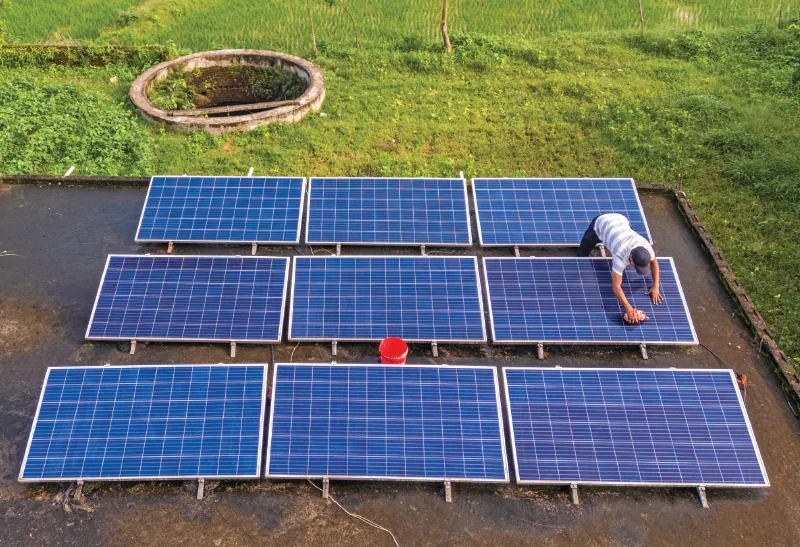
Synchronised setting
The farmer cluster bears 30% of the cost of the MLI systems and other expenses. They grow similar vegetables all through the year, synchronising their cultivation cycles to reach a larger amount of produce to the nearest market. With crop diversification, Ms Nag’s annual income has jumped from ₹80,000-₹90,000 a few years ago to ₹800,000 to ₹900,000, a ten-fold increase.
That is a typical lift for many of the smallholder farmers in Jharkhand who have taken to solar energy and modern agricultural practices. Within the Trusts’ countrywide DRE initiative, which reaches nine states and one union territory, Jharkhand’s farmers have adopted a number of solar solutions.
The DRE push in Jharkhand has resulted in the installation of more than 1,000 MLI systems and portable pumps; solar insect trappers and power sprayers; cold-storage units, vaccination chambers; solar dryers, pruners and moisture sensors; and other equipment that have collectively made farming just a little bit easier for Ms Nag and her compatriots.
About 25,000 households have benefitted from adopting these clean, environment-friendly technologies. Also, unlike bulky and unwieldy diesel pumps which needed considerable physical strength to operate, solar MLI systems are easy to run, which suits women farmers.
There are solar solutions at every stage of the agriculture and animal husbandry value chain. “Income enhancement is the primary goal of the DRE programme and, to that end, we cover both the pre- and post-production stages of agriculture,” says Sirshendu Paul, executive director, CInI.
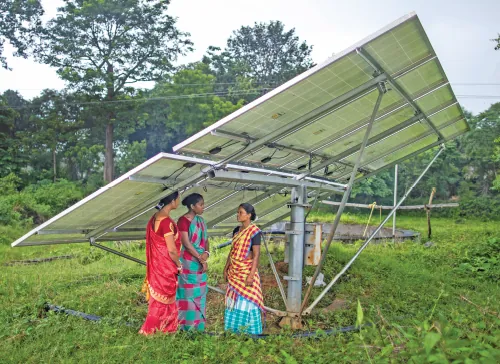
More to the energy story
Integrating solar solutions into the ‘distributed renewable energy’ programme means combining devices for optimal energy use. Juliyani Tiru, a 44-year-old farmer from Bichna village in Jharkhand’s Khunti district, uses a solar-powered MLI to water her 1-acre plot, and she has attached an insect trap to it. The automated trap emits an ultraviolet light that ensnares the insects.
“In the beginning, I was not sure if the trap would work; it sounded too good to be true,” says Ms Tiru. “But it is so effective that I use less pesticide in my fields, and my vegetables are growing in a cleaner environment.”
When she does need pesticides, Ms Tiru uses a solar-powered sprayer that can be carried around or mounted on a bicycle. Ms Tiru’s savings on pest control, combined with bountiful harvests, have lifted her household’s income from ₹80,000 annually to ₹400,000.
Deepak Singh, a farmer from Bhonda village in Khunti, installed a solar MLI in 2021 and later attached a solar-powered drip irrigation line to it to water his 3-acre plot.
“I was initially sceptical about solar because I wasn’t sure it was worth the investment.” Mr Singh, who shares a production patch with 15 other cultivators. “I used to grow vegetables on about a quarter of my field; now I use it in its entirety.”
Worried about theft, Mr Singh spent many months sleeping out in his field to guard his equipment when it had just been installed. “That used to happen when there were fewer solar panels,” says Garima Kumari, team leader (Jharkhand), CInI, an associate organisation of the Tata Trusts. “Now everyone wants solar solutions and they are getting them at reasonable rates thanks to government subsidies and our support.”
Multi-cropping push
The small and fragmented land holdings of these farmers make multi-cropping the best option. And solar solutions enable that. “Better incomes can be achieved only by helping farmers transition from traditional subsistence levels of production to commercial quantities of produce,” adds Mr Paul.
“Earlier our work focussed on bolstering the primary monsoon crop which used to be the mainstay of the household,” says Sudipta Das, an assistant manager with CInI. “For farmers to also grow vegetables we had to provide the requisite irrigation support, which we can now do with solar pumps.”
Adds Garima Kumari, team leader (Jharkhand), CInI.: “We have tweaked our programmes to shift from food sustainability to income enhancement through the cultivation of high-value vegetables. Our solar technology has been integrated into what we call a production hub.”
Several levels up from the production patch that Ms Nag belongs to, the hub comprises several large clusters of farmers — 40-50 in each cluster, with upwards of 12 acres between them — and may cater to as many as 250-300 cultivators collectively owning some 60-70 acres.
Along with encouraging commercial-level output, the hub tries to reduce the cost of inputs for farmers through bulk procurement of seeds, fertilisers, etc. Solar-powered systems provide a timely and reliable supply of water, fuelling a shift to more profitable crops and better prices through collective selling. All this is overseen and managed by different farmer producer companies where farmers are shareholders.
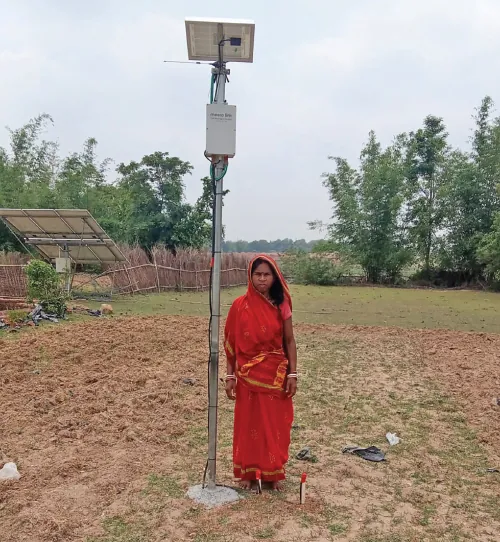
Mukta Nag, a board member of the Murhu Nari Shakti Kisan Producer Company Limited, sees a huge benefit for farmers thanks to solar. “Ever since they adopted solar strategies, our members have been able to utilise their entire holding and produce more for the market,” she says. “Now they are taking the seeds we provide and cultivating two or more seasons of fruit and vegetables where earlier it was barely one.”
The farmers in the initiative are also experimenting with new methods more confidently, like using grafts for tomatoes to secure higher yields, cultivating plants that survive longer, and growing their own saplings in nethouses watered by solar-powered drip lines. (A notch below greenhouses, net houses have an optimal microclimate that protects high-value crops from harsh weather, pests and excessive heat.)
There’s more in the solar mix. Solar mills, driers and grinders help farmers produce flour or red chillies without the drudgery of having to do this by hand, and solar cold-storage units allow them to preserve unsold stock for another day rather than sell them at low rates.
“Our farmers were already employing a package of practices that delivered a lot,” says Ms Nag. “Now solar is transforming their lives and bank balances, and also helping them conserve precious resources. That’s a win any way you look at it.”