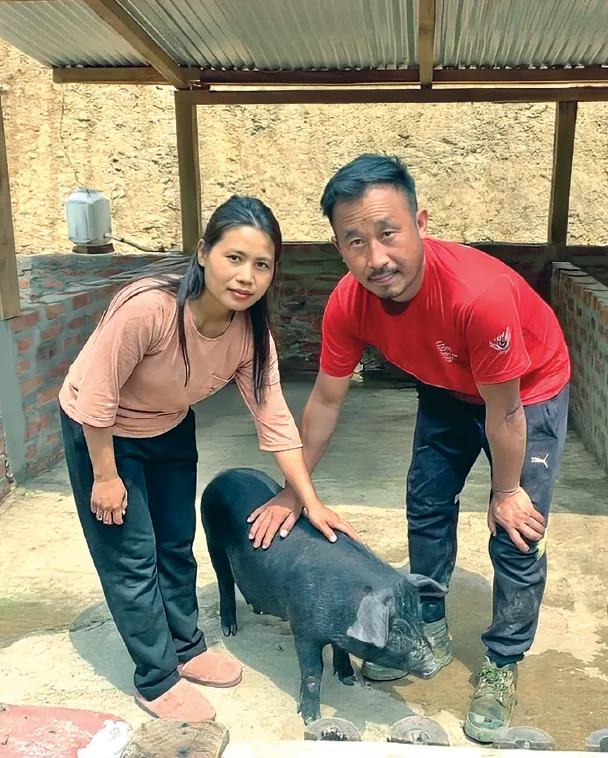
Village way to go
Peleneinuo Khing, 34, and her husband Gwahilo, 36, are piggery entrepreneurs from Gwachonlo village in Nagaland’s Tseminyu district. The couple, who have a young son, previously lived in Kohima, where Mr Khing worked as a sales executive in a private company. With that not amounting to much, the family decided in 2024 to return home to their village. The hope was that they could find a better livelihood source, and that’s how it has turned out.
Born and raised in Gwachonlo, Ms Khing has always felt a strong connection to her roots. “I have forever had an interest in livestock rearing, particularly piggery, since I grew up in a family that was involved in it,” she says. Building on this interest, the couple decided to take up piggery as a full-time business.
That was in 2024, when the Khings began their entrepreneurship journey by purchasing seven piglets, six breeding sows and one boar. It was far from smooth sailing in the initial stages, though. With little exposure to modern piggery practices — sanitation measures, size of the breeding units, proper drainage systems, etc — meeting expectations proved problematic.
Joining the ‘integrated livelihoods programme’ being implemented by the North East Initiative Development Agency (NEIDA) was the turning point for Ms Khing. She received capacity building support through training in piggery management practices, gaining a scientific understanding of rearing methods as well as sanitation and biosecurity measures.
Recognising Ms Khing’s dedication and willingness to learn, NEIDA supported her with a mini-breeding unit in 2025. Since then, the Khings have steadily expanded their enterprise and they now own seven sows, one boar and 15 fatteners. The piggery business they had set so much store by has become a reliable source of income.
As a member of the Nzon Nyegi Farmer Producer Organisation, Ms Khing benefits from access to pig feed at subsidised rates, timely delivery within the village and reduced input costs.
Looking ahead, Ms Khing hopes to further scale up her business by increasing the number of breeding sows, supplying piglets within her village and beyond, expanding her fattening units to better manage feed costs, and adopting artificial insemination techniques.